Why "Harsh Fills" Are the Real Test of Your Packaging Choice
After working with brands across food, beverage, household chemicals, and personal care for over two decades, we at YLTPACK have seen how often purchasers underestimate the chemical interaction between their fill and their pouch. This guide walks you through exactly how to match materials to harsh fills so you can order with confidence.
What Counts as a "Harsh Fill" — And Why It Matters for Pouch Integrity
A "harsh fill" is any liquid or semi-liquid product that places chemical, thermal, or mechanical stress on flexible packaging beyond what plain water would. Think of it as a spectrum rather than a binary category.
Common Harsh Fill Categories
| Fill Type | Examples | Primary Stress on Film |
|---|---|---|
| High-acid liquids | Citrus juice, vinegar, kombucha | Chemical degradation of adhesive layers |
| Oily / fatty products | Olive oil, salad dressings, CBD oils | Plasticizer migration, delamination |
| Alcohol-based | Hand sanitizer, tinctures, mouthwash | Solvent attack on sealant layer |
| Hot-fill products | Soups, sauces filled above 85°C | Thermal seal failure, warping |
| Aggressive chemicals | Bleach, industrial detergents, fertilizers | Oxidation, barrier breakdown |
Each category attacks packaging differently. Acidic fills target lamination adhesives. Oils slowly migrate through monolayer films. Alcohols can dissolve certain sealant resins. Understanding which stress your product creates is step one in material selection.
The Anatomy of a Multi-Layer Pouch — Where Failures Actually Happen
A typical stand up bag with spout uses three to five distinct layers, each performing a specific job. When harsh fills cause failure, it almost never happens evenly across the entire structure. It targets the weakest link.
Layer-by-Layer Breakdown
- Outer print layer (PET or BOPA): Provides structure, printability, and puncture resistance. Rarely attacked by fills directly.
- Barrier layer (aluminum foil or EVOH): Blocks oxygen, moisture, and light. Critical for product shelf life.
- Adhesive layers: Bond everything together. This is the most vulnerable point for acidic and solvent-based fills.
- Inner sealant layer (PE or CPP): The only layer that directly contacts your product. If chosen incorrectly, migration or seal failure follows.
In our 6,800㎡ cleanroom facility, we run accelerated aging tests that simulate 12 months of shelf contact in just 4 weeks. This lets us catch delamination or migration issues before production, not after your product reaches store shelves.
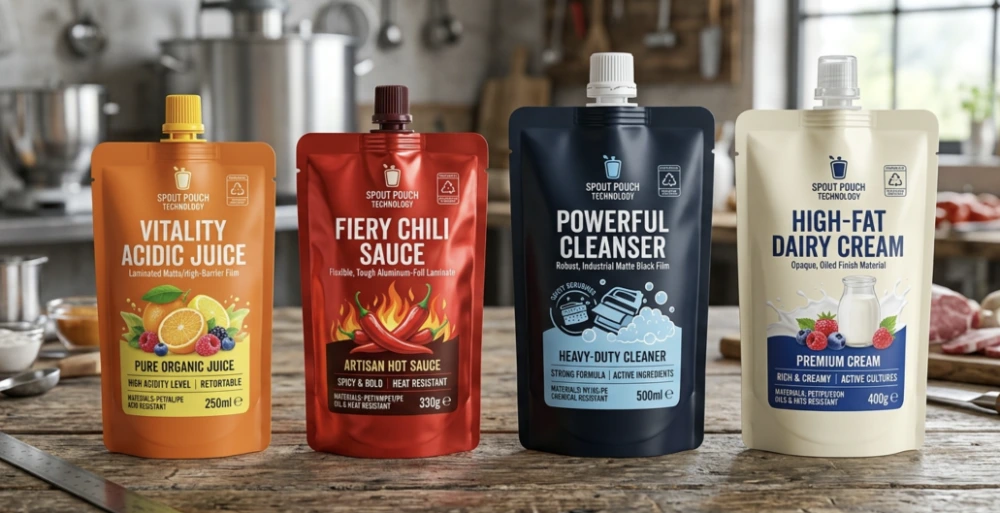
Matching Materials to Your Specific Fill: A Decision Framework
Rather than memorizing chemistry tables, use this practical framework. It starts with your fill's dominant characteristic and maps to recommended structures.
For Acidic Fills (pH Below 4.0)
Citrus juices, fermented beverages, and vinegar-based sauces demand acid-resistant adhesives and a robust inner sealant. Standard solvent-based adhesives break down at low pH over time. The fix? Solvent-free polyurethane adhesives paired with a thick linear low-density polyethylene (LLDPE) sealant layer.
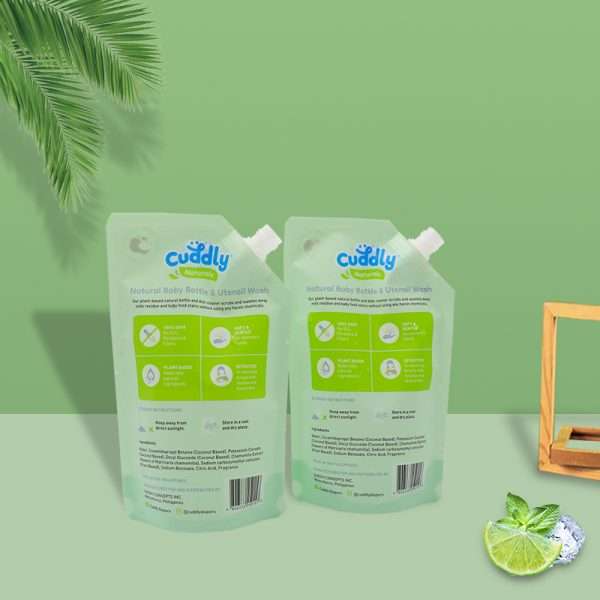
A spouted stand up pouch with cap for juice, for example, needs to survive 6–12 months of continuous acid contact without any taste transfer. We typically recommend a PET/AL/LLDPE structure with acid-resistant lamination glue for these applications.
For Oily and Fatty Fills
Oils are sneaky. They don't visibly attack packaging — they slowly permeate through insufficiently thick sealant layers, causing softening and eventual pinhole leaks. For cooking oils, nut butters in liquid form, or CBD tinctures, you need:
- A sealant layer of at least 80 microns (preferably 100μm for extended shelf life)
- Nylon (BOPA) as the outer layer for superior flex-crack resistance
- Aluminum foil barrier to prevent oxidation and rancidity
Because we hold FDA and ISO 22000 certifications, we recommend food-contact compliant resins that have passed specific migration testing for fatty food simulants — not just generic "food safe" labels.
For Alcohol-Based Fills
Alcohol above 20% concentration acts as a solvent. It can dissolve certain adhesives and attack standard polyethylene sealants. The solution involves using chemical-resistant co-extruded sealant films and two-component reactive adhesives that fully cure before filling.
Brands launching hand sanitizer or alcohol-based mouthwash in flexible pouches often learn this the hard way. We've helped several North American brands reformulate their packaging structure after their initial supplier's pouches started leaking at the three-month mark.
For Hot-Fill Applications (Above 85°C)
Standard polyethylene sealants soften around 90°C, causing seal failure during filling. The answer is cast polypropylene (CPP) or retort-grade films that maintain integrity at elevated temperatures.
| Sealant Type | Max Fill Temperature | Typical Use Case |
|---|---|---|
| Standard LDPE | 70°C | Room-temp liquids, cold beverages |
| Medium-density PE | 85°C | Warm-fill sauces, dairy |
| CPP (Cast Polypropylene) | 121°C | Hot-fill soups, retort products |
| Retort-grade CPP | 135°C | Sterilized foods, medical liquids |
Hot-fill also demands careful spout selection. The spout and cap assembly must use PP-based resins with matching thermal resistance — a detail many brands overlook until their caps warp during filling.
For Aggressive Chemicals and Detergents
Household cleaners, industrial solvents, and agricultural chemicals require the most robust structures. High-density polyethylene (HDPE) or specialized co-extruded films with chemical-resistant tie layers become necessary. In many cases, a mono-material PE structure (for recyclability) can still work if the wall thickness is appropriate.
If you're evaluating a recyclable spouted stand up pouch supplier, ask specifically about mono-PE structures rated for chemical fills. Not all recyclable options can handle aggressive formulations.
The Spout Itself: An Often-Overlooked Failure Point
Here's something many purchasing teams miss entirely: the pouch film might be perfect, but the spout fails. Spouts are injection-molded components welded to the film. Their material must also resist whatever you're filling.
Spout Material Compatibility
- Standard PP spouts: Suitable for water, juice, wine, and most food products
- HDPE spouts: Better chemical resistance for cleaning products and solvents
- Modified PP with additives: For extreme pH or temperature applications
The weld zone between spout and film is the single most common leak point. It requires precise temperature control during manufacturing — something that depends heavily on equipment calibration and operator skill. Our in-house design team often helps brands who only have a rough idea of their requirements by running compatibility samples before committing to full production.
Testing Protocols You Should Demand From Any Supplier
Material selection on paper is only half the job. Real-world performance requires validation testing. Before you approve a structure for mass production, insist on these tests:
Essential Test Checklist
- Migration testing: Ensures no harmful substances transfer from packaging to product (mandatory for food and personal care)
- Seal strength testing: Measures whether seals hold under pressure after extended product contact
- Accelerated shelf-life simulation: Exposes filled pouches to elevated temperature and humidity to predict 12–18 month performance in weeks
- Drop testing: Filled pouches dropped from defined heights to test seal and film integrity under impact
- Squeeze/pressure testing: Simulates shipping compression and consumer handling
As a manufacturer that has produced packaging for 20+ years, we provide full test reports with every material qualification. We've found that brands who skip this step often face field failures that cost 5–10 times more than the testing itself would have.
Sustainability Considerations for Harsh-Fill Pouches
There's a growing tension in the packaging world: brands want sustainable materials, but harsh fills often require multi-layer, multi-material structures that are difficult to recycle. Here's the honest picture.
Mono-material PE pouches (which are widely recyclable) can handle many food and beverage applications. But highly acidic, hot-fill, or chemical products often still require aluminum foil barriers or EVOH layers that complicate recycling streams. According to a 2025 report by the Flexible Packaging Association, approximately 34% of liquid pouch applications can already transition to recyclable mono-material structures without performance loss — but the remaining 66% still require multi-material solutions.
Our recommendation: start with performance requirements first, then explore where recyclable alternatives can match them. Forcing a sustainable structure onto a harsh fill often leads to product failure, which creates more waste than using the correct material in the first place.
Filling Equipment Compatibility: The Bridge Between Material and Production
Your material choice also affects how efficiently you can fill pouches on your production line. Different film structures have different stiffness, heat-seal characteristics, and static behavior during spout pouch filling operations.
If you're researching a spouted stand up pouch filling machine for small business operations, keep in mind that thicker, stiffer films designed for aggressive chemicals may require different jaw pressures and seal times than standard food-grade films. Always share your material specification with your filling equipment provider before purchasing either component.
Key Filling Considerations by Material
| Film Structure | Filling Speed Impact | Seal Parameter Adjustment |
|---|---|---|
| PET/AL/PE (standard) | Optimal for most machines | Standard temperature and dwell time |
| BOPA/AL/CPP (hot-fill) | Slightly slower cooling required | Higher seal temperature, longer dwell |
| Mono-PE (recyclable) | May require anti-static treatment | Narrower seal window, precise control needed |
| Heavy-gauge chemical film | Reduced line speed by 10-15% | Higher pressure, extended cooling |
Real-World Scenarios: How Brands Get Material Selection Right
Let us share a few patterns we've seen working with brands in different product categories. These aren't hypothetical — they reflect common conversations we have every week.
Scenario 1: Cold-Pressed Juice Brand
A U.S.-based juice company needed packaging for a high-acid citrus blend (pH 3.2) with a 90-day refrigerated shelf life. Their initial supplier used standard adhesives that delaminated after 45 days. We recommended a PET/AL/LLDPE structure with acid-resistant lamination and a 100μm sealant. Six months later — zero field complaints.
Scenario 2: Natural Cleaning Product Startup
A startup wanted eco-friendly liquid pouch packaging for a plant-based all-purpose cleaner. The formula included d-limonene (a citrus solvent) which attacks standard PE. We moved them to a co-extruded sealant with a chemical-resistant inner layer while keeping the outer structure recyclable. The hybrid approach gave them both performance and a credible sustainability story.
Scenario 3: Bulk Custom Sauce Brand
A restaurant supply brand sourcing custom printed spouted stand up pouch wholesale quantities needed hot-fill capability at 92°C for their BBQ sauce line. Standard PE pouches failed during filling trials. Transitioning to a BOPA/AL/CPP structure solved the thermal issue while maintaining the premium matte-finish print quality they wanted for retail crossover.
Red Flags When Evaluating Suppliers for Harsh-Fill Applications
Not every pouch manufacturer understands harsh-fill chemistry. Here's what should concern you during the supplier evaluation process:
- "One structure fits all" claims: Any supplier suggesting the same film for juice and industrial cleaner doesn't understand material science.
- No migration or compatibility testing offered: If they can't test, they can't guarantee performance.
- Vague adhesive specifications: The adhesive system is where most failures occur. Demand specifics.
- No experience with your product category: Ask for references or case studies with similar fills.
- Unwillingness to provide samples for your own fill testing: This is a basic expectation for any serious manufacturer.
Working with brands across North America, Europe, and Southeast Asia, we've found that the most common mistake is choosing a supplier based purely on unit cost without verifying material compatibility. A pouch that's 15% cheaper but fails at month three isn't saving anyone money.
How to Start the Conversation With Your Packaging Partner
When you reach out to a manufacturer about resealable pouch design for harsh fills, come prepared with these details. It dramatically speeds up the material recommendation process:
- Exact product formulation (or at minimum: pH level, alcohol %, oil content, active chemicals)
- Fill temperature
- Target shelf life
- Storage conditions (ambient, refrigerated, or variable)
- Desired pouch size and estimated order volume
- Any regulatory requirements (FDA, EU food contact, EPA for chemicals)
The more detail you share upfront, the faster a qualified manufacturer can narrow down your ideal structure. At YLTPACK, we typically provide material recommendations within 48 hours of receiving a complete brief — and we send physical samples for your own testing before any bulk commitment.
Got questions about which structure works for your specific formula? Reach out via WhatsApp at +86 182 1944 5665 or email [email protected]. We're happy to review your product details and suggest a tested material configuration — no obligation.
Frequently Asked Questions
Can I use the same pouch material for juice and cleaning products?
No. Juice requires food-grade, acid-resistant structures with FDA-compliant sealants, while cleaning products need chemical-resistant films that handle solvents and oxidizers. The adhesive systems, sealant chemistries, and barrier requirements differ fundamentally. Always match your structure to the specific chemical profile of your fill.
How do I know if my product qualifies as a "harsh fill"?
If your product has a pH below 4.0, contains more than 10% alcohol, includes essential oils or solvents, requires hot-fill above 80°C, or contains oxidizing agents — it's a harsh fill. When in doubt, provide your formulation to your packaging partner and request compatibility testing before committing to production.
What's the minimum order quantity for custom harsh-fill pouches?
This varies by supplier and complexity. At YLTPACK, minimums depend on pouch size, structure, and printing requirements. Custom structures for aggressive fills may have slightly higher minimums due to specialized material sourcing, but we work with brands at various scales — from emerging startups to established distributors running millions of units monthly.
How long does material qualification testing take before I can start bulk production?
Standard compatibility testing takes 2–4 weeks for accelerated shelf-life simulation. If your fill is particularly aggressive (high alcohol, extreme pH, or strong solvents), extended 6-week testing may be recommended. Factor this timeline into your product launch schedule — it's far less costly than discovering failures after you've filled 50,000 units.
Are there recyclable options for harsh-fill applications using flexible packaging?
For moderate harsh fills (mildly acidic juices, light oil-based products), mono-PE recyclable structures are increasingly viable. However, highly aggressive fills — strong solvents, extreme acids, or high-temperature products — still typically require multi-material structures with aluminum or EVOH barriers. The technology is evolving rapidly, and new high-barrier mono-material films are entering the market. Ask your supplier about the latest options for your specific application.