Why Pouch Size Matters More Than You Think for Cat Treats
Having produced pet food packaging for over two decades, we at YLTPACK see brands make the same sizing mistakes repeatedly. This guide walks you through exactly how to match your pouch size to your product, your customer, and your business goals—whether you're filling 50g single-serve pouches or 200g family-size options.
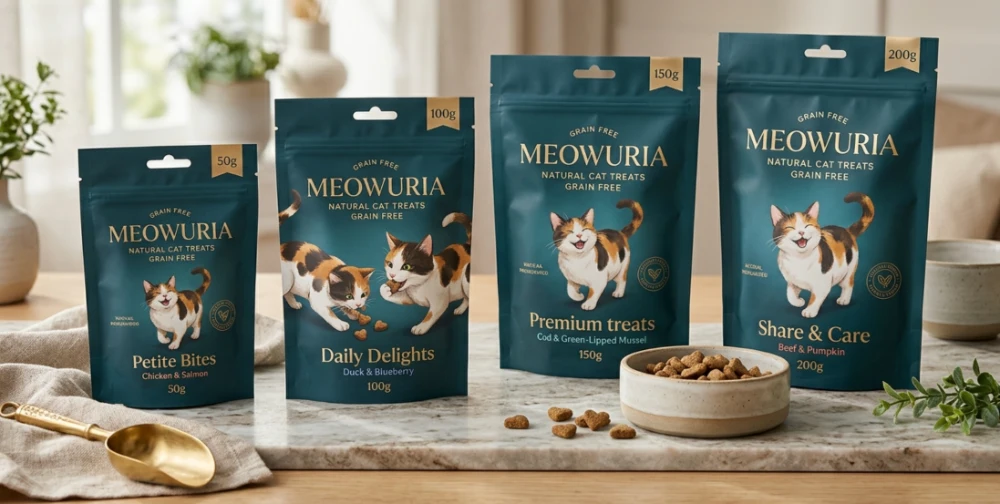
Understanding the 50g–200g Range: What Each Size Actually Serves
Not every pouch size fits every product or sales channel. The 50g to 200g range covers the sweet spot for cat treats, but each increment serves a distinct purpose. Let's break it down.
| Pouch Size | Typical Use Case | Target Customer | Channel Fit |
|---|---|---|---|
| 50g | Single-serve, trial packs, travel | New customers, impulse buyers | Convenience stores, e-commerce samples |
| 80g–100g | Standard retail, subscription boxes | Single-cat households | Grocery, pet specialty retail |
| 120g–150g | Multi-cat homes, value packs | Loyal repeat buyers | Pet superstores, online DTC |
| 200g | Bulk buy, club packs, economy SKU | Cost-conscious multi-cat owners | Warehouse clubs, large e-commerce orders |
50g Pouches: The Gateway Format
Think of 50g as your handshake with new customers. It's low commitment, easy to display at checkout, and perfect for trial campaigns. If you're running a subscription box partnership or launching a new flavor, this is where you start.
The trade-off? Per-unit packaging costs are higher relative to product weight. You'll need higher volumes to offset that. But the customer acquisition value often justifies the investment.
80g–100g Pouches: The Retail Workhorse
This is the size most brands default to—and for good reason. It balances freshness (the product gets consumed within a week or two) with perceived value. Pet specialty retailers typically allocate shelf space assuming this format.
If your treats are freeze-dried or have lower density, a 100g pouch gives you visible "fill" without excessive air space. That visual matters: pet owners associate a full-looking pouch with quality.
120g–200g Pouches: Loyalty and Value Territory
Larger formats signal confidence. You're telling the customer: "You'll love this enough to buy more." These work well for established flavors with proven repeat purchase rates. They're also ideal for e-commerce, where shipping cost per gram drops as pouch size increases.
One critical note: once you go above 150g for cat treats, freshness becomes a real concern. Unless the pouch features strong barrier properties and a quality resealable zipper, the last portions can go stale. Cat owners notice—and they won't repurchase.
Freshness Protection: The Non-Negotiable Factor in Sizing Decisions
Here's something many first-time brands overlook: pouch size isn't just about volume. It's about how long the product stays fresh after opening. Cats are notoriously picky, and treats that lose aroma or texture get ignored.
A smaller pouch gets consumed faster, reducing exposure to air and moisture. A larger pouch needs engineered solutions to maintain quality across multiple openings. This is where your packaging spec becomes a product decision, not just a logistics one.
Barrier Materials That Match Your Size
- 50g–80g: Standard multi-layer laminate (PET/AL/PE) provides adequate protection since the product is consumed quickly.
- 100g–150g: Consider adding a metalized layer or foil barrier for oxygen control. Resealable cat food bags to keep fresh become essential at this volume.
- 200g: Full aluminum foil barrier plus a heavy-duty zipper. Some brands add a one-way degassing valve if the treats are freshly baked or contain oils that off-gas.
Because we hold FDA and ISO 22000 certifications, our team at YLTPACK often advises brands to match barrier grade to consumption speed—not just product type. A 200g pouch of freeze-dried chicken treats needs different protection than a 200g pouch of crunchy biscuits.
Zipper and Reseal Mechanisms
For any pouch above 50g, a reseal feature isn't optional—it's expected. Pet owners open and close treat pouches multiple times daily. The closure needs to survive dozens of cycles without failing.
- Press-to-close zippers: Cost-effective, works well up to 120g.
- Slider zippers: Easier for one-handed use, better for 150g+ where the pouch is bulkier.
- Velcro-style closures: Premium feel, but higher per-unit cost. Best reserved for luxury positioning.
How Product Density and Shape Affect Your Pouch Dimensions
Weight alone doesn't determine pouch size. A 100g pouch of airy, puffed treats needs completely different dimensions than 100g of dense, chewy bites. This is where brands frequently miscalculate on their first production run.
Calculating Fill Volume vs. Weight
Work backwards from your product's bulk density. Measure how much volume 100g of your finished treats actually occupies when loosely poured. Then add 15–20% headspace for seal integrity and shelf presence.
| Treat Type | Approx. Bulk Density | 100g Requires (Volume) | Recommended Pouch Style |
|---|---|---|---|
| Freeze-dried chunks | Low (0.15–0.25 g/cm³) | 400–650 cm³ | Stand-up pouch, wide gusset |
| Crunchy biscuits | Medium (0.35–0.50 g/cm³) | 200–285 cm³ | Stand-up or flat bottom |
| Soft/chewy bites | High (0.60–0.80 g/cm³) | 125–165 cm³ | Pillow pouch or compact stand-up |
| Jerky strips | Medium-high (0.45–0.60 g/cm³) | 165–220 cm³ | Three-side seal or stand-up |
Our in-house design team often helps brands who only have a rough product concept. We'll request a sample of the finished treats, measure actual density in our lab, and recommend dimensions that avoid the "half-empty bag" problem that frustrates consumers.
Choosing Size Based on Sales Channel and Shelf Strategy
Your pouch size needs to work within the physical and psychological constraints of where it's sold. An e-commerce-first brand has different priorities than one selling primarily through pet retail chains.
Retail Shelf Considerations
- Shelf depth: Most pet retail shelves are 30–40 cm deep. Your stand-up pouch needs to fit without flopping forward.
- Facing width: Narrower pouches get more facings per shelf meter. An 80g pouch that's 12 cm wide gives you twice the visual presence of a 200g pouch that's 22 cm wide—in the same allocated space.
- Planogram politics: Retailers assign space by sales velocity. Smaller SKUs that turn faster often earn more shelf real estate over time.
E-Commerce and DTC Shipping
For online brands, dimensional weight pricing changes the math. A lightweight but bulky 200g pouch of freeze-dried treats might cost as much to ship as a much heavier product. Consider pouches with narrower gussets that reduce box size requirements.
Airtight cat food bags prevent stale kibble during the longer transit and warehouse storage times typical of e-commerce fulfillment. If your treats sit in a distribution center for weeks before reaching the customer, your barrier spec needs to account for that extended timeline.
Subscription and Auto-Ship Models
If your brand relies on recurring delivery, the 80g–120g range hits a sweet spot. It lasts one to three weeks for a single cat, which aligns well with monthly subscription cycles. Too large, and the customer cancels because they still have product left. Too small, and they feel they're not getting enough value.
Sustainability: Size Choices That Reduce Waste
Pet owners increasingly factor environmental responsibility into purchase decisions. A 2025 Nielsen IQ report showed that sustainable pet product claims grew 14% year-over-year in the U.S. market. Your pouch size plays directly into this narrative.
Right-Sizing Eliminates Excess Material
An oversized pouch wastes film, ink, and transport space. If your 100g of treats comfortably fits a pouch rated for 80g, you're burning resources on unnecessary packaging. Right-sizing means your pouch dimensions match your actual product volume with appropriate—but not excessive—headspace.
Eco-friendly cat food bags recyclable options are increasingly available in mono-material structures (all-PE or all-PP). These work well across the 50g–200g range, though barrier performance may require additional testing for larger sizes that stay open longer.
Bulk Formats Reduce Per-Serving Packaging
A single 200g pouch uses less total material than four 50g pouches containing the same amount. For environmentally conscious brands, offering large cat food bags bulk buy options alongside single-serve formats lets customers choose their impact level.
Working with brands across North America and Europe, we've found that clearly communicating this trade-off on the packaging itself—"This 200g pouch uses 60% less material than buying four small packs"—drives measurable consumer preference.
Minimum Order Quantities and How Size Affects Your Budget
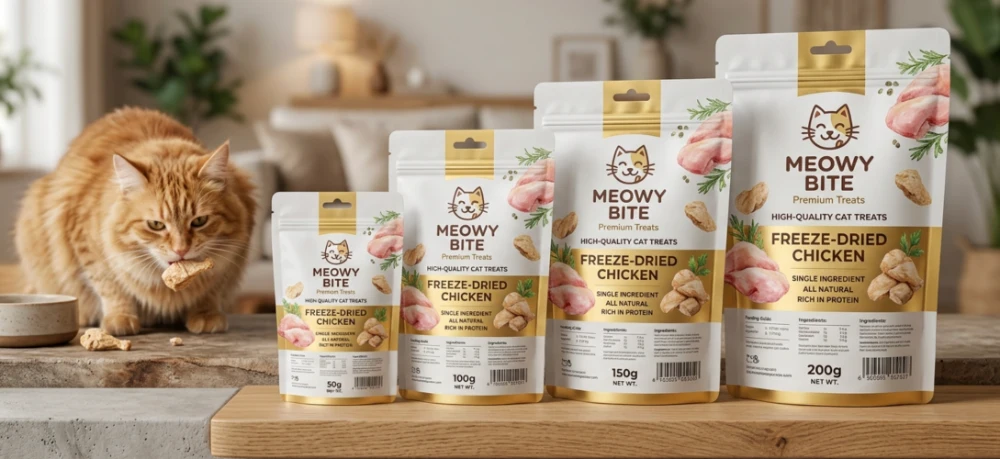
Let's talk practically about production planning. Pouch size affects your minimum order requirements, storage needs, and cash flow—especially for emerging brands watching every dollar.
How Sizing Impacts Production Runs
- Smaller pouches (50g–80g) typically require higher minimum quantities because they run faster through filling equipment. However, the per-unit packaging cost is lower.
- Larger pouches (150g–200g) may have lower minimum order quantities in terms of units, but higher per-unit costs and more warehouse space required for finished goods.
As a manufacturer that has produced packaging for 20+ years, we recommend brands start with one core size (typically 80g–100g), validate market demand, then expand to flanking sizes. Trying to launch three sizes simultaneously triples your tooling costs and inventory complexity.
Planning a Size Range Strategically
Many successful treat brands follow this rollout pattern:
- Phase 1: Launch with 80g–100g as your anchor SKU.
- Phase 2: Add a 50g trial size for sampling programs and convenience retail.
- Phase 3: Introduce 150g–200g for loyal customers and e-commerce value bundles.
This phased approach lets you use learnings from Phase 1 to optimize designs for subsequent sizes—adjusting gusset width, material gauge, or closure type based on real customer feedback.
Design and Branding Considerations by Pouch Size
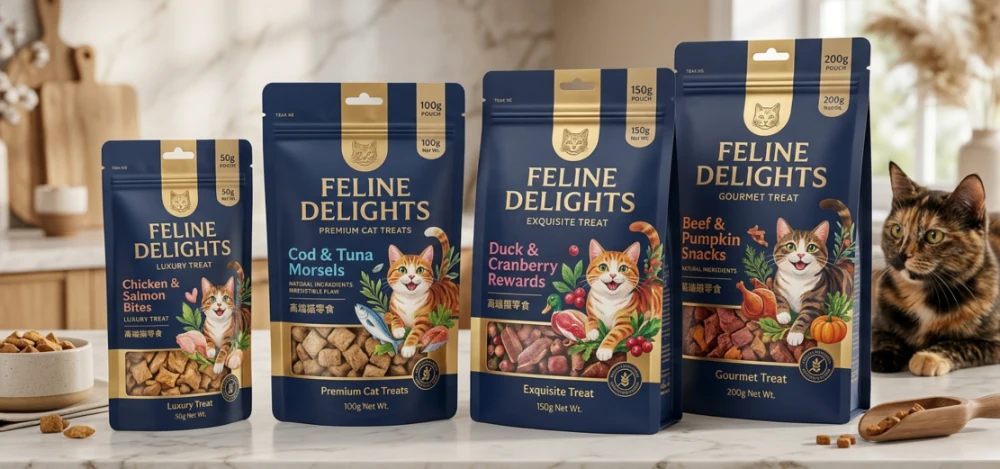
Your packaging is your billboard. The amount of printable surface area changes dramatically between a 50g pouch and a 200g pouch, and your design strategy needs to adapt accordingly.
Small Pouches (50g–80g): Simplicity Wins
Limited real estate means you need to prioritize. Lead with your brand name, one hero image, and the flavor. Regulatory text and ingredient lists will consume much of your back panel. Keep designs clean and high-contrast for grab-and-go visibility.
Large Pouches (150g–200g): Tell a Story
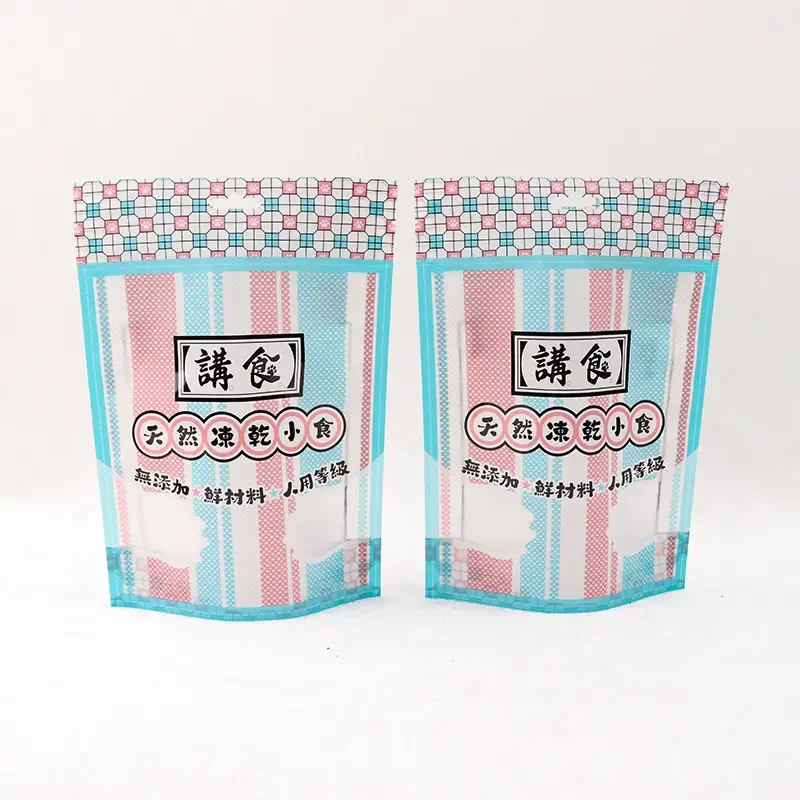
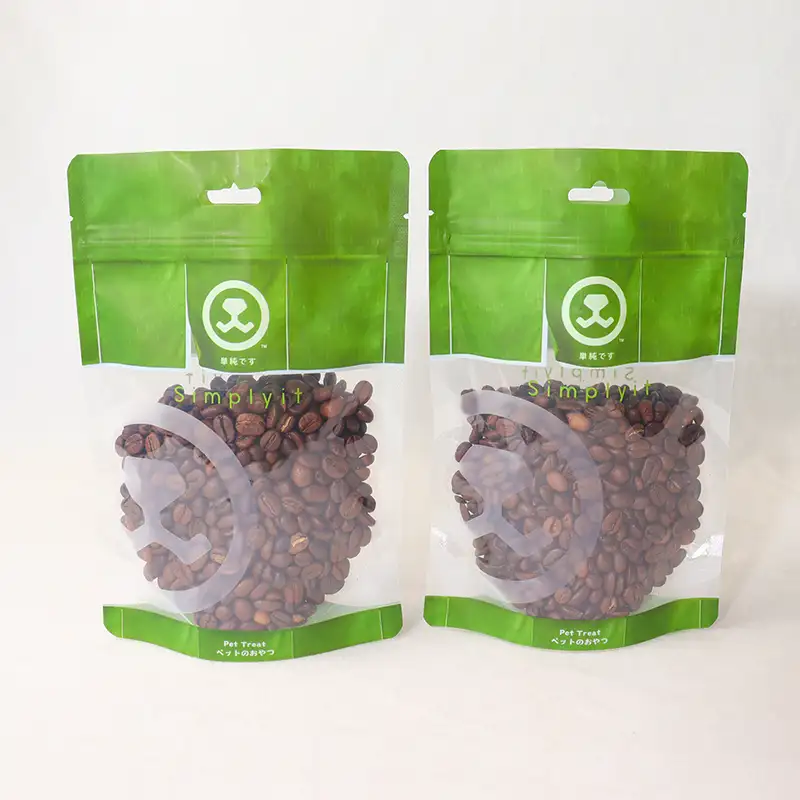
More surface area gives you room to communicate your brand's values, sourcing story, and feeding guidelines without crowding. Consider a clear window so pet owners can see the actual treats inside—transparency (both literal and figurative) builds trust.
In our 6,800㎡ cleanroom facility, we run high-definition gravure printing up to 10 colors, which means even complex lifestyle imagery reproduces crisply at larger pouch sizes. For smaller formats, we often recommend simpler graphic treatments that don't lose detail when scaled down.
Ingredient Transparency Matters
Today's cat owners scrutinize ingredient panels closely. Regardless of size, ensure your pouch design allocates enough space for clear, readable nutritional information. The trend toward clean-label pet treats makes this non-negotiable for consumer trust.
A Quick Decision Framework: Matching Size to Your Specific Situation
Still unsure which size fits your brand? Run through this checklist:
- What's your treat's bulk density? Low-density products need bigger pouches for the same weight.
- Where are you selling? Retail favors 80g–100g; e-commerce can handle 150g–200g.
- How often does your target customer's cat eat treats? Daily-use products work in larger sizes; occasional treats stay fresher in smaller ones.
- What's your brand positioning? Premium lines often use smaller, elegant pouches. Value lines lean larger.
- What barrier protection do you need? Longer consumption windows require stronger barriers, which affects material cost at every size.
Best cat food bags for storage combine the right barrier material with an appropriate size-to-consumption ratio. The "right" pouch is the one that gets emptied before freshness degrades.
Frequently Asked Questions
What's the most popular pouch size for cat treats in retail stores?
The 80g to 100g range dominates pet specialty retail. It offers a balance of perceived value, shelf-life management, and visible shelf presence. Most planogram allocations are designed around this format, making it the safest starting point for new brands entering physical retail.
Can I use the same pouch design across different sizes?
You can maintain brand consistency, but you'll need to adapt layouts for each size. A design that works beautifully on a 200g stand-up pouch will look cramped on a 50g format. Our design team typically creates a scalable brand system with flexible elements that adjust across SKUs without losing recognition.
How do I know if my pouch size keeps treats fresh long enough?
Request accelerated shelf-life testing from your packaging supplier. This simulates weeks of real-world conditions in days, measuring oxygen transmission, moisture ingress, and aroma retention. For pouches above 120g, test with the zipper being opened and closed daily to mimic actual use patterns.
Is it more cost-effective to order one large size or multiple small sizes?
A single size simplifies production, reduces tooling costs, and streamlines inventory. However, offering multiple sizes serves different customers and channels. The most efficient approach is launching one size, proving demand, then expanding. This avoids committing capital to unproven SKUs.
What sustainable material options work for treat pouches in this size range?
Mono-material PE and PP structures are recyclable in many curbside programs and work across the full 50g–200g range. For smaller pouches with faster consumption, you can sometimes reduce barrier layers without compromising freshness—which makes the structure simpler and easier to recycle. Compostable films are emerging but currently have limitations in moisture barrier performance for pet food applications.
Ready to Get Your Pouch Size Right?
Choosing between 50g and 200g isn't a guess—it's a strategic decision driven by your product's physical properties, your customer's usage habits, and your sales channel requirements. Get it right, and your packaging works harder for your brand with every unit sold.
If you'd like guidance on which size range fits your specific treat formula and market strategy, the YLTPACK team is happy to talk through options. We'll evaluate your product density, recommend dimensions, and send sample pouches so you can test fit and feel before committing to a full production run.
Reach out anytime: WhatsApp +86 182 1944 5665 | Email: [email protected]