The right spout pouch size does more than hold product. It directly affects filling efficiency, leakage risk, shelf appeal, shipping cost, and customer satisfaction.
For brands selling liquids, semi-liquids, and refill formats, choosing the wrong pouch can create avoidable waste and expensive complaints. This guide explains how to select the best custom spout pouch with practical sizing data, real-world use cases, and buyer-focused advice.
Why Spout Pouch Size Matters More Than Most Brands Realize
Many buyers focus on graphics first and size second. In practice, pouch size is one of the most important technical decisions in flexible packaging.
If the pouch is too small, overfilling can stress seals and increase leakage. If it is too large, excess headspace may hurt appearance, reduce transport efficiency, and create a poor pouring experience.
Industry packaging teams often find that a poorly matched pouch size can increase freight cost per unit and reduce carton loading efficiency. It can also lead to unstable shelf presentation, especially in stand-up formats.
- Too small: filling difficulty, seal stress, leakage risk
- Too large: wasted material, poor appearance, higher freight cost
- Wrong shape or spout position: awkward pouring and weaker user experience
- Wrong material: pouch deformation, barrier failure, or product incompatibility
Common Problems Buyers Face When Choosing Spout Pouch Sizes
Most purchasing mistakes happen before production starts. Buyers often choose a size based only on volume, without checking viscosity, filling line conditions, and final use.
- Overfilling: actual fill volume exceeds safe pouch capacity
- Poor shelf display: pouch height or bottom gusset does not support stable standing
- Wrong spout position: center or corner spout does not match how the product is poured
- Material mismatch: lightweight film used for heavy or hot-filled products
- Carton inefficiency: pouch dimensions do not optimize secondary packaging
These issues are common in food, beverage, household, and personal care packaging. They are especially costly in refill pouch projects, where high-volume transport efficiency matters.
Standard Spout Pouch Sizes and Capacity Guide
Standard sizes are widely used because they reduce development time and often lower mold-related costs. They are a practical option for brands testing a new SKU or launching with a limited budget.
Typical capacities range from small single-use packs to large family-size refill formats. The best size depends on product density, viscosity, and filling method.
Table: Standard Spout Pouch Sizes by Volume, Dimensions, and Best Use
| Volume | Typical Dimensions (W x H + Gusset) | Common Spout Range | Best Use |
|---|---|---|---|
| 30ml | 70 x 100mm | 8.6mm - 10mm | Samples, gels, travel care, baby puree trial packs |
| 50ml | 80 x 120mm | 8.6mm - 10mm | Sauce samples, skincare, compact liquid portions |
| 100ml | 100 x 150mm | 8.6mm - 12mm | Juice, baby food, shampoo travel pack |
| 250ml | 130 x 200mm + bottom gusset | 10mm - 12mm | Juice, puree, yogurt, liquid soap |
| 500ml | 160 x 230mm + bottom gusset | 12mm - 16mm | Detergent, shampoo, body wash, edible oil |
| 1L | 180 x 290mm + bottom gusset | 16mm - 22mm | Household refill pouch, laundry liquid, bulk beverage |
| 2L | 240 x 320mm + bottom gusset | 16mm - 22mm | Large-format refill pouch, industrial or family-use liquids |
Dimensions vary by structure, seal width, spout fitment, and pouch shape. A custom spout pouch is often the better option when standard dimensions do not fit the product or brand strategy.
How to Choose the Right Spout Pouch Size for Your Product
Size selection should never be based on volume alone. Buyers should evaluate product flow behavior, filling conditions, shelf goals, and shipping requirements together.
Product Type and Filling Volume
Different products behave differently inside the pouch. A 500ml juice pouch and a 500ml honey pouch may require different dimensions and spout sizes because viscosity changes filling speed and consumer use.
- Juice: usually 100ml to 250ml for children, 500ml to 1L for family use
- Sauce: often 50ml to 500ml depending on retail or foodservice use
- Detergent: commonly 500ml to 2L for refill pouch applications
- Baby food: often 90ml to 150ml with easy-squeeze format
- Shampoo: usually 250ml to 1L depending on retail refill strategy
- Refill pouch formats: 500ml, 800ml, 1L, and 2L are common
It is also important to leave proper headspace. Many manufacturers recommend a safe filling margin rather than filling to the maximum geometric volume.
Spout Diameter and Pouring Convenience
Spout size changes the consumer experience. Thin liquids can work well with smaller spouts, while thick liquids often need larger diameters for easier dispensing.
- 8.6mm - 10mm: suitable for thin liquids and small portions
- 10mm - 12mm: versatile for juice, puree, and light personal care liquids
- 16mm and above: better for detergent, refill pouch use, and thicker products
If the spout is too narrow, users may squeeze too hard, causing splashing or uneven dispensing. For thicker formulations, this becomes a major complaint driver.
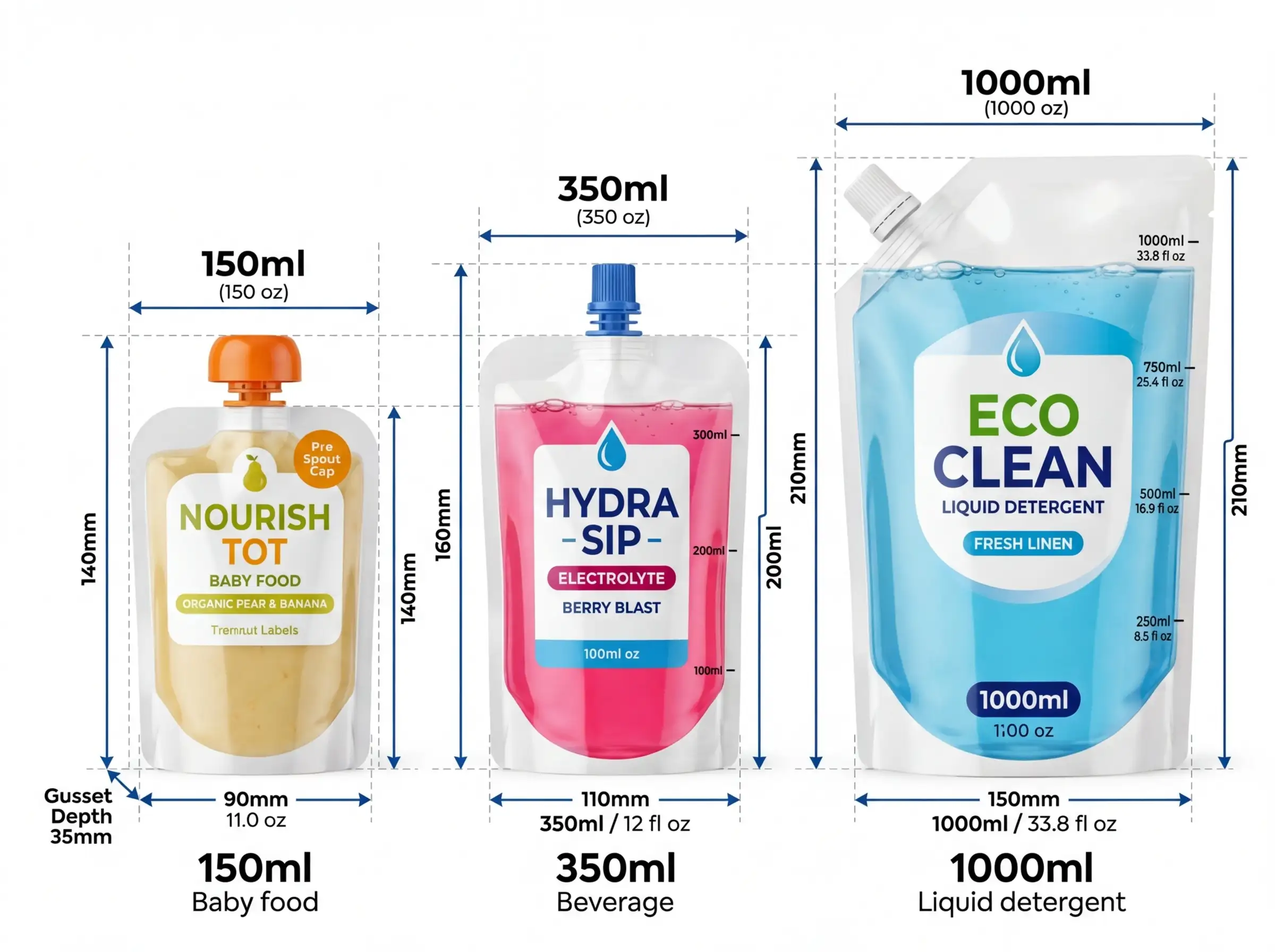
Shelf Impact and Shipping Efficiency
Pouch size affects more than the primary pack. It also influences carton count, pallet pattern, warehouse use, and retail display.
A taller pouch may look premium on shelf but reduce carton efficiency. A wider pouch may improve front-facing graphics but require stronger film or a wider bottom gusset to stand properly.
| Size Factor | Retail Impact | Logistics Impact |
|---|---|---|
| Taller pouch | Better visibility on shelf | May reduce carton packing density |
| Wider pouch | Larger branding area | Can improve stack stability |
| Larger gusset | Better stand-up performance | May increase material usage |
| Corner spout | Cleaner pour for refill use | Good for household product handling |
Custom Spout Pouch vs Standard Sizes: Which Is Better?
There is no single best choice for every project. The right option depends on launch speed, cost target, branding needs, and technical performance.
Best Cases for Standard Sizes
Standard sizes are useful when speed matters. They are often chosen for pilot runs, market tests, and products using common filling lines.
- Faster procurement
- Lower development complexity
- Reduced mold or setup cost
- Suitable for mainstream product volumes
Best Cases for a Custom Spout Pouch
A custom spout pouch is better when product performance or brand differentiation is a priority. It allows precise adjustment of width, height, gusset, spout placement, and visual impact.
- Unique product shape or dose requirement
- Special shelf presence
- Improved pouring performance
- Better fit for export cartons and pallet plans
- Brand distinction in crowded categories
For premium packaging, baby-focused products, and competitive retail segments, custom dimensions often deliver a better long-term return than stock sizes.
Popular Spout Stand Up Pouch Pouch Formats in the Market
The market uses several pouch structures for different products and user habits. The most effective format depends on how the consumer holds, pours, squeezes, and stores the pack.
Center Spout Stand Up Pouch
This format is common for juices, puree, and baby food. The centered spout creates a balanced appearance and works well for direct drinking or controlled squeezing.
It is also popular for child-oriented packaging because the front panel remains visually clean for branding.
Corner Spout Pouch
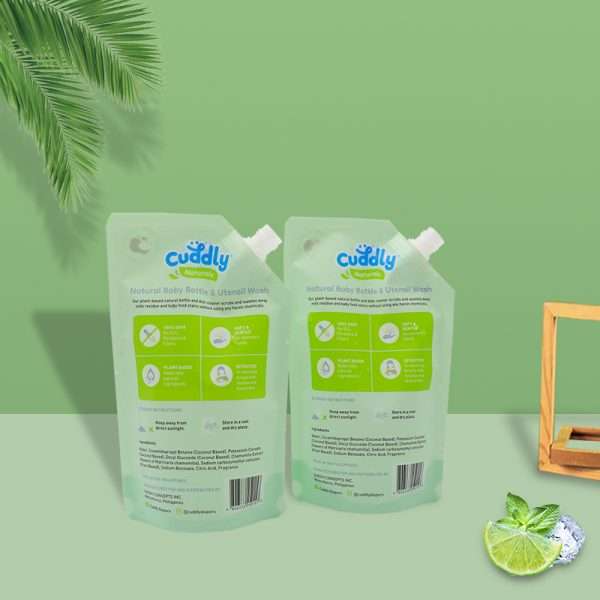
This format is widely used for detergents, household liquids, and refill pouch applications. The corner position makes pouring into bottles easier and often reduces mess.
For larger capacities like 500ml to 2L, corner spouts are often more practical than centered spouts.
Shaped Custom Spout Pouch
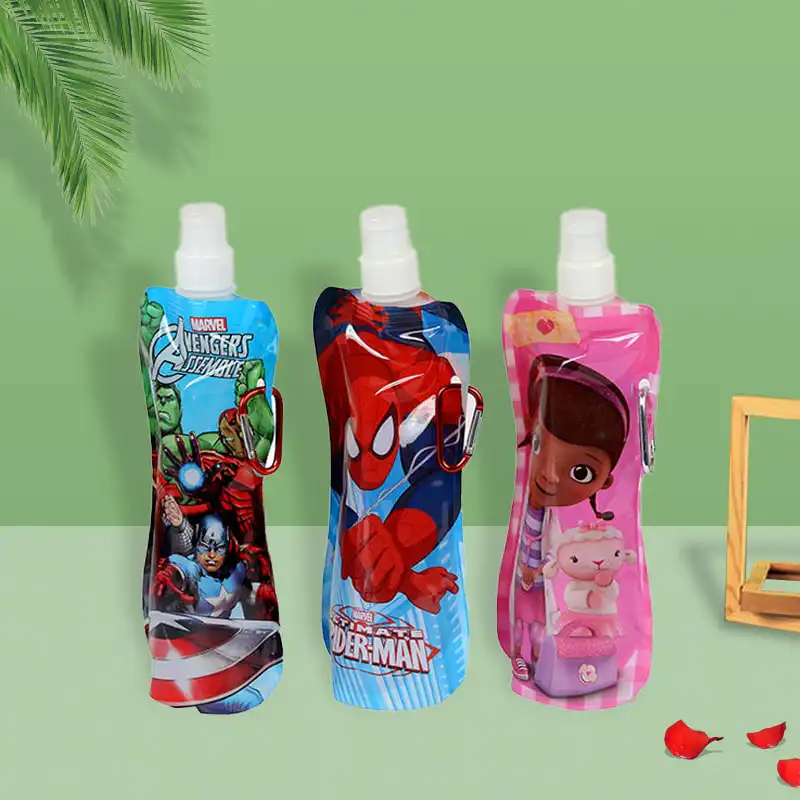
Shaped pouches support premium branding and category differentiation. They are often used for children’s nutrition products, promotional packs, and high-visibility retail launches.
A shaped custom spout pouch can improve recognition, but it must still be engineered for filling stability and seal strength.
Real-World Examples of Spout Pouch Sizes by Industry
Buyers often want a shortcut: what works in real markets. The table below summarizes common packaging practices seen across food, beverage, and personal care categories.
Table: Recommended Spout Pouch Sizes for Food and Beverage
| Product | Recommended Size | Typical Spout | Notes |
|---|---|---|---|
| Yogurt | 80ml - 150ml | 8.6mm - 10mm | Popular for children and on-the-go use |
| Puree | 90ml - 150ml | 10mm - 12mm | Requires easy squeeze and clean flow |
| Juice | 100ml - 250ml | 8.6mm - 10mm | Common in single-serve retail formats |
| Honey | 200ml - 500ml | 12mm - 16mm | Higher viscosity needs wider dispensing |
| Edible oil | 500ml - 1L | 12mm - 16mm | Often uses corner spout for controlled pouring |
Table: Recommended Spout Pouch Sizes for Home and Personal Care
| Product | Recommended Size | Typical Spout | Common Format |
|---|---|---|---|
| Shampoo | 250ml - 1L | 10mm - 16mm | Stand-up refill pouch |
| Body wash | 400ml - 1L | 10mm - 16mm | Corner spout pouch |
| Liquid soap | 250ml - 500ml | 10mm - 12mm | Retail refill pouch |
| Laundry detergent | 800ml - 2L | 16mm - 22mm | Large refill pouch |
These ranges reflect common market practice, but final dimensions still depend on formula density, cap style, filling tolerance, and transport conditions.
Key Material Structures That Affect Spout Pouch Sizing
Size and material must work together. A pouch that looks correct on paper may fail in production if the film structure is not matched to the product.
Lightweight Structures for Single-Use Packs
Small-capacity packs often use lighter laminates to reduce cost and improve flexibility. These are suitable for samples, trial products, and short-use consumer packs.
However, lightweight structures may be less suitable for heavy fills, aggressive formulas, or long-distance export handling.
High-Barrier Structures for Sensitive Liquids
Products that need freshness protection often require stronger barrier layers. This is common for baby food, nutrition products, sauces, and oxygen-sensitive liquids.
High-barrier materials can slightly affect final pouch stiffness and dimensions. That is why prototype testing matters before confirming mass production.
| Material Approach | Best For | Key Benefit |
|---|---|---|
| Lightweight laminate | 30ml - 100ml single-use packs | Lower cost, flexible handling |
| Medium barrier structure | Juice, shampoo, soap | Balanced cost and performance |
| High-barrier laminate | Baby food, puree, sensitive liquids | Better shelf life and protection |
Compliance, Safety, and Quality Standards to Check Before Ordering
Certification is not just a marketing detail. It is a practical checkpoint for product safety, production control, and export readiness.
ISO 22000 and FDA Considerations
For food-contact packaging, buyers often look for suppliers that operate under recognized safety systems. ISO 22000 supports food safety management, while FDA-related compliance is important for many export projects and market expectations.
These standards help buyers reduce risk when sourcing pouches for food, beverage, or sensitive liquid applications.
Leak Testing and Production Consistency
Even the best pouch design can fail if sealing quality is inconsistent. Reliable suppliers should control seal strength, dimensional tolerance, fitment consistency, and leak performance.
This is especially important for larger refill pouch formats, where higher weight puts more stress on seals and spout areas.
Sample Data Table for Buyers Comparing Spout Pouch Size Options
Buyers often need a quick technical comparison before requesting samples. The table below helps narrow options based on product behavior and filling conditions.
Table: Size Selection by Product, Filling Temperature, Spout Type, and Use Case
| Product | Suggested Size | Filling Temperature | Spout Type | Use Case |
|---|---|---|---|---|
| Baby puree | 100ml | Ambient / hot fill depending on formula | Center spout | Direct consumption |
| Fruit juice | 150ml - 250ml | Ambient / pasteurized filling | Center spout | Retail single serve |
| Honey | 250ml - 500ml | Ambient | Wider spout | Controlled dispensing |
| Shampoo | 500ml - 1L | Ambient | Corner spout | Retail refill |
| Laundry detergent | 1L - 2L | Ambient | Corner spout, large diameter | Household refill pouch |
Why Brands Choose YLTPACK for Custom Spout Pouch Projects
When buyers need dependable packaging support, they usually want three things: technical guidance, consistent quality, and responsive service. YLTPACK is positioned to support those needs with practical manufacturing experience.
Established Experience Since 2005
YLTPACK was established in 2005. With long-term manufacturing experience, the company supports brands in selecting the right pouch size, structure, and production approach for different markets.
Free Samples for Size and Structure Testing
Before mass production, buyers can request free samples to evaluate size, material feel, spout style, and general fit for their filling project. This helps reduce development risk and improves decision-making.
Certified Quality and Custom Manufacturing
YLTPACK supports custom production based on customer requirements. The company highlights compliance with ISO 22000, FDA, and related quality expectations for packaging projects that require safety and export confidence.
For brands looking for a custom spout pouch, tailored dimensions, material structures, and spout configurations can be developed according to product and market needs.
Contact Information for Fast Inquiry
For project discussions, sample requests, or quotation support, contact YLTPACK at [email protected].
FAQ About Spout Pouch Sizes
What is the most common spout pouch size?
The most common sizes are typically 100ml, 250ml, 500ml, and 1L. In food applications, 100ml to 250ml is widely used, while household refill pouch formats often use 500ml to 1L.
How do I know which custom spout pouch size is right for my product?
Start with product type, target fill volume, viscosity, and how the consumer will use it. A custom spout pouch is usually best when standard sizes do not provide the right pouring performance, shelf impact, or carton efficiency.
What size refill pouch is best for household products?
For household products, 500ml, 800ml, 1L, and 2L are the most practical ranges. The best refill pouch size depends on product weight, bottle refill frequency, and consumer handling convenience.
Are custom spout pouch sizes more expensive than standard ones?
They can be, especially if special tooling, low MOQ production, or unique shapes are required. However, custom sizing can improve branding, reduce waste, and create better long-term packaging performance.
What spout size should I choose for thick liquids?
Thick liquids usually need a wider spout, often 12mm to 16mm or larger depending on flow behavior. This improves dispensing ease and reduces user frustration.
Can I get free samples before mass production?
Yes. YLTPACK can provide free samples so buyers can review pouch size, structure, and suitability before placing a bulk order.
Final Thoughts: Choose the Right Spout Pouch Size for Better Performance and Sales
The right pouch size improves filling reliability, transport efficiency, user convenience, and shelf presentation. It also helps prevent leakage, reduce waste, and support stronger brand perception.
Whether you need a stock format or a fully custom spout pouch, the best results come from matching size, spout, material, and use case as one complete packaging system.
CTA: Request Free Samples and Custom Spout Pouch Support from YLTPACK
If you are planning a new pouch project, do not rely on guesswork. Get practical size recommendations, free sample support, and custom manufacturing guidance from YLTPACK.
Contact YLTPACK today at [email protected] to request free samples, discuss your ideal custom spout pouch, and find the right solution for food, beverage, personal care, and refill pouch packaging.