Why Treat Bags and Food Bags Aren't the Same Thing (And Why It Matters for Your Brand)
After working with pet brands across North America and Europe for over two decades, we've seen a recurring mistake. Brands try to use a single bag style for both products—and end up compromising freshness, shelf appeal, or user experience. This guide breaks down exactly where treat pouches and bulk food bags diverge, so you can make smarter sourcing decisions.
Size, Portion, and How Consumers Actually Use These Bags
The most obvious difference is size, but it goes deeper than dimensions. Pet owners interact with these two bag types in completely different contexts. A food bag sits in a pantry or storage bin. A treat pouch travels to the park, lives in a coat pocket, or sits on a kitchen counter for quick reward sessions.
This means treat bags need to prioritize portability, easy open-close cycles, and portion control treat bags functionality. Food bags, on the other hand, need to handle weight, resist puncture, and maintain freshness across weeks of repeated access.
Typical Use Patterns
| Feature | Treat Bag | Food Bag |
|---|---|---|
| Typical weight range | 50g – 500g | 2kg – 15kg |
| Opening frequency | 5–20 times per day | 1–2 times per day |
| Location of use | On-the-go, training, kitchen | Pantry, garage, laundry room |
| Primary user concern | Freshness between quick opens | Long-term storage integrity |
| Expected shelf life | 2–8 weeks | 6–18 months |
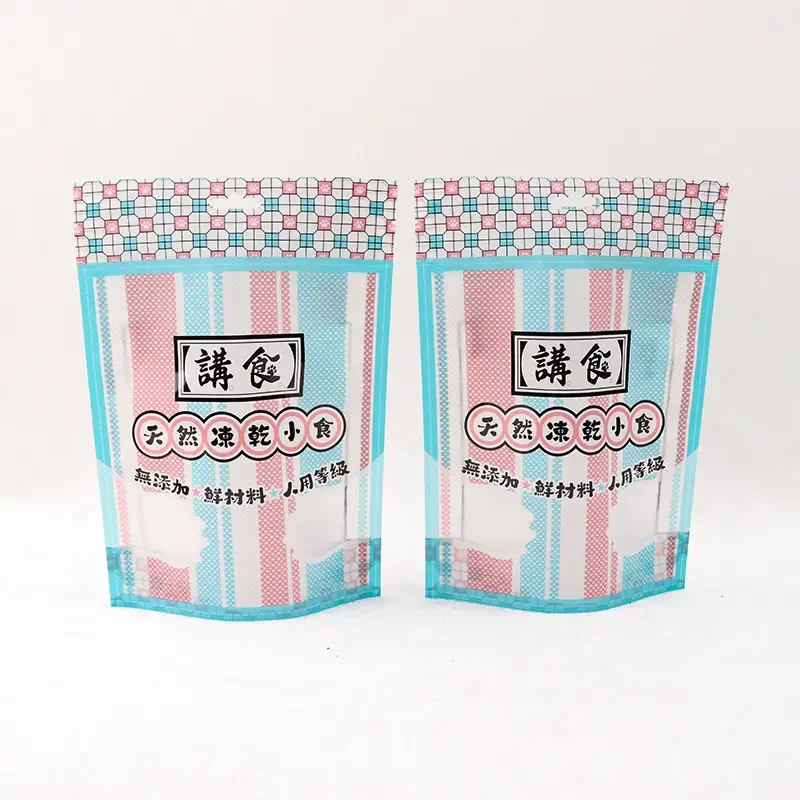
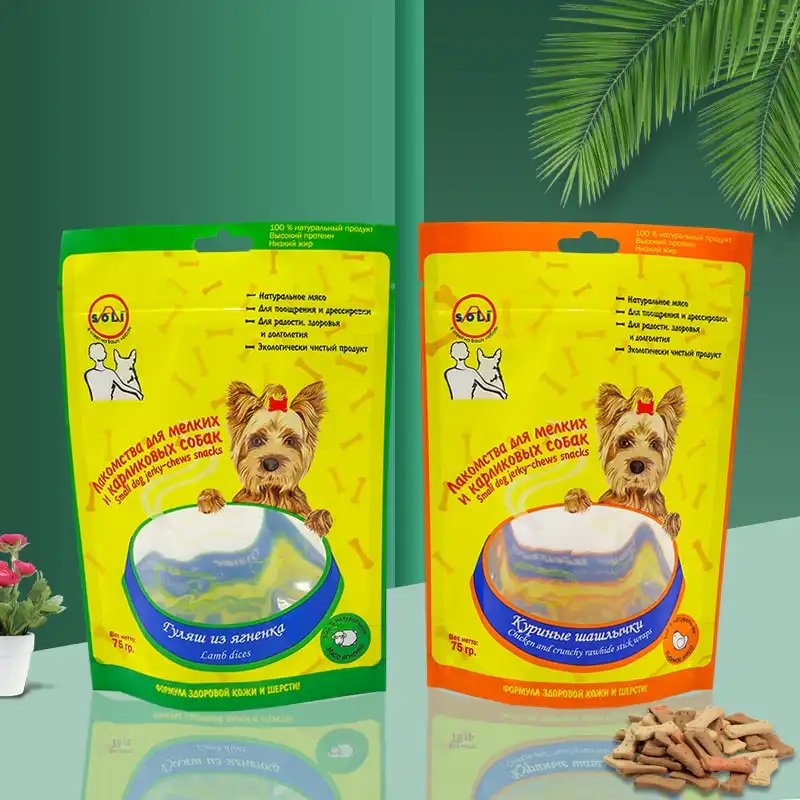
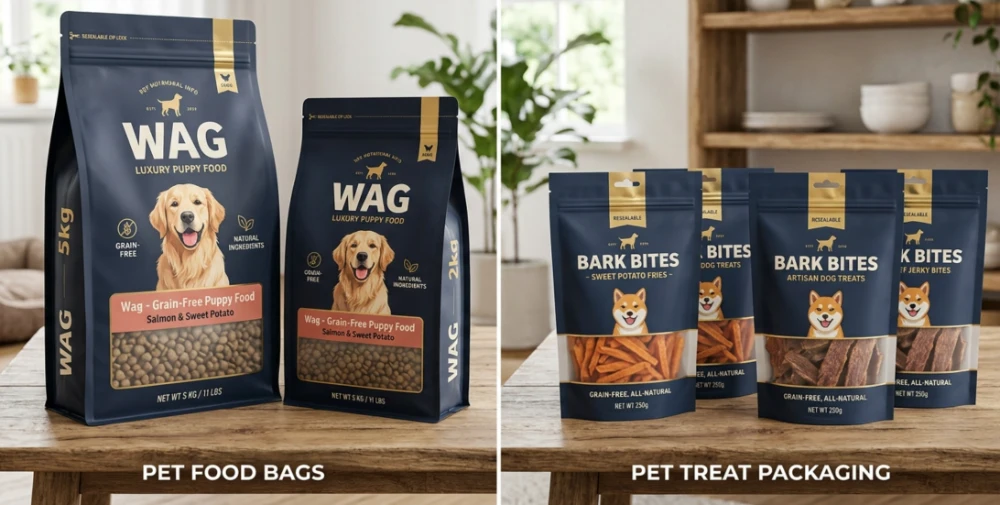
When you understand these patterns, the design decisions start making sense. A stand up pouch pet treat packaging format works beautifully for snack-sized products because it's shelf-stable, compact, and eye-catching at retail. For a 10kg food bag, you need a flat-bottom gusseted structure with reinforced seams.
Barrier Properties: Protecting Very Different Products
Here's where material science gets genuinely interesting. Treats and kibble have different moisture contents, fat levels, and oxidation vulnerabilities. A jerky-style treat with 20–30% moisture needs a very different barrier than a dry extruded kibble at 8–10% moisture.
What Each Product Needs
- Treats (soft/semi-moist): High moisture barrier to prevent drying out, moderate oxygen barrier to slow fat oxidation, aroma retention so the product smells appealing at every opening
- Treats (freeze-dried): Extreme moisture barrier (these products are hygroscopic), high oxygen barrier, often nitrogen-flushed
- Dry food/kibble: Moderate moisture barrier, strong oxygen and light barriers to prevent rancidity, grease resistance for high-fat formulas
In our 6,800㎡ cleanroom facility, we run barrier testing on every material combination before recommending a laminate structure. It's not enough to say "use foil"—the specific layering of PET, ALU, and PE films determines real-world performance. Pet owners today are highly aware of product freshness; a stale-smelling treat reflects poorly on your brand, not the bag.
Closure Systems: The Feature Customers Notice Most
Think about the last time you struggled with a bag that wouldn't reseal properly. Now imagine that frustration multiplied by 15 daily training sessions. Closure design is arguably where treat bags demand the most innovation.
Common Closure Options Compared
| Closure Type | Suitability for Treats | Suitability for Food Bags | Notes |
|---|---|---|---|
| Press-to-close zipper | Excellent | Good (small bags only) | Easy one-hand operation |
| Slider zipper | Good | Excellent | More reliable for heavy, bulky contents |
| Tin tie | Moderate | Poor | Artisan/craft aesthetic, limited resealing |
| Velcro-style | Excellent | Not practical | Quick access, quieter opening |
| Fold-and-clip | Poor | Moderate | Budget option, not airtight |
For brands exploring resealable pet bag design options, we typically recommend press-to-close zippers for treat pouches under 250g. They're cost-effective, intuitive, and survive hundreds of open-close cycles. For larger food bags, slider zippers provide better tactile feedback and seal security when dealing with heavier contents.
Structural Design: Standing Out on Shelf and in Hand
Retail shelf space is competitive—especially in the pet aisle. But treat bags and food bags compete differently. Treats sell on impulse and emotion ("my dog will love this"). Food sells on trust and value ("this will nourish my dog for the next month").
Design Choices That Reflect These Buying Triggers
- Treat pouches: Vibrant colors, clear windows to show product texture, compact shapes that fit near checkout, matte-finish films for premium feel
- Food bags: Information-dense panels, nutritional charts, clear ingredient hierarchy, structured shapes that stack and store efficiently
Our in-house design team often helps brands who only have a rough idea of what they want. One thing we consistently advise: for treats, invest in a window. Pet owners want to see what they're feeding their animals. According to a 2025 Packaged Facts survey, 68% of pet owners said visible product quality influenced their purchase decision at shelf.
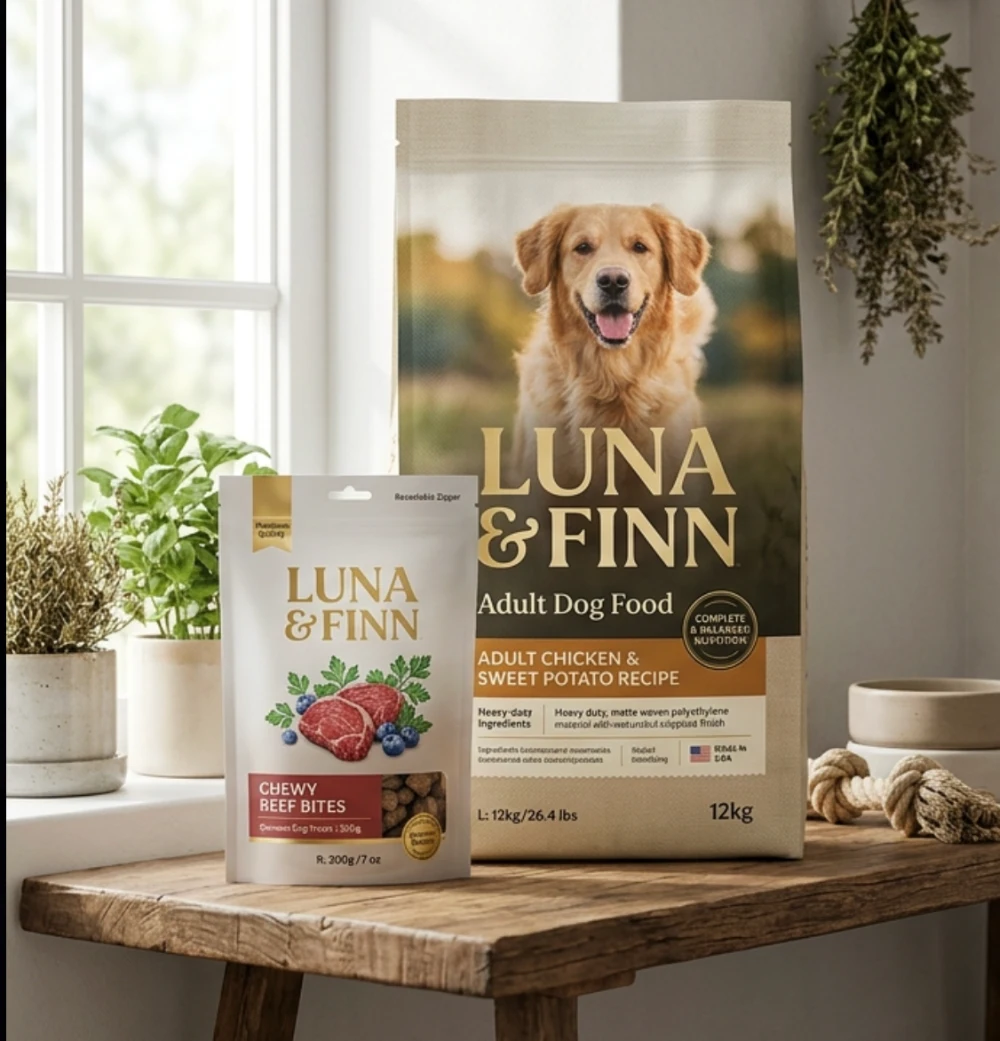
If you're a growing brand looking at pet treat packaging design ideas 2026, consider kraft-paper laminates with spot-gloss printing. They communicate "natural" and "premium" simultaneously—two qualities pet parents actively seek.
Material Choices: Sustainability Meets Function
Sustainability isn't a nice-to-have anymore. Pet owners—particularly millennials and Gen Z—actively seek brands that reduce environmental impact. But here's the tension: barrier performance and recyclability often conflict.
Where Each Bag Type Stands on Sustainability
For treat pouches (smaller format, lighter contents), brands have more flexibility to adopt eco-friendly pet treat packaging bags. Mono-material PE or PP structures can achieve adequate barriers for products with shorter shelf lives. Some brands are successfully using compostable films for treats that move quickly off shelves.
Food bags face a tougher challenge. The extended shelf life requirements (often 12+ months) typically demand multi-layer laminates that are harder to recycle. However, progress is real. PCR (post-consumer recycled) content in PE layers is now commercially viable without compromising food safety—something we validate through our FDA and ISO 22000 certified processes.
- Short shelf life treats: Compostable or mono-PE films viable
- Extended shelf life treats: Recyclable PE/PE laminates with barrier coatings
- Dry food bags: PCR-content PE layers, paper/PE combinations for lighter formulas
- Heavy food bags (5kg+): Woven PP with PE liner remains the workhorse, but PCR integration is growing
Printing and Branding: Different Rules for Different Shelves
The printing approach changes significantly between these two formats. Treat bags often use rotogravure or digital printing for high-impact, full-coverage graphics. They're small canvases—every square centimeter matters.
Food bags, especially larger ones, may use flexographic printing for cost efficiency at volume. The larger surface area allows more information panels, feeding guides, and brand storytelling without feeling cramped.
Key Branding Considerations
| Element | Treat Bag Priority | Food Bag Priority |
|---|---|---|
| Logo placement | Front-center, large | Top-third for shelf visibility |
| Color palette | Bold, playful, appetite-driven | Trust-building, clean, informative |
| Typography | Friendly, rounded fonts | Clear, readable at distance |
| Regulatory info | Back panel (space is limited) | Side panels with room for detail |
| Finish | Matte, soft-touch, spot UV | Gloss or semi-gloss for durability |
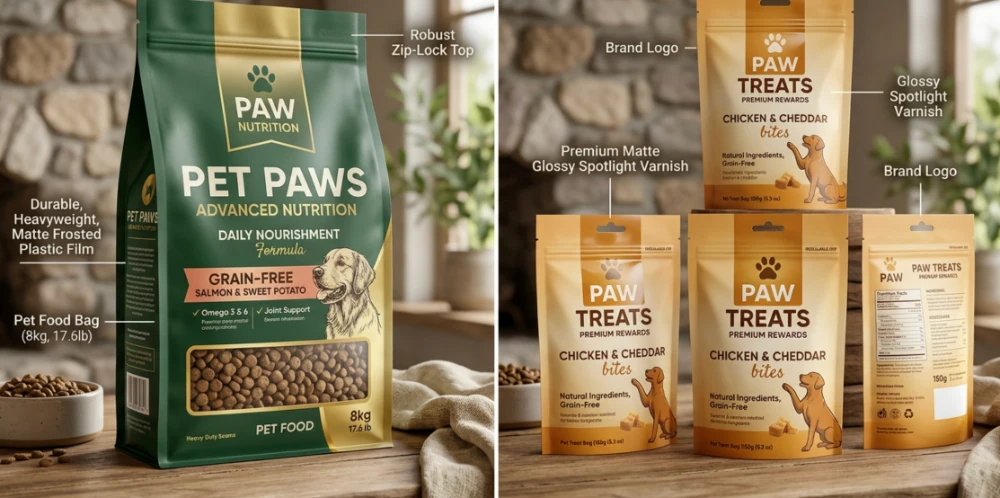
Working with brands across North America, we've found that the most common mistake is designing the treat pouch as a miniature version of the food bag. They need distinct visual identities—even within the same brand family. A treat is a joy purchase; the design should feel like a reward, not a chore.
Minimum Order Quantities and Production Realities
This is where custom pet treat packaging for small business gets tricky. Treat SKUs often have more flavor variants, seasonal editions, and limited runs. That means smaller orders per design. Food bags typically involve fewer SKUs at higher volumes.
What This Means for Your Sourcing Strategy
- Treat bags: You might need 5–8 different designs at lower quantities. Look for manufacturers offering digital printing for short runs alongside gravure for core SKUs.
- Food bags: Fewer designs, higher volume per run. Gravure printing becomes cost-effective quickly. Focus on consistency and structural durability testing.
At YLTPACK, we handle both scenarios because we control the entire production chain—from film extrusion through printing and bag-making. That vertical integration means we can run a 5,000-unit treat pouch order on Tuesday and a 50,000-unit food bag order on Wednesday without outsourcing or quality gaps.
Regulatory Compliance: Same Industry, Different Details
Both categories must meet food-contact material regulations (FDA 21 CFR in the US, EU Regulation 1935/2004 in Europe). But the specifics differ based on product characteristics.
- High-moisture treats: Migration testing becomes critical because moisture can accelerate chemical transfer from packaging to product
- Fatty treats: Simulant testing with oil-based solutions required
- Dry kibble: Standard migration testing with dry-food simulants
Because we hold FDA and ISO 22000 certifications, we run these tests as standard protocol rather than as add-on services. Every material batch gets validated before production starts. For brands selling into multiple markets, we provide compliance documentation for both US and EU requirements.
Pet Food Storage Solutions: What Consumers Expect in 2026
Consumer expectations around pet food storage solutions have evolved rapidly. Freshness indicators, easy-pour spouts on large bags, and re-closable systems that actually work are table stakes now. Here's what's trending:
- For treats: Single-serve sachets within a larger parent bag, QR codes linking to sourcing information, transparent panels showing ingredient origin
- For food: Built-in measuring scoops, oxygen absorber pockets, pour-friendly bag shapes with stabilizing gussets
Pet owners increasingly treat their animals like family members. They want the same packaging innovation they experience in human food—applied to what they feed their pets. Brands that recognize this and invest in thoughtful bag design earn stronger loyalty and higher repeat purchase rates.
Making the Right Choice for Your Product Line
The decision between treat bag and food bag specifications isn't either/or—most brands need both. The key is understanding that these are fundamentally different products requiring distinct engineering approaches.
Quick Decision Checklist
- ☑️ Product moisture content determines your minimum barrier requirements
- ☑️ Expected shelf life dictates material complexity
- ☑️ Consumer use pattern (frequency, location) drives closure choice
- ☑️ Retail channel (pet specialty vs. grocery vs. online) influences size and format
- ☑️ Brand positioning (premium vs. value) guides finish and printing method
- ☑️ Sustainability commitments may limit material options—plan early
If you're uncertain where to start, reach out to our team at YLTPACK. With 20+ years manufacturing pet treat packaging and bulk pet food packaging for brands at every growth stage, we can walk you through material options, structural prototypes, and compliance requirements—before you commit to a single production run.
Frequently Asked Questions
Can I use the same bag material for both treats and dry food?
Technically possible but rarely advisable. Treats typically require higher moisture barriers and more frequent resealing functionality. A bag optimized for 10kg of kibble won't perform well holding 100g of soft jerky treats. The material laminate, closure type, and even bag shape should be matched to how consumers actually interact with each product.
What's the minimum order quantity for custom treat pouches?
This varies by manufacturer and printing method. Digital printing allows runs as low as 1,000–3,000 units, while rotogravure typically starts at 10,000–20,000 units per design. At YLTPACK, we offer flexible minimums specifically because we understand that treat lines often need multiple flavors in smaller batches.
How do I choose between a stand-up pouch and a flat pouch for treats?
Stand-up pouches offer superior shelf presence and stability—they display more branding surface and stay upright in retail settings. Flat pouches work better for single-serve portions, sample packs, or products sold primarily online where shelf display isn't a factor. Consider your primary sales channel first.
Are compostable or recyclable options available for treat bags without sacrificing freshness?
Yes, for products with shorter shelf lives (under 6 months). Mono-material polyethylene structures and certain bio-based films now achieve adequate oxygen and moisture barriers for many treat formats. For longer shelf life requirements, recyclable laminates with barrier coatings are the current sweet spot between sustainability and performance.
What information should I prepare before requesting a packaging quote?
Come prepared with: product type and moisture content, target shelf life, bag dimensions or target weight per unit, estimated annual volume, your priority markets (US, EU, etc.), and any sustainability requirements. Having a rough design concept helps but isn't essential—our design team can develop artwork from a basic brand guideline. Reach out via WhatsApp at +86 182 1944 5665 or email [email protected] to start the conversation.