Kraft Paper Look vs. Metallic Finish: Which One Wins Over Pet Owners?
Having worked with brands across North America, Europe, and Asia-Pacific for over two decades, we've seen this exact debate play out hundreds of times. So let's break it down honestly—kraft paper texture versus metallic sheen—and help you decide which direction aligns with your brand story, your customer base, and your supply chain realities.
Why Surface Finish Matters More Than You Think
Pet owners are emotionally invested buyers. According to a Packaged Facts report from early 2025, over 68% of U.S. pet owners say they consider packaging appearance when choosing between two similar products. That's not vanity—it's pattern recognition. People associate visual cues with product quality.
A matte kraft look says "natural, transparent, wholesome." A metallic finish says "premium, science-backed, performance." Neither is universally better, but choosing the wrong one for your audience creates cognitive dissonance that quietly kills conversion.
Think of it this way: if your recipe emphasizes farm-raised proteins and a natural ingredients label, wrapping it in flashy chrome sends a mixed message. Conversely, a high-performance formula for working dogs might feel underwhelming in an uncoated brown pouch.
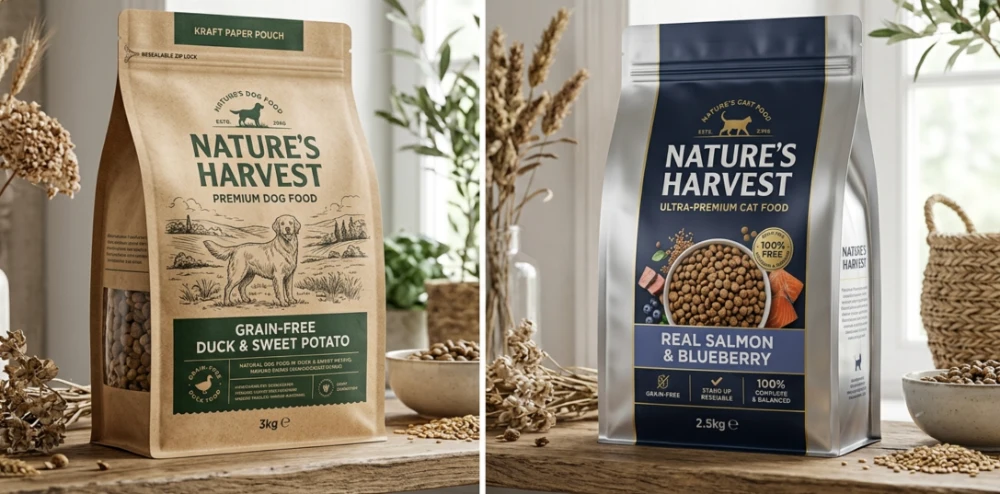
The Kraft Paper Aesthetic: What It Communicates
Brand Signals
- Earthy, honest, back-to-basics
- Transparency and clean-label values
- Environmental consciousness
- Small-batch or artisanal quality
Kraft-look pouches have surged in popularity, especially among indie brands targeting millennial and Gen-Z pet parents. These buyers care deeply about ingredient sourcing, sustainability claims, and brand authenticity. A kraft exterior—often combined with a clear window showing the actual kibble or freeze-dried product—reinforces that transparency message instantly.
Technical Realities
Here's something many first-time brand owners miss: what looks like kraft paper on the outside isn't always kraft paper throughout the laminate structure. Modern flexible pouches use multi-layer constructions. The outer layer might be a printed kraft-look film, while the inner layers handle barrier protection and shelf life preservation.
This matters because you don't have to sacrifice functionality for aesthetics. In our 6,800㎡ cleanroom facility, we produce kraft-look laminates that still achieve excellent moisture and oxygen barrier ratings. You get the visual appeal without compromising on freshness.
Where Kraft Works Exceptionally Well
- Organic or all-natural pet food lines
- Treats and snacks with visible product windows
- Brands positioned against mass-market competitors
- Products sold in specialty pet boutiques or farmers markets
- Subscription box brands emphasizing an "unboxing" experience
The Metallic Finish: What It Communicates
Brand Signals
- Premium positioning and clinical authority
- Performance nutrition and science-driven formulation
- Shelf presence in crowded retail environments
- Established brand confidence
Metallic finishes—whether full foil, spot metallic accents, or holographic elements—command attention. In a retail aisle with 40+ competing SKUs, a reflective surface catches light and draws the eye. For brands competing in supermarket chains or big-box stores, that split-second visibility advantage can directly impact sales velocity.
Technical Realities
Metallic finishes typically involve either aluminum foil lamination or metallized film layers. Both provide outstanding barrier properties, making them inherently strong at blocking light, moisture, and oxygen—all critical for extending product freshness without excessive preservatives.
Because we hold FDA and ISO 22000 certifications, we often recommend metallic structures for brands whose formulas contain sensitive oils (like omega-3 supplements for coat health) that degrade under light exposure. The finish isn't just decorative—it's functional.
Where Metallic Works Exceptionally Well
- Veterinary-recommended or prescription diet lines
- Performance formulas for active or working dogs
- Brands competing in mass retail environments
- Products with high-fat or oil-sensitive ingredients
- Lines emphasizing advanced nutritional science
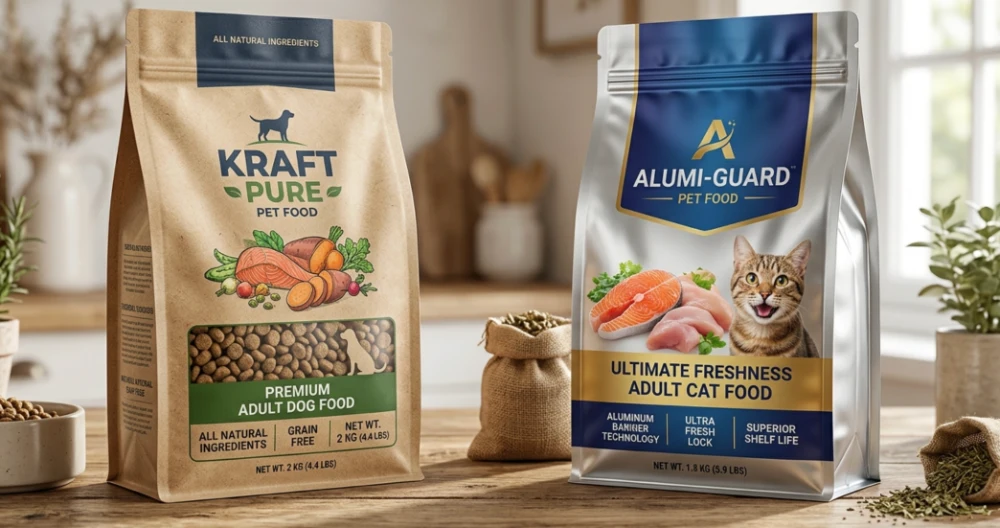
Head-to-Head Comparison
| Factor | Kraft Paper Look | Metallic Finish |
|---|---|---|
| Brand perception | Natural, honest, artisanal | Premium, clinical, high-performance |
| Shelf visibility | Moderate—stands out by contrast in metallic-heavy aisles | High—catches light and draws eye quickly |
| Barrier protection | Good (with proper laminate engineering) | Excellent (inherent aluminum barrier) |
| Sustainability perception | Strong—consumers associate kraft with eco-friendly | Weaker—metallic reads as "less recyclable" |
| Actual recyclability | Depends on laminate structure (not always recyclable) | Depends on laminate structure (not always recyclable) |
| Print vibrancy | Muted, earthy tones work well; bright colors may appear dull | Colors pop; excellent for bold graphic designs |
| Target customer | Health-conscious, eco-aware, indie-brand shoppers | Performance-focused, retail-browsing, brand-loyal buyers |
| Best retail channel | Specialty stores, DTC, subscription | Supermarkets, pet superstores, vet clinics |
The Sustainability Question: It's Not Black and White
Here's where things get nuanced. Many brands choose kraft specifically because they want to signal eco-friendliness. And consumers do perceive kraft as more sustainable—a 2024 McKinsey consumer survey found that 74% of respondents associated brown/kraft textures with "environmentally responsible" brands.
But perception and reality don't always align. A kraft-look pouch with a PET/PE laminate isn't necessarily more recyclable than a metallized pouch. Both require specialized recycling infrastructure. The real path to sustainable pet food packaging solutions lies in material engineering—mono-material structures, PCR content, or compostable laminates—not just surface appearance.
As a manufacturer that has produced packaging for 20+ years, we've seen brands get burned by making sustainability claims based solely on the "look" of their pouch. If genuine environmental responsibility is part of your brand promise, the conversation needs to go deeper than surface finish. It needs to address the full laminate structure, ink systems, and end-of-life pathway.
That said, kraft aesthetics paired with genuinely biodegradable pet food packaging options or certified compostable films can be a powerful combination—authentic inside and out.
What About Combining Both? The Hybrid Approach
You don't have to pick one extreme. Some of the most effective custom pet food packaging design we've produced uses a hybrid approach:
- Kraft base with metallic foil accents—spot gold or silver stamping on a kraft body creates a "premium natural" feel
- Metallic base with matte kraft-textured panels—combines shelf pop with earthy ingredient storytelling
- Kraft front, metallic back—the front communicates values while the back (often where the nutritional information panel sits) benefits from metallic barrier properties
Our in-house design team often helps brands who only have a rough idea of their positioning explore these hybrid concepts through mock-ups and material samples before committing to a full production run. It's the kind of exploratory work that prevents expensive mistakes.
Making the Decision: A Framework for Your Brand
Start With Your Customer, Not Your Preference
Personal taste is irrelevant here. What matters is what your target buyer associates with quality and trust. If you sell primarily through specialty pet stores to health-conscious owners, kraft aligns. If you're fighting for attention in a Walmart aisle, metallic gives you an edge.
Consider Your Product Category
Treats and toppers tend to do well in kraft-look pouches—especially with a clear window. Main meal products, particularly those with clinical or performance positioning, lean metallic. Supplement-infused formulas benefit from metallic's superior light barrier.
Think About Your Full Line
If you plan to expand from one SKU to a full range, think about how your packaging system will scale visually. A kraft foundation with color-coded accents scales beautifully across flavor variants. Metallic works well with a uniform finish and label differentiation.
Evaluate Your Supply Chain Needs
Both finishes are available in stand-up pouches, flat-bottom bags, and side-gusseted formats. Both support resealable bag design features like press-to-close zippers. The structural choice is independent of the finish choice—so don't let anyone tell you that one finish limits your bag format options.
Common Mistakes We See Brands Make
Working with brands across multiple continents, we've noticed a few recurring errors when it comes to choosing finishes for this product category:
- Choosing kraft purely for "sustainability" without verifying the actual laminate structure. If your inner layers are conventional PE, the kraft exterior is cosmetic—not environmental.
- Using metallic everywhere without purpose. Full metallic coverage can read as "cheap" if the print quality isn't high. Selective metallic elements on a matte or satin base look far more premium.
- Ignoring how the finish photographs. If your primary sales channel is e-commerce or social media, test how your packaging looks on screen. Metallic finishes can create glare in product photography, while kraft textures photograph warmly and consistently.
- Forgetting about tactile experience. Kraft-look films often have a soft-touch texture that consumers enjoy holding. Metallic is smooth and cool. Both trigger different subconscious quality assessments when a shopper picks up the bag.
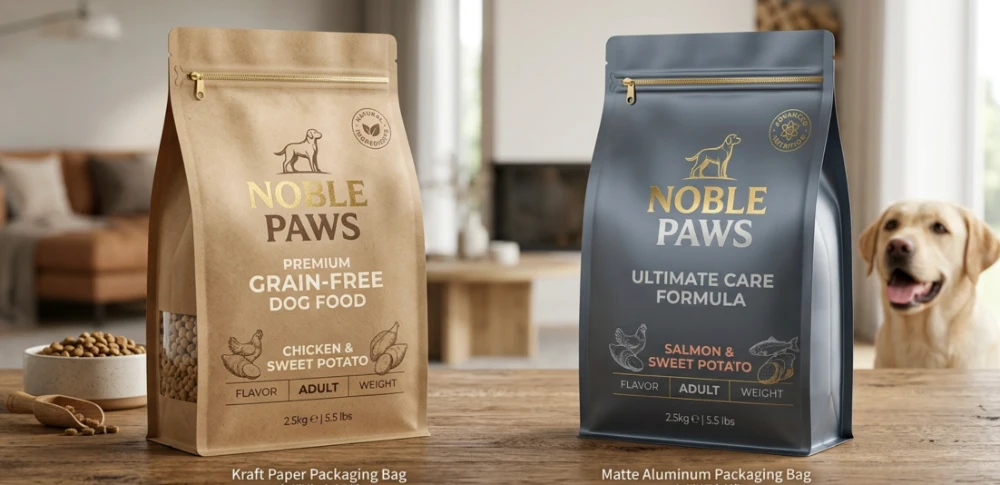
What's Trending Right Now
Based on what we're producing in volume across our facility through the first half of 2026, here are the pet food packaging trends 2026 is bringing:
- Matte kraft with minimal, typographic-forward design (fewer graphics, more white space)
- Soft-touch metallic finishes replacing high-gloss chrome looks
- Transparent windows getting larger—owners want to see the actual product
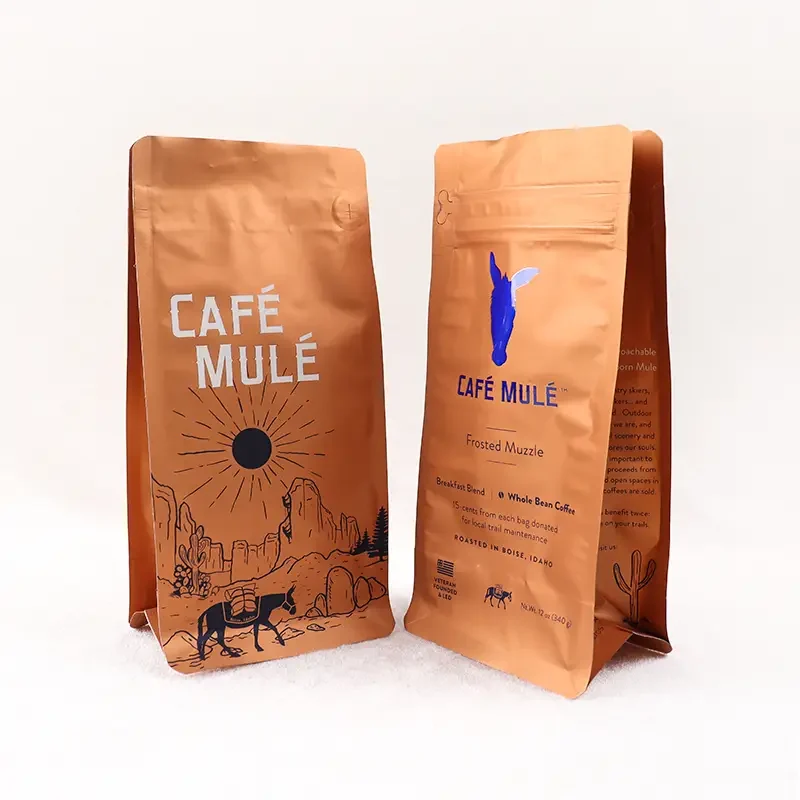
- Earth-tone metallic colors (bronze, copper, muted gold) replacing silver and bright gold
- Eco-friendly pet food packaging materials like mono-PE structures gaining traction among brands with genuine sustainability commitments
The broader shift is toward tactile, authentic-feeling surfaces regardless of base material. Even metallic finishes are moving toward matte and satin rather than mirror-shine. The market is rewarding subtlety over flash.
How to Brief Your Packaging Supplier
When you're ready to move forward, here's what a good supplier conversation should cover:
- Share your brand positioning deck—even if it's rough. Visual references help more than verbal descriptions.
- Define your retail environment—where will this bag physically sit? Online only? Retail shelf? Both?
- Clarify your barrier requirements—how long must the product stay fresh? What's the fat content? Any light-sensitive ingredients?
- State your sustainability goals honestly—do you need certified compostable? PCR content? Or is "recyclable-ready" sufficient for now?
- Request physical samples—never commit to a full run based on a digital render alone. Touch the material. Test the zipper. Check print color accuracy against your brand standards.
At YLTPACK, we typically send material swatch books and printed samples before any order is confirmed. It saves everyone time and eliminates guesswork on how that kraft texture or metallic sheen will actually look and feel in hand.
Final Verdict: There's No Universal Winner
If you've read this far hoping for a simple "kraft is better" or "metallic is better" answer—sorry. The honest answer is that both can outperform, depending on alignment between your brand identity, your customer's expectations, and your product's functional needs.
What we can say with confidence, after producing millions of pouches across both finish families, is this: the brands that succeed are the ones that make intentional, informed choices rather than following trends blindly. They test. They get samples. They think about their customer's hands, eyes, and values—not just their own logo.
If you're in the early stages of developing your packaging strategy and want to explore options with people who've seen what works (and what flops), reach out to our team. We're happy to talk through material options, share relevant case studies, and send sample packs so you can compare finishes side by side.
Get in touch: WhatsApp +86 182 1944 5665 | Email: [email protected]
Frequently Asked Questions
Is kraft paper packaging actually more eco-friendly than metallic alternatives?
Not necessarily. The sustainability of any flexible pouch depends on its full laminate structure—not just the outer printed layer. A kraft-look film laminated to conventional plastic isn't inherently more recyclable. If sustainability matters to your brand, ask your supplier about mono-material options, compostable films, or PCR (post-consumer recycled) content regardless of which finish you prefer. The surface and the structure are independent decisions.
Can metallic finishes still look "natural" or "premium healthy"?
Absolutely. The old-school shiny chrome look is fading. Today's metallic options include soft matte metallics, warm bronze and copper tones, and subtle spot-foil accents that complement natural brand stories beautifully. A matte gold accent on a white or cream base can feel just as "wholesome" as kraft while still delivering strong shelf presence and barrier properties.
What's the minimum order quantity to get a custom-printed pouch with either finish?
This varies by supplier. At YLTPACK, our MOQs depend on bag size, structure, and print complexity rather than finish type alone. We work with startup brands doing initial launches as well as established companies ordering millions of units. The right approach is to share your projected volumes and timeline so your supplier can recommend the most cost-effective production path for your situation.
How do I choose between kraft and metallic if I sell both online and in retail stores?
Consider which channel drives more revenue and optimize for that. If retail is primary, lean toward finishes with stronger shelf visibility (metallic or hybrid). If DTC and subscription dominate your sales, prioritize how the bag photographs and how it feels during unboxing—kraft often wins here. Some brands create channel-specific SKUs with different outer finishes but identical inner barrier structures, though this increases complexity.
Will my choice of finish affect the shelf life of the product inside?
The finish itself doesn't determine shelf life—the barrier layers within the laminate do. However, metallic structures often use aluminum foil or metallized film that inherently provides excellent oxygen and light barriers. Kraft-look pouches can achieve similar barrier performance with the right inner layer engineering (such as EVOH or aluminum foil sandwiched between structural layers). Always specify your required shelf life target so your manufacturer can engineer the laminate accordingly, regardless of outer appearance.