Short answer: match the bag to how fast the food gets eaten, not to how much you want to fit inside. For most dry kibble lines, that means 3–5 lb bags for small breeds and trial buyers, 12–15 lb for the everyday shelf hero, and 25–30 lb for value and multi-dog households. Wet pouches sit at 2.6–3.5 oz for cats and 5.5–7 oz for dogs. This pet food packaging size guide walks through the reasoning behind those numbers so you can build a lineup that sells instead of sitting in a warehouse.
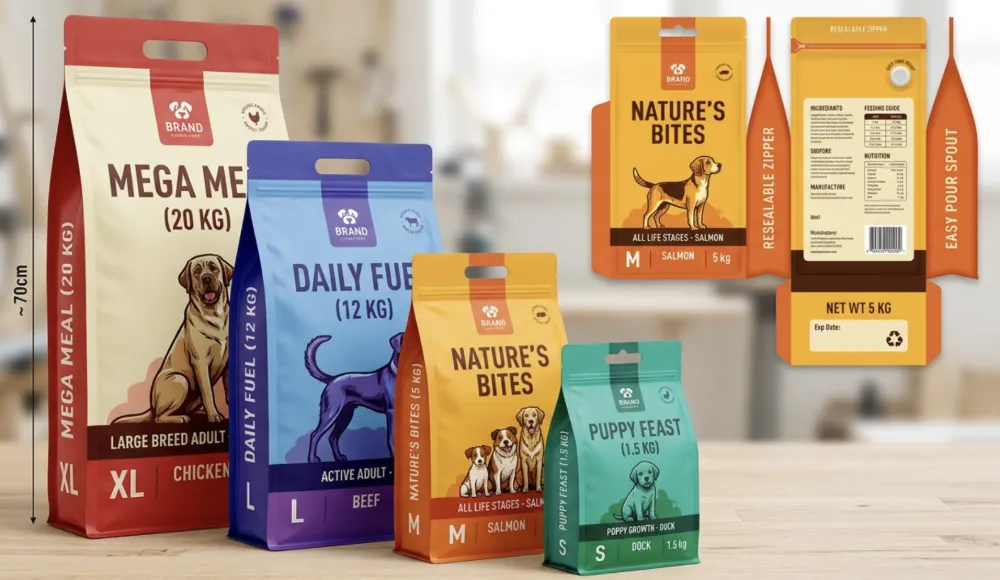
Why Bag Size Decides More Than You Think
Size is the first spec brands pick and the one they regret most. It sets your shelf footprint, your cost per serving, your freshness window, and whether a first-time buyer takes a chance on you.
Working with brands across North America and Europe, we've found the most common mistake is copying a competitor's format without checking who actually buys it. A premium freeze-dried topper in a 20 lb bag makes no sense — the price point scares people off and the food goes stale before it's finished.
Three forces pull on every size decision:
- Consumption speed — how many days until the bag is empty
- Price psychology — the number a shopper will pay without thinking twice
- Physical reality — shelf height, pallet math, and what a customer can carry to the car
Get those three aligned and the rest of your packaging decisions get easier.
The Consumption Math: Start With the Pet, Not the Bag
Here's the calculation that should drive your whole lineup. Take the daily feeding amount, multiply by your target repurchase cycle, and you have your bag weight.
Most pet owners want to buy dry food every 3–4 weeks. Any longer and freshness becomes a real concern — fats oxidize, kibble goes rancid, and your brand takes the blame.
| Pet Weight | Daily Dry Food | 30-Day Need | Recommended Bag |
|---|---|---|---|
| 4–10 lb (small cat, toy dog) | 0.5–1.0 oz–2.5 oz | 2–5 lb | 3 lb / 4 lb |
| 10–25 lb (small dog) | 3–6 oz | 6–11 lb | 5 lb / 8 lb |
| 25–50 lb (medium dog) | 7–12 oz | 13–22 lb | 15 lb / 20 lb |
| 50–90 lb (large dog) | 13–20 oz | 24–37 lb | 25 lb / 30 lb |
| Multi-pet household | Varies | 35 lb+ | 30 lb / 40 lb |
Notice the overlap. A 15 lb bag serves medium dogs on a monthly cycle and small dogs on a longer one. That's why mid-size formats do the heaviest lifting in most catalogs.
The Small-Breed Reality
Toy and small breeds represent a huge slice of the market, and they eat very little. The best pet food packaging sizes for small breeds land between 2 and 5 pounds — anything larger sits open on a shelf for two months.
Small-breed owners also tend to buy premium. They'll pay more per pound because the absolute spend stays low. A 3 lb bag at a premium price feels reasonable; a 25 lb bag at the same per-pound rate feels like a car payment.
Building a Product Ladder That Actually Converts
Don't think of sizes as variants. Think of them as steps in a relationship with the buyer.
Step 1: The Trial Size (5–12 oz)
Small stand-up pouches or flat bottom bags in the 8–12 oz range give hesitant shoppers a low-risk entry. These move well at checkout counters, in vet clinics, and in subscription welcome boxes.
Our in-house design team often helps brands who only have a rough idea of what they want here — usually the answer is a tall, narrow pouch that reads "premium sample" rather than "cheap afterthought."
Step 2: The Commitment Size (3–5 lb)
This is your conversion workhorse. The buyer liked the trial, their pet didn't refuse it, and now they want a month's supply without a big outlay.
Step 3: The Loyalty Size (12–20 lb)
Repeat customers move here. Per-serving cost drops, which rewards loyalty, and the larger surface area gives you room for the storytelling that pet owners actually read.
Step 4: The Value Size (25–40 lb)
Breeders, kennels, rescues, and multi-dog families. Different buyer, different priorities: handle strength, resealability, and stackability matter far more than shelf aesthetics.
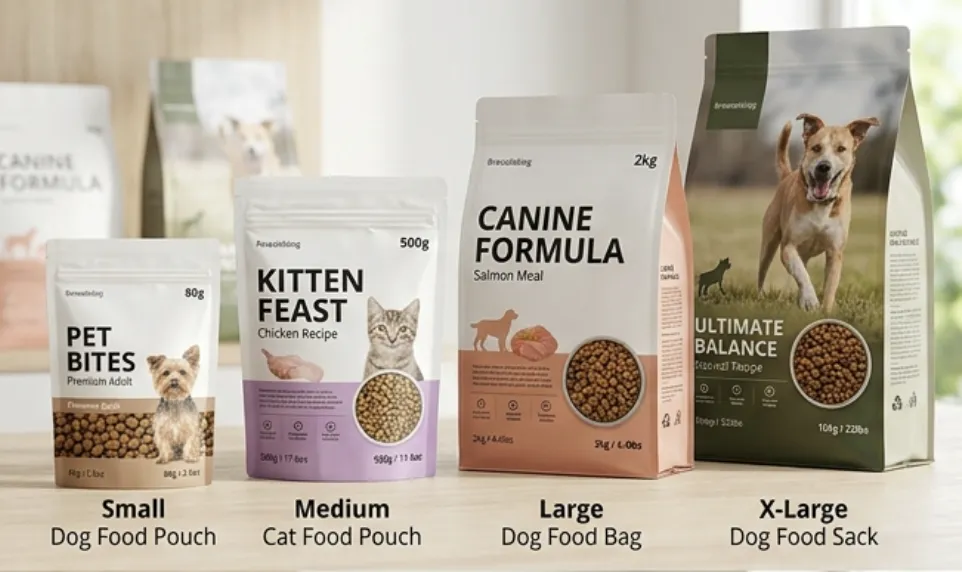
Dry Kibble vs Wet Food vs Treats: Different Rules Entirely
Each category has its own physics. Treating them the same causes leaks, blowouts, and returns.
| Category | Common Sizes | Preferred Format | Key Structural Concern |
|---|---|---|---|
| Dry kibble | 3, 5, 15, 25, 30 lb | Flat bottom / block bottom bag | Puncture resistance, gusset strength, stacking |
| Wet food pouch | 2.6–3.5 oz (cat), 5.5–7 oz (dog) | Retort pouch | Heat tolerance to 121°C, seal integrity |
| Freeze-dried raw | 3.5–16 oz | Stand-up pouch with valve | Moisture barrier, fragile piece protection |
| Semi-moist treats | 4–12 oz | Stand-up pouch, resealable | Humectant migration, aroma retention |
| Dental chews / bones | 6 oz–2 lb | Side gusset or flat pouch | Sharp-edge puncture, window clarity |
| Supplements / toppers | 1.5–8 oz | Small stand-up or 3-side seal | Powder sifting, precise dosing |
Wet Food Deserves Its Own Chart
Portion accuracy is the entire selling point of a pouch. A cat food pouch size chart by weight is worth building before you commit to tooling, because the difference between 2.6 oz and 3.0 oz changes your feeding guidelines, your case count, and your retort cycle time.
Because we hold FDA and ISO 22000 certifications, we recommend validating retort pouch seals at full production speed rather than on bench samples — thermal stress behaves differently once the line is running.
Bulk or Single-Serve? Running the Comparison Honestly
A bulk vs single serve pet food packaging comparison usually gets framed as a cost question. It's really a distribution question.
| Factor | Bulk (15 lb+) | Single-Serve / Small Format |
|---|---|---|
| Packaging cost per lb of food | Lower | Higher |
| Freight efficiency | Strong | Weaker per unit of food |
| Shelf space per SKU | Large footprint | Compact, more facings |
| Trial conversion | Poor | Strong |
| Freshness after opening | Risk over 4+ weeks | No degradation |
| Ecommerce shipping fit | Dimensional weight penalties | Fits standard rates |
| Best channel | Big box, farm stores, warehouse clubs | Online, subscription, boutique, vet |
Most growing brands land on a hybrid: two small formats to acquire customers, two large formats to retain them. Skipping the small end starves your funnel. Skipping the large end caps your revenue per customer.
Physical Constraints Nobody Mentions Until Production
This is where theory meets the warehouse floor. Three checks save real money.
Shelf Height
Standard retail shelving gives you roughly 12–16 inches of clearance. A 25 lb bag that stands 24 inches tall has to lie down, which kills your front-panel visibility. Design tall for small bags, wide and squat for large ones.
Pallet Efficiency
A standard pallet measures 48 × 40 inches. Bag dimensions that leave four inches of dead space per row waste a surprising share of every truckload. Adjusting a bag width by half an inch can add a full column per layer.
Fill Volume vs Stated Weight
Kibble density varies widely — roughly 0.35 to 0.55 g/cm³ depending on formulation and extrusion. Two brands both labeled 15 lb can need noticeably different bag volumes. As a manufacturer that has produced packaging for 20+ years, we always ask for a density sample before finalizing dimensions, because a bag sized for the wrong density either bursts at the seams or arrives looking half empty.
Quick Pre-Production Checklist
- Confirmed bulk density from an actual production batch
- Verified headspace for nitrogen flush if used
- Measured shelf clearance at your top three retail accounts
- Pallet layout drawn with the exact bag footprint
- Filling equipment jaw width and bag opening compatibility checked
- Carry handle placement tested loaded, not empty
What Pet Owners Read on the Bag — and Why Size Limits It
Ingredient transparency drives modern buying decisions. Shoppers turn the bag over, scan the first five ingredients, look for named proteins, check the guaranteed analysis, and increasingly search for sourcing origin.
That's a lot of information. A 3 oz treat pouch simply doesn't have room for full storytelling plus regulatory panels plus feeding charts. You'll need to prioritize: certifications and the hero claim on front, ingredients and analysis on back, everything else moves to a QR code.
Larger bags flip the problem. Suddenly you have acres of space and brands fill it with filler copy. Better use: a clear feeding table, a transition-to-new-food schedule, and a resealing instruction that actually gets followed.
Functional Features by Size
| Bag Size | Resealing | Handle | Window | Degassing Valve |
|---|---|---|---|---|
| Under 1 lb | Zipper or tin tie | Not needed | Optional, small | Rarely |
| 3–8 lb | Zipper strongly recommended | Optional die-cut | Common | For freeze-dried |
| 12–20 lb | Zipper or slider | Reinforced plastic or die-cut | Small only | Situational |
| 25 lb+ | Often none — pour spout instead | Required, load-tested | Avoid, weakens structure | No |
One note on zippers at scale: above about 20 lb, a zipper often fails under the weight of shifting kibble. Customers then blame the food. A tear-notch top with a separate storage recommendation performs better in practice.
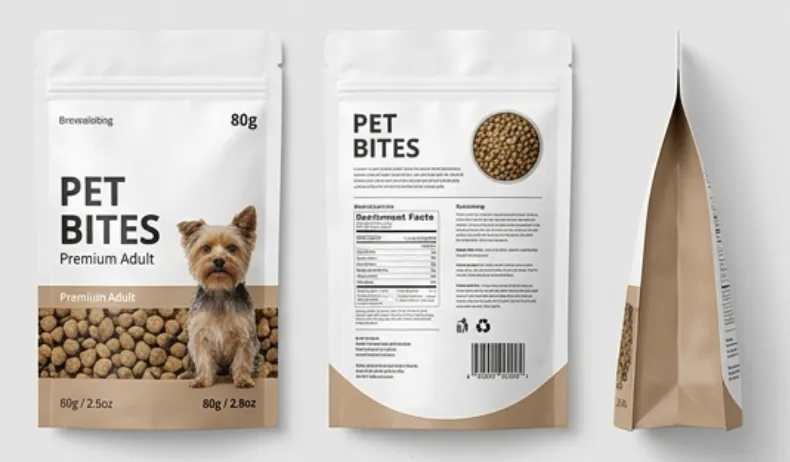
Material Structure Changes With Size
A 3 oz pouch and a 30 lb bag can't share the same laminate. Weight, drop height, and abrasion during transit all scale up.
| Size Range | Typical Structure | Approx. Total Thickness | Notes |
|---|---|---|---|
| Under 1 lb | PET/PE or PET/MPET/PE | 85–110 μm | Metallized layer for oxygen control |
| 3–8 lb | PET/AL/PE or PET/MPET/PE | 110–140 μm | Foil for high-fat formulas |
| 12–20 lb | BOPP/PE or PET/PE with heavier sealant | 140–180 μm | Sealant layer carries the load |
| 25 lb+ | Woven PP with BOPP lamination, or heavy PE | 180 μm+ | Drop-test from 1.2 m minimum |
| Retort pouch | PET/AL/NY/CPP | 120–150 μm | Must survive 121°C sterilization |
Fat content matters as much as weight. High-fat premium formulas above 18% fat need stronger oxygen barriers and fat-resistant sealants, or you get grease strike-through and weakened seals within months. In our 6,800㎡ cleanroom facility we run oxygen transmission testing on structures before they go to print, which catches these mismatches early.
Sustainability Without Breaking the Format
Recyclable mono-material structures have improved a lot, but they still behave differently from multi-layer laminates. Stiffness, seal window, and barrier all shift.
Practical guidance on sustainable pet food packaging size options for 2026: mono-PE recyclable structures now work reliably up to about 20 lb for dry food. Above that, most brands still need a woven or heavier structure for drop and abrasion performance.
- Small formats (under 5 lb) — mono-PE or PCR-content films work well, minimal compromise
- Mid formats (5–20 lb) — achievable with mono-PE, expect a slightly thicker gauge
- Large formats (20 lb+) — recyclable woven PP is the more realistic route
- Retort pouches — hardest category; foil-free retort structures are advancing but need validation
Our GRS certification covers recycled-content films, and we've seen more brands request 30% PCR in mid-size bags as a middle path — real reduction without re-qualifying the whole structure.
Deciding Your Launch Lineup
New brands ask how many sizes to launch with. The honest answer: fewer than you want.
Every additional format means separate tooling, separate inventory, separate forecasting risk. Two or three sizes at launch, expanded once you have real sell-through data, beats five sizes with dead stock in three of them.
A Sensible Starting Point
| Brand Situation | Launch Sizes | Reasoning |
|---|---|---|
| Online-only, subscription | Trial + 5 lb + 15 lb | Shipping-friendly, clear upgrade path |
| Boutique / vet channel | Trial + 4 lb | Premium positioning, limited shelf depth |
| Regional retail | 5 lb + 15 lb + 30 lb | Covers browse, family, and value shoppers |
| Small-breed specialist | 1 lb + 3 lb | Matches actual consumption honestly |
| Treats / toppers only | 4 oz + 12 oz | Impulse plus repeat purchase |
If you're still weighing how to choose dog food bag size guide questions against your forecast, work backward from your first purchase order quantity. Spreading a modest order across five formats leaves you short on all of them.
Working With a Packaging Partner on Sizing
Bring these to your first conversation and you'll skip weeks of back and forth:
- Product density sample or a filled bag from a competitor you like
- Target retail price bands per size
- Filling method — hand-fill, semi-auto, or automatic line
- Where it sells — shelf, warehouse, or direct shipping
- Fat content and any aromatic or moisture-sensitive ingredients
- Whether you need matching structures across the range or per-size optimization
At YLTPACK we usually start by sizing the mid-range format first, then scaling up and down from that reference, since it's the one that carries the most volume and reveals structural issues earliest.
If you'd like a second opinion on dimensions before committing to plates and tooling, reach us at [email protected] or on WhatsApp at +86 182 1944 5665. Sharing your density figures and target price points is usually enough for us to sketch a workable size ladder.
The Takeaway
Bag sizing isn't a design detail — it's a commercial decision wearing a design costume. Match the format to consumption speed, respect the physical limits of shelves and pallets, and let material structure follow weight rather than the reverse.
Start narrow, measure sell-through, expand from evidence. The brands that grow steadily are usually the ones that resisted launching every format at once and let real customer behavior tell them what to add next.
Frequently Asked Questions
What bag size sells best for dry dog food?
The 12–15 lb range performs most consistently across channels. It covers a month for medium dogs, fits standard shelving, ships without heavy dimensional weight penalties, and sits at a price point that repeat buyers accept without hesitation.
Should every size in my range use the same material structure?
Not necessarily. Visual consistency matters for brand recognition, but a 3 lb pouch and a 30 lb bag face very different stresses. Keep the printed look aligned and let thickness and sealant layers vary by weight.
How do I know if my bag needs a degassing valve?
Valves matter for products that release gas after packing, mainly freeze-dried and some high-fat formulas. Standard extruded kibble rarely needs one. If you're nitrogen flushing, you want a sealed bag, not a valved one.
What minimum order quantity should I expect for custom sizes?
It depends on print method and structure. Digital printing supports lower volumes and suits testing multiple formats; rotogravure needs higher quantities but delivers better economics once a size is proven. We can outline both paths for your specific dimensions.
Can I change bag size later without redoing artwork?
Partially. Layout scales, but bleed areas, seal zones, and panel proportions shift, so plan on a light artwork revision rather than a full redraw. Keeping your core logo, color blocks, and photography in the same positions reduces the rework significantly.