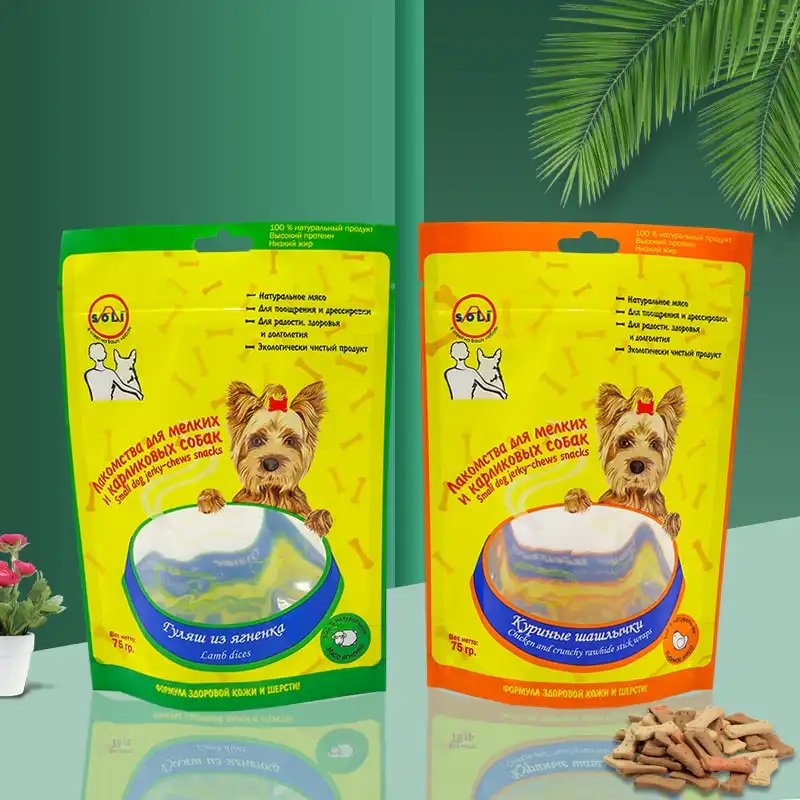
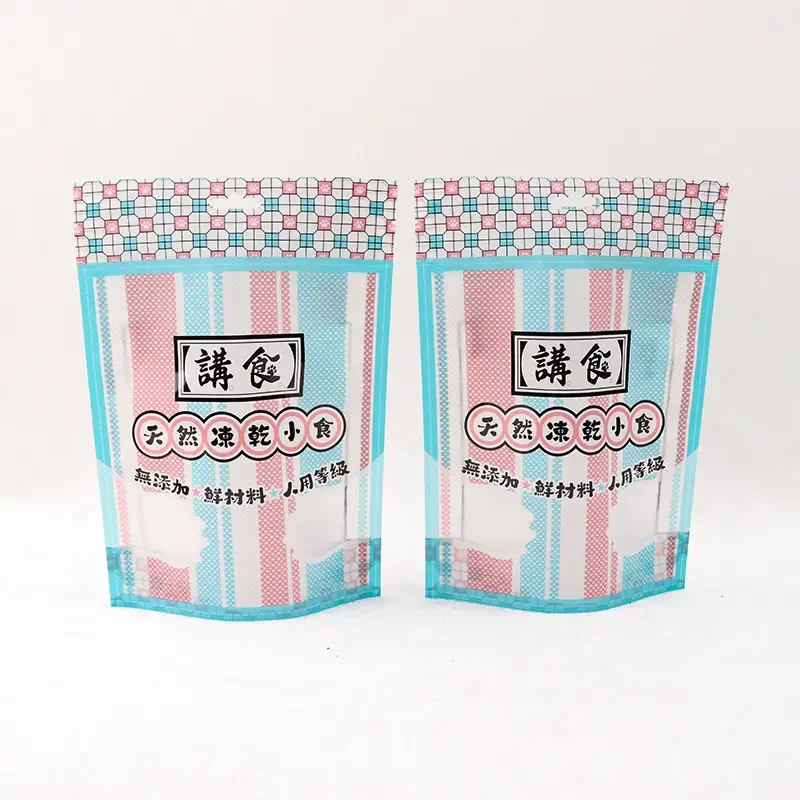
Short answer: for most brands scaling up right now, the seven formats worth shortlisting are the resealable stand-up pouch, the flat-bottom (box) pouch, the quad-seal bag, mono-material recyclable PE structures, kraft paper composites, high-barrier vacuum pouches for raw and fresh, and single-serve sachets or spouted pouches for wet food and toppers. If you're evaluating the best packaging for pet food brands 2025 shortlists were built around, the honest answer is that format follows formula: fat content, fill weight, and where the bag ends up (shelf, subscription box, freezer) decide the winner far more than aesthetics do.
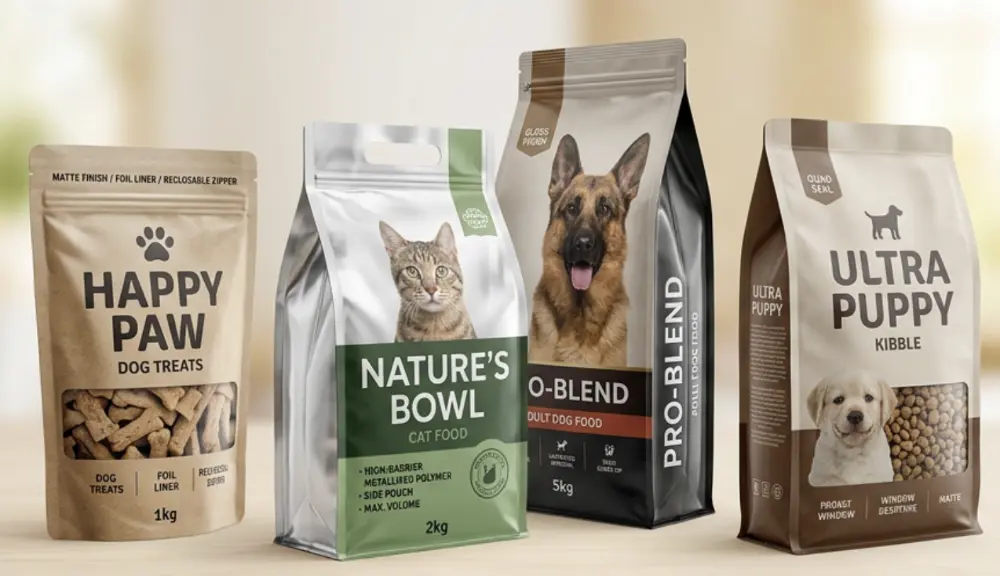
The Seven Formats at a Glance
We've run production for kibble, freeze-dried raw, dental chews, and wet toppers, and these seven cover roughly 95% of what brands actually order. Here's how they compare before we get into the details.
| Format | Typical Fill Weight | Barrier Ceiling (OTR, cc/m²/day) | Shelf Presence | Common Fit |
|---|---|---|---|---|
| Stand-up pouch (doypack) | 0.5 – 5 lb | <1 with metallized layer | Good | Treats, trial sizes, freeze-dried |
| Flat-bottom / box pouch | 2 – 15 lb | <1 | Excellent — 5 printable panels | Premium kibble, retail shelf |
| Quad-seal bag | 10 – 40 lb | 1 – 3 | Moderate | Bulk kibble, feed store channel |
| Mono-material PE (recyclable) | 1 – 25 lb | 1 – 5 with EVOH or coating | Good | Brands with store drop-off claims |
| Kraft paper composite | 0.5 – 8 lb | 0.5 – 2 (with inner liner) | Strong "natural" cue | Small-batch, boutique, grain-free |
| High-barrier vacuum pouch | 0.25 – 5 lb | <0.5 | Functional | Raw, gently cooked, frozen |
| Sachet / spouted pouch | 0.5 – 12 oz | <0.1 with foil | High — sampling driver | Wet food, broths, toppers |
Why the Format Conversation Changed
Three forces reshaped this category, and none of them are about looks.
First, premiumization. American pet owners spent an estimated $152 billion on their animals in 2024 according to APPA data, and the fastest growth sat in fresh, frozen, and freeze-dried — categories that need better barrier than a paper sack can give.
Second, regulation. Extended producer responsibility laws in California, Colorado, Oregon, Maine, and Minnesota put fee schedules on packaging weight and recyclability. Multi-layer laminates that used to be invisible on a P&L now carry a line item.
Third, the ingredient-transparency shift. Pet owners read pet food panels the way they read their own cereal boxes. That's why window patches, QR-linked sourcing pages, and "no fillers" callouts moved from nice-to-have to expected — and why panel real estate now drives format selection.
1. Resealable Stand-Up Pouches
The workhorse. Low tooling burden, stands on shelf, and a press-to-close zipper or slider keeps kibble from going stale after day three. Freshness complaints in reviews are almost always a closure problem, not a formula problem.
Where it wins: treats, freeze-dried nuggets, 1–3 lb trial sizes, and subscription boxes. Where it struggles: anything over about 5 lb, where the bottom gusset starts to bulge and the bag tips.
If you're sourcing eco-friendly pet food pouches with resealable features, be specific about the zipper type. A standard PE zipper often isn't recycle-stream compatible with a PET-based laminate, which quietly kills the recyclability claim you paid for.
Closure Options Compared
| Closure | Reseal Cycles | Added Cost Impact | Notes |
|---|---|---|---|
| Press-to-close zipper | 50+ | Low | Most common; specify 8mm+ profile for kibble dust |
| Slider zipper | 100+ | Moderate | Better for arthritic hands — a real selling point for senior-dog lines |
| Tin tie | 20 – 30 | Low | Pairs with kraft; not airtight |
| Velcro-style closure | 200+ | Moderate | Strong for large-format bags |
| Degassing valve + zipper | 50+ | Moderate | Useful for freshly extruded or fermented formulas |
2. Flat-Bottom Box Pouches
If your bag has to compete on a retail shelf, this is usually the answer. Five printable panels, a rigid rectangular footprint, and it stacks without slumping. Brands moving from a gusseted pouch to a box pouch typically gain 30–40% more usable front-panel area at the same fill weight.
The practical benefit is merchandising: a box pouch faces forward at full height instead of leaning, so your ingredient callouts stay readable at eye level. For grain-free and limited-ingredient lines where the panel does the selling, that matters.
Our in-house design team spends a lot of time here — dielines for box pouches are unforgiving, and a 3mm error in the side gusset shows up as a crooked seam across the whole run. YLTPACK holds side-gusset registration tolerance to ±1mm on box pouch runs, which is the difference between a clean shelf face and a batch you argue about.
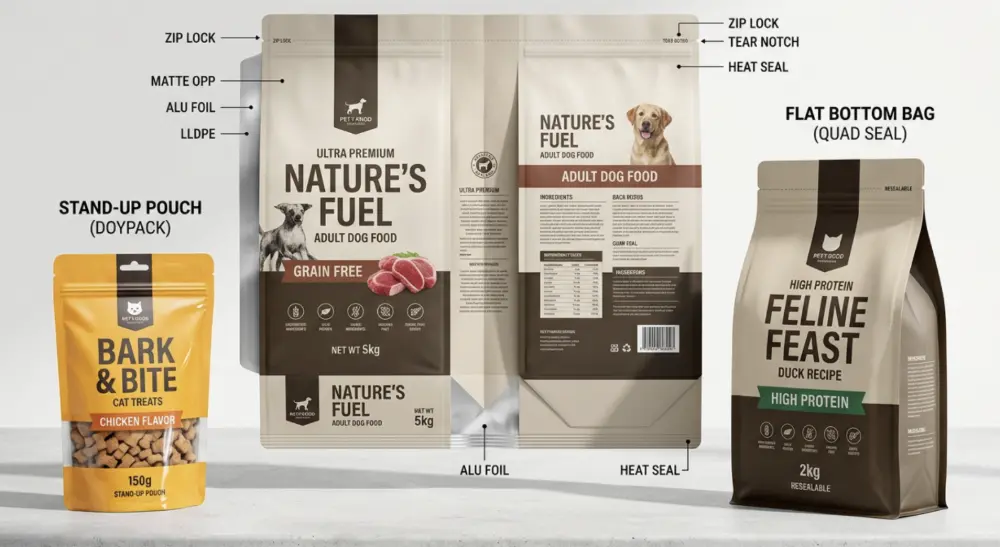
3. Quad-Seal Bags for Bulk Kibble
Above 15 lb, physics takes over. Quad-seal construction distributes weight across four vertical seals instead of two, which is why it dominates the 20–40 lb feed-store segment.
What to test before committing:
- Drop test: 4-foot flat drop and corner drop, filled to spec, on the actual formula — dense kibble behaves differently than airy extrudate
- Stack test: minimum 6-high pallet load for 72 hours; watch for seal creep at the bottom layer
- Handle placement: punch handles fail on wet floors; a laminated carry handle holds up better
- Puncture resistance: kibble edges abrade the inner layer during transit vibration
Because we hold ISO 22000 certification, we run these tests on the food-contact structure rather than a generic film sample — the results differ more than most buyers expect.
4. Mono-Material Recyclable Structures
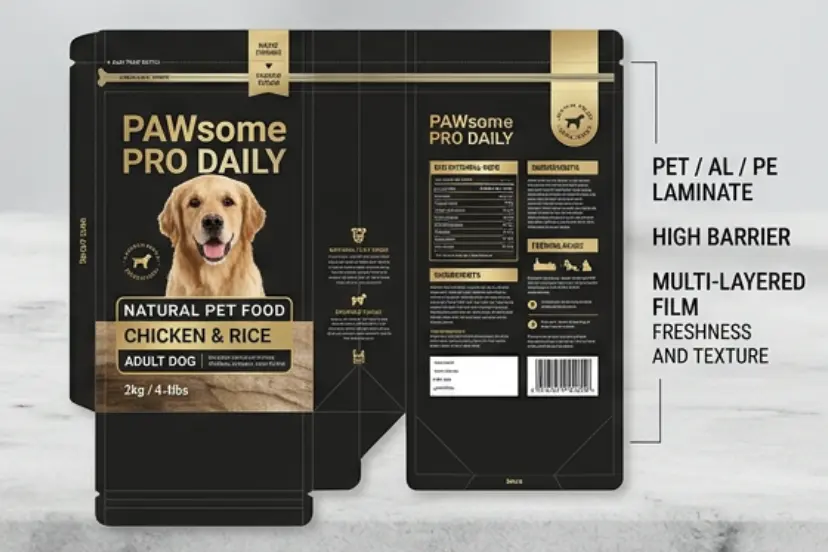
This is where the compliance pressure landed. Traditional pet food bags use PET/AL/PE or PET/MET-PET/PE — great barrier, no recycling stream. Mono-material PE swaps every layer to the same polymer family so the bag can enter store drop-off collection.
The honest tradeoff is barrier. Here's what the numbers actually look like.
| Structure | OTR (cc/m²/day) | WVTR (g/m²/day) | Realistic Shelf Life | Recycle Stream |
|---|---|---|---|---|
| PET / AL foil / PE | <0.1 | <0.1 | 24 months | None |
| PET / MET-PET / PE | 0.5 – 1.5 | 0.3 – 0.6 | 18 months | None |
| Mono-PE with EVOH | 1 – 3 | 1 – 2 | 12 – 15 months | Store drop-off |
| Mono-PE with barrier coating | 3 – 5 | 2 – 4 | 9 – 12 months | Store drop-off |
| Kraft / PLA / metallized liner | 0.5 – 2 | 0.5 – 1.5 | 12 – 18 months | Partial / varies |
Recyclable mono-material packaging for dog food brands works cleanly when your inventory turns in under nine months and your fat content sits below roughly 18%. Above that, oxidation risk climbs and rancidity complaints follow. A 22% fat puppy formula in a 4 OTR bag sitting in a warm warehouse for a year is a recall waiting to happen.
5. Kraft Paper Composites
Kraft signals "real food" faster than any printed claim, which is why boutique and fresh-adjacent brands keep coming back to it. The construction is usually kraft outer, barrier middle, food-grade inner.
Two things to know. Kraft scuffs — dark inks show white creasing after transit, so keep artwork light or add a matte varnish. And kraft absorbs moisture, so warehouse humidity above roughly 65% RH will soften the bag over time.
On biodegradable pet food bags for premium brands: certified compostable films exist and they perform, but industrial composting access in the U.S. covers a minority of households. We'd rather tell a brand that upfront than let them print a claim their customers can't act on. Recyclable-with-drop-off is usually the more defensible position today.
6. High-Barrier Vacuum Pouches for Raw and Fresh
Raw and gently cooked is the fastest-moving corner of the category, and it's the least forgiving on packaging. You're dealing with freezer temperatures, high moisture, sharp bone fragments, and often high-pressure processing.
Requirements that are non-negotiable here:
- Cold-crack resistance down to -20°F without seal fracture
- Puncture resistance for bone-in and raw meaty pieces
- HPP compatibility if you're pressure-treating — many standard laminates delaminate at 87,000 psi
- Seal integrity under vacuum, verified by dye penetration testing
Flexible packaging designs for fresh pet food 2025 launches leaned on tend to combine a vacuum-formed pouch with a printed sleeve, so the brand gets full-color graphics without printing directly onto a film that has to survive freeze-thaw cycles.
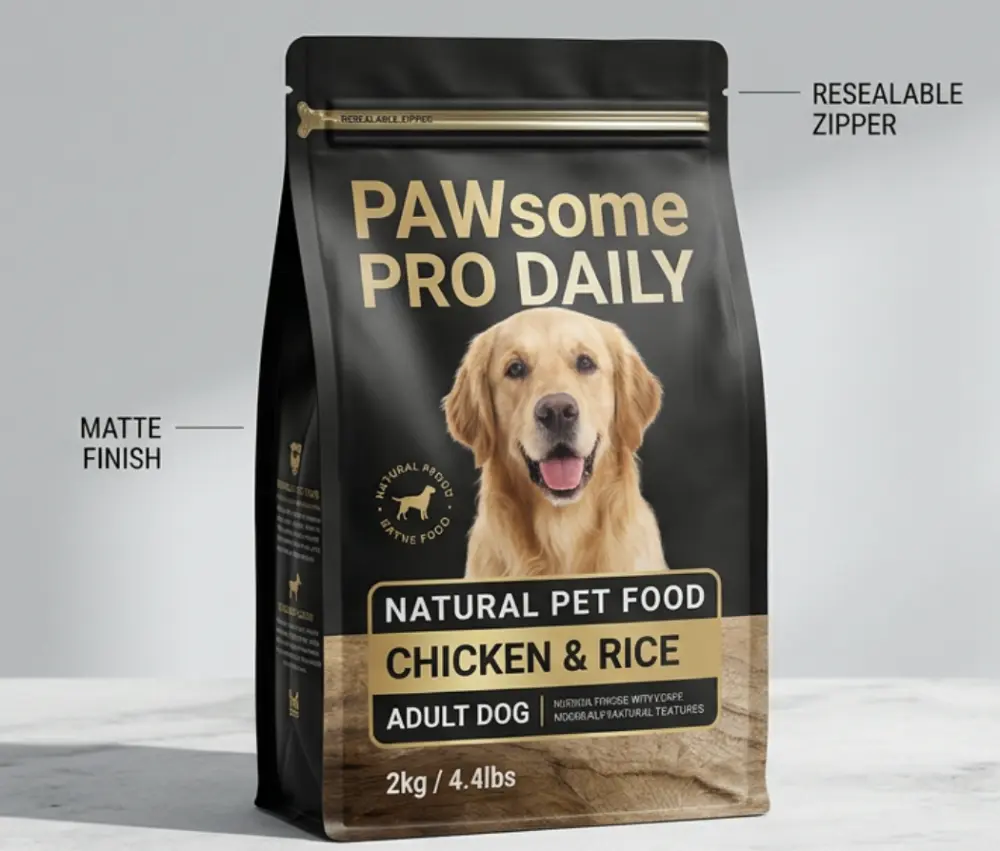
7. Sachets and Spouted Pouches
Single-serve is your cheapest acquisition tool. A 1.5 oz topper sachet gets a skeptical owner to try your formula without committing to a bag, and retort-capable sachets hold 18–24 months shelf stable without refrigeration.
Spouted pouches handle broths, goat milk, and pourable toppers. Watch spout diameter — anything under 8mm clogs with pumpkin or fiber-heavy blends, and that generates returns.
Matching Material to Formula: The Practical Table
This is the decision most brands get wrong. Fat content and moisture are the two variables that break bags.
| Product Type | Fat Content | Moisture | Minimum Barrier Needed | Recommended Format |
|---|---|---|---|---|
| Standard dry kibble | 10 – 16% | 8 – 10% | OTR <3 | Mono-PE or quad-seal |
| Premium high-fat kibble | 18 – 25% | 6 – 9% | OTR <1 | Box pouch, metallized |
| Freeze-dried raw | 20 – 35% | <3% | OTR <0.5, WVTR <0.5 | Foil stand-up pouch |
| Semi-moist treats | 8 – 15% | 15 – 25% | WVTR <1 | High-barrier pouch |
| Frozen raw | 15 – 30% | 65 – 75% | Cold-crack rated | Vacuum pouch |
| Wet food / topper | 3 – 8% | 75 – 82% | Retort-rated foil | Sachet or spouted pouch |
Sustainable pet food packaging solutions 2025 buyers gravitated toward mostly failed or succeeded on this table alone. A recyclable structure that can't protect a 30% fat freeze-dried formula isn't sustainable — it's a bag of spoiled product.
What Pet Owners Actually Look For on the Bag
Working with brands across North America, we've noticed the same pattern in customer feedback: buyers scan for four things in under six seconds.
- Protein source, first and specific. "Deboned chicken" outperforms "chicken meal" every time
- What's absent. No corn, no by-product meal, no artificial preservatives
- A window, or a very good reason there isn't one. Seeing the kibble builds trust — though windows cut barrier performance, so a small oval beats a full panel
- Feeding guidance they can find without turning the bag over
Design implication: reserve the top third of your front panel for the protein claim, and don't let a certification badge cluster eat the space where the differentiator should live.
Your Pre-Quote Spec Checklist
Suppliers can only quote accurately against real numbers. Bring these:
- Fill weight per SKU and product bulk density (lb/ft³)
- Fat and moisture percentages from your guaranteed analysis
- Target shelf life in months, and your storage conditions
- Filling method — hand-fill, auger, vertical form-fill-seal, or pre-made pouch
- Distribution path: retail shelf, direct ship, or both
- Any recyclability or compliance claim you plan to print
- Annual volume estimate, even if it's a range
- Whether you have print-ready artwork or a rough concept
The most common gap we see is item 4. A pouch designed for hand-filling will jam a form-fill-seal line, and that discovery usually happens after the film is printed.
Where We Fit
YLTPACK has manufactured flexible packaging since 2005, and pet food is one of the categories we know best — partly because it punishes shortcuts. Our food-contact structures are produced under ISO 22000 and FDA-compliant material standards, which matters when your buyer's QA team asks for documentation.
The short version of what working with us looks like in numbers:
| Capability | YLTPACK Standard |
|---|---|
| Years in flexible packaging | Since 2005 (20 years) |
| Minimum order quantity | 3,000 – 5,000 pcs per SKU |
| Quote turnaround | Within 2 business days |
| Digital proof / dieline | 24 – 48 hours |
| Plate-to-delivery lead time | 15 – 25 days |
| Print capability | Up to 10-color rotogravure, ±1mm registration |
| Barrier range available | OTR <0.1 to 5 cc/m²/day |
| Certifications | ISO 22000, FDA-compliant food-contact materials |
| Free samples | 2 – 3 candidate structures per inquiry |
Practical next step: send your fill weight, fat percentage, and target shelf life to [email protected] or message us on WhatsApp at +86 182 1944 5665, and ask for free samples in two or three candidate structures. Fill them with your actual product and store them for 60 days. That test tells you more than any spec sheet, and it costs you nothing but time.
Our design team also works with brands who show up with a sketch and a color idea rather than a finished dieline — that's a normal starting point, not a problem.
The Bottom Line
There is no single winner. Box pouches own premium retail. Quad-seal owns bulk. Mono-PE is the right call when turnover is fast and fat is moderate. Vacuum pouches are mandatory for raw. Sachets buy you trial.
Pick your format from the formula outward, verify barrier against your real shelf life, and test with your actual product before you commit to a print run.
Frequently Asked Questions
What type of pouch keeps kibble freshest for subscription boxes?
A metallized stand-up pouch with an 8mm or wider press-to-close zipper usually performs best. The metallized layer holds oxygen transmission below 1 cc/m²/day, and the wider zipper profile seals reliably even when kibble dust settles in the tracks. For formulas above 18% fat, request OTR testing documentation before committing to a structure — oxidation is the leading cause of rancidity complaints in subscription models where bags sit in a pantry for weeks after opening.
Can I print "recyclable" on my bag if it's mono-material PE?
In most cases, yes — but specify "recyclable at participating store drop-off locations" rather than curbside, because PE film recycling infrastructure varies by municipality. The How2Recycle label system offers pre-approved language that keeps you compliant across states. Avoid printing a blanket "recyclable" claim without the qualifier, especially if you distribute in California, Colorado, or Oregon where EPR regulations enforce accuracy.
How much does a custom printed pet food pouch cost per unit?
Pricing depends on six variables: structure complexity, barrier requirements, pouch size, closure type, print colors, and order volume. A simple 1 lb stand-up pouch with two-color flexographic printing might run one range at 10,000 units, while a five-color rotogravure box pouch with a slider zipper and window costs considerably more per piece but justifies itself at higher volume. We quote based on your actual specs rather than offer generic pricing, because a mismatch on barrier or closure usually costs more to fix than it saves upfront. Email your fill weight, fat percentage, and annual volume estimate to [email protected] — or send it over WhatsApp at +86 182 1944 5665 — and we'll return a bracket within two business days.
What's the minimum order quantity for custom pouches?
Most flexible packaging manufacturers set MOQs between 5,000 and 10,000 pieces per SKU, driven by printing plate costs and material roll minimums. At YLTPACK, we've structured production to accommodate smaller initial runs for new brands testing formulas or entering a new channel — typical floor is 3,000 to 5,000 units depending on structure complexity. If you're launching and uncertain about velocity, consider starting with a stock pouch and a label rather than full custom printing; it costs more per unit but eliminates the risk of 8,000 obsolete bags when you reformulate three months in.
Do I need a different bag structure for frozen raw versus freeze-dried?
Yes, and the difference matters. Frozen raw requires cold-crack resistance, puncture toughness for bone fragments, and seal integrity under vacuum — typically a seven-layer coextruded structure rated to -20°F. Freeze-dried, by contrast, is low-moisture and fragile, so the priority shifts to oxygen and moisture barrier to prevent rehydration and oxidation; a metallized or foil laminate with a gentle inner sealant works well. Freeze-dried also benefits from a degassing valve if you're packaging within 48 hours of processing, because residual moisture outgasses and can cause the pouch to pillow. Using a frozen-raw structure for freeze-dried over-engineers the bag and adds cost you don't need; using a freeze-dried structure for frozen raw fails in the freezer.