Here's the short version: for most dried fruit, you want a high-barrier laminated stand-up pouch with a resealable zipper, built on a metallized or foil-based structure that keeps water vapor transmission under roughly 0.5 g/m²/day. That single choice protects texture, color, and aroma far more than anything else you'll do. Everything else in this dried fruit packaging guide — bag format, closure style, label compliance, sustainability swaps — is refinement on top of that foundation.
Now let's unpack why, because the difference between a mango slice that stays chewy for 12 months and one that turns into a sugar-crusted brick at month four is usually one layer of film.
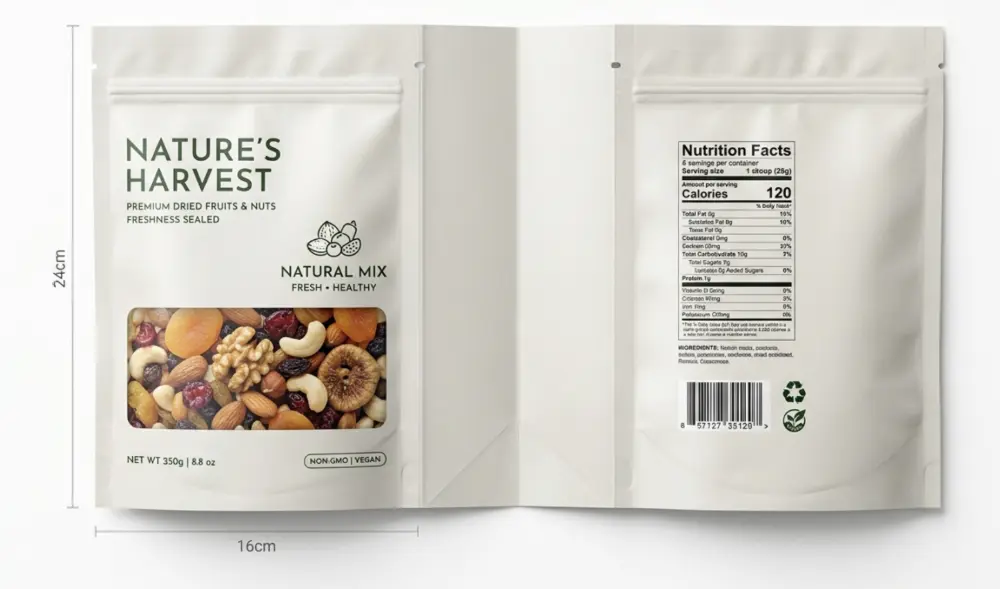
What Actually Ruins Dried Fruit (And What Your Bag Has to Block)
Dried fruit sits in an awkward middle zone. It's not shelf-stable like a cracker, and it's not refrigerated like fresh produce. Its stability depends on holding water activity (aw) in a narrow band — typically 0.60 to 0.65.
Drop below that and the fruit hardens. Climb above it and you invite mold, yeast, and clumping. Your bag's entire job is holding that line.
| Threat | What It Does to the Product | Packaging Response |
|---|---|---|
| Moisture gain | Mold, clumping, surface stickiness, aw creep above 0.65 | Low WVTR film (metallized, foil, or EVOH) |
| Moisture loss | Hardening, brittle texture, weight shortfall vs. net weight claim | Same barrier — it works both directions |
| Oxygen | Color browning, vitamin C loss, rancidity in oil-coated fruit | OTR below 1 cc/m²/day + optional nitrogen flush |
| Light (UV) | Pigment fade in cranberries, cherries, goji berries | Opaque or metallized layer; limit window size |
| Physical damage | Punctures from banana chips, apple slices, date pits | Higher-gauge sealant layer (100–120 micron PE) |
Notice that moisture appears twice. Brands often obsess over keeping moisture out and forget that a leaky bag also lets it escape. A 200g pouch of apricots that loses 3% weight over a year is both a quality problem and a net-weight compliance problem.
Sugar Bloom: The Complaint You'll Hear Most
That white powdery film on dates and prunes? It's usually crystallized fructose or glucose migrating to the surface, triggered by temperature swings and moisture cycling. It's harmless, but customers return product over it constantly.
Working with fruit brands across North America and Europe, we've found the fix is rarely the recipe — it's tightening the barrier so the internal humidity stops cycling. A structure change often eliminates the complaint entirely.
Choosing Your Film Structure: The Decision That Sets Shelf Life
This is where the real money and the real shelf life live. When brands ask about the best packaging materials for dried fruit shelf life, the honest answer is: it depends on your target duration, your distribution climate, and whether you need a window.
Below are the structures we produce most often for fruit, with typical performance figures measured at 23°C / 50% RH.
| Structure | WVTR (g/m²/24h) | OTR (cc/m²/24h) | Typical Shelf Life | Best Fit |
|---|---|---|---|---|
| PET / PE (clear) | 5.0 – 8.0 | 50 – 110 | 3 – 6 months | Fast-turn bulk, foodservice, low-sugar chips |
| PET / MPET / PE | 0.3 – 0.8 | 0.5 – 1.5 | 10 – 14 months | Retail mainstream — raisins, cranberries, mango |
| Kraft / PET / VMPET / PE | 0.3 – 0.8 | 0.5 – 1.5 | 10 – 14 months | Natural-look brands wanting real barrier |
| PET / AL / PE (foil) | < 0.1 | < 0.1 | 18 – 24 months | Export, hot-humid markets, sulfite-free apricots |
| MDO-PE / EVOH / PE (recyclable) | 1.5 – 4.0 | 1.0 – 3.0 | 8 – 12 months | Brands with store drop-off recycling goals |
| Kraft / PLA / cellulose (compostable) | 8.0 – 15.0 | 10 – 30 | 3 – 5 months | Short supply chains, local retail, small formats |
A pattern worth noting: the jump from clear PET/PE to metallized costs relatively little per bag but roughly triples usable shelf life. If you're deciding where to spend, spend here first.
When Foil Is Worth It — And When It Isn't
Foil laminates are the reference standard, but they're not automatic. Consider them when:
- Product ships through or sells in humid climates (Gulf states, Southeast Asia, coastal Latin America)
- You've removed sulfites, which strips out a chemical safety net for color and microbial stability
- Ocean freight adds 6–10 weeks before the product even reaches a shelf
- The fruit is oil-coated or yogurt-covered, where rancidity is the limiting factor
Skip foil when your product turns in under six months domestically, or when a metallized structure already hits your target with margin to spare. Because we hold FDA and ISO 22000 certifications, we're required to document barrier claims — so we'd rather run a real shelf-life test than sell you an over-specified film you don't need.
The Window Trade-Off
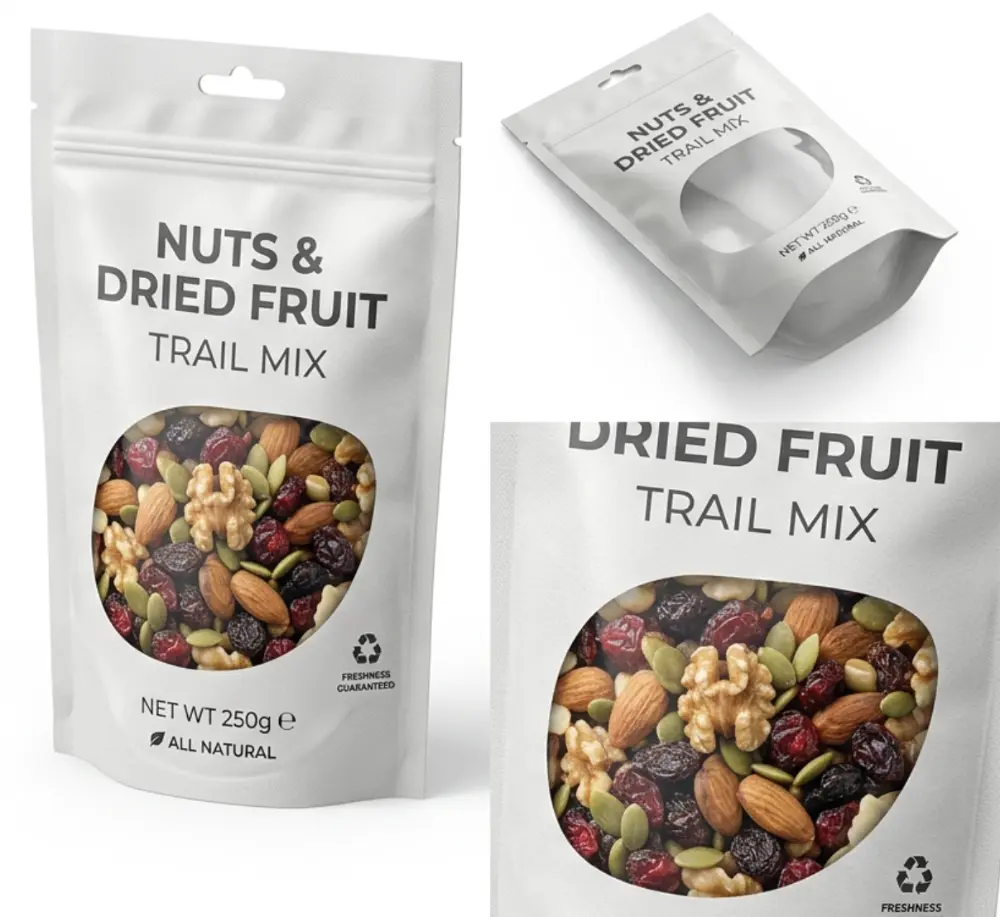
Shoppers want to see fruit. Windows sell. But every square centimeter of clear PET is a hole in your barrier and a UV entry point.
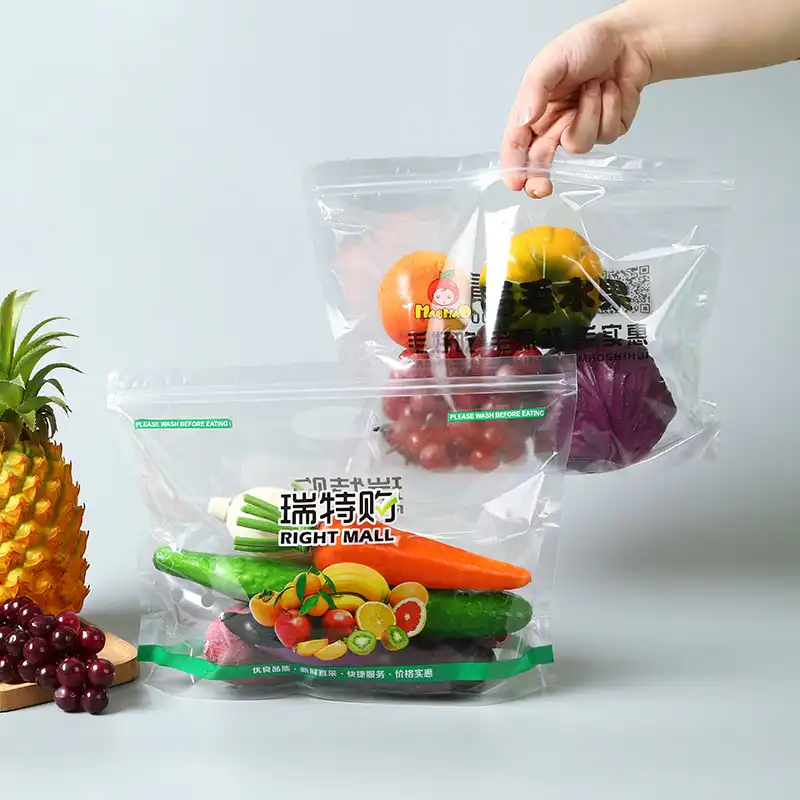
Our practical rule: keep transparent area under 15% of the front panel, position it low on the pouch where product settles, and avoid windows entirely for pigment-sensitive fruit like tart cherries or goji berries. A narrow vertical strip window performs better than a large oval — same visual payoff, a fraction of the exposure.
Understanding Barrier Numbers Without an Engineering Degree
Suppliers throw WVTR and OTR figures around freely. Here's how to read them like a buyer, not a chemist.
WVTR (water vapor transmission rate) measures moisture passing through the film. Lower is better. OTR (oxygen transmission rate) measures oxygen ingress. Also lower is better.
But the numbers on a spec sheet describe flat film. Your finished bag has seals, a zipper track, and a bottom gusset — real-world performance is always worse. That's why proper moisture barrier bags for dried fruit storage should be evaluated as finished pouches, not as laminate rolls.
| Target Shelf Life | Finished-Pouch WVTR Target | Finished-Pouch OTR Target | Recommended Base |
|---|---|---|---|
| 6 months | < 2.0 | < 10 | Metallized or EVOH |
| 12 months | < 0.8 | < 2.0 | Metallized, double-metallized |
| 18–24 months | < 0.2 | < 0.5 | Aluminum foil laminate |
Ask any supplier for accelerated shelf-life data at 38°C / 90% RH, not just ambient figures. Twelve weeks under those conditions approximates roughly a year of normal retail life — a far more useful test than a room-temperature promise.
Bag Formats: Matching Shape to How Your Product Sells
Format affects shelf presence, filling speed, and shipping cost more than most brands expect. Here's how the common options compare.
| Format | Practical Fill Range | Shelf Presence | Notes |
|---|---|---|---|
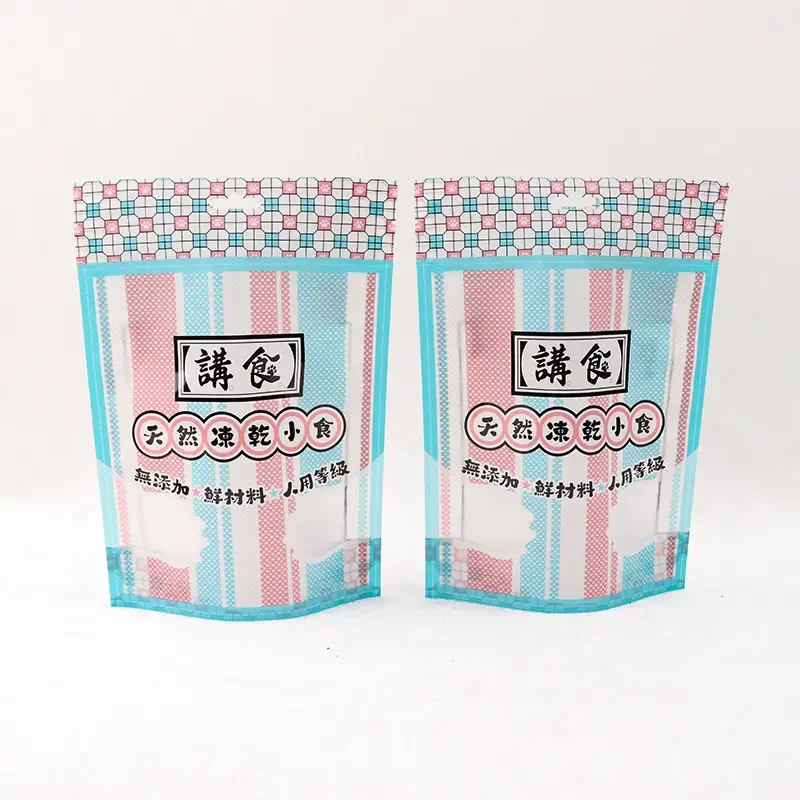
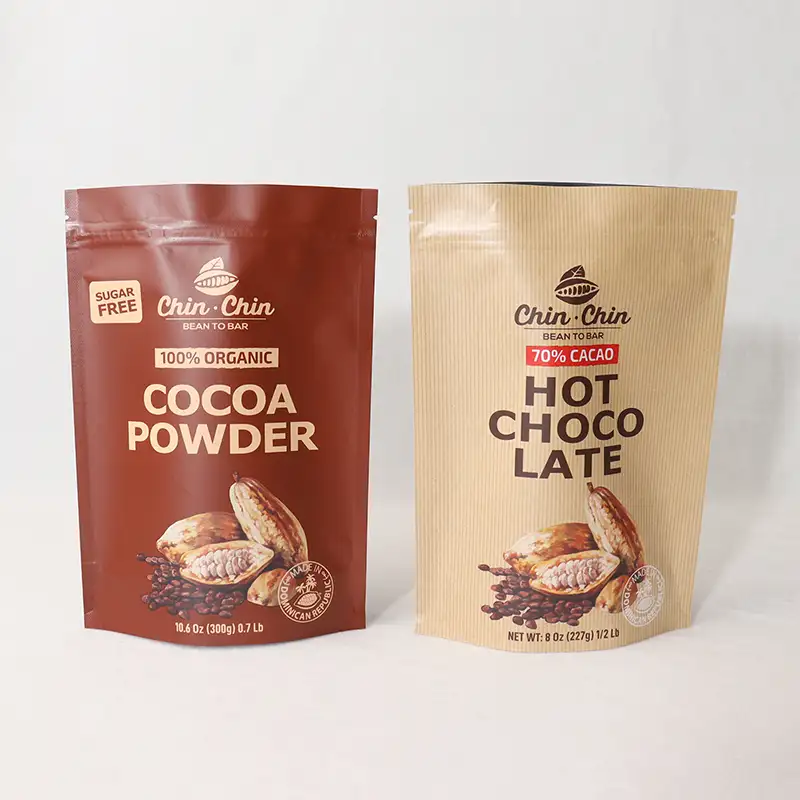
| Stand-up pouch (doypack) | 50g – 1kg | Strong | The default for retail fruit; wide zipper compatibility |
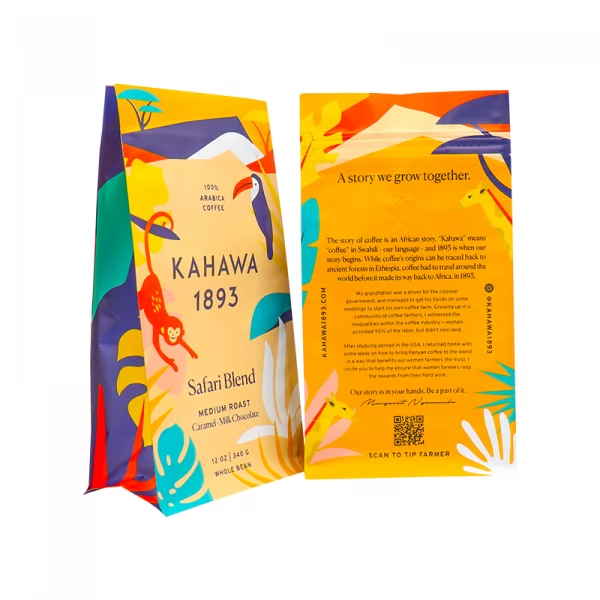
| Flat-bottom (box pouch) | 150g – 2kg | Strongest | Five printable panels, stacks well, premium feel |
| 3-side seal sachet | 15g – 60g | Moderate | Snack packs, sampling, lunchbox multipacks |
| Side-gusset bag | 500g – 5kg | Low | Bulk, foodservice, wholesale club channels |
| Roll stock (film reels) | Any (VFFS) | N/A | Lowest cost per unit at high volume; needs a filling line |
A Note on Fruit-Specific Fill Behavior
Dried fruit doesn't settle like nuts or granola. Sticky pieces bridge and cling to the pouch walls, leaving a half-empty appearance even at correct net weight.
Two fixes work well: size the pouch tighter to actual fill volume (aim for 80–85% fill), and specify a slightly higher-slip sealant layer so product releases from the film. Anti-block additives in the inner PE help significantly with dates, figs, and honey-coated pieces.
Closures: What Customers Actually Touch
Dried fruit is a multi-serving product. Roughly speaking, if a shopper can't reclose the bag, they won't buy it twice. Resealability is not a luxury feature here — it's table stakes.
| Closure Type | Reseal Quality | Cost Impact | Best Application |
|---|---|---|---|
| Press-to-close zipper | Good | Low | Standard 100g–500g retail pouches |
| Pocket / hooded zipper | Good, cleaner reseal | Low–Medium | Sticky fruit where debris blocks the track |
| Slider zipper | Very good | Medium | Larger 500g+ family packs, club stores |
| Child-resistant zipper | Very good | Medium–High | Functional or infused fruit products |
| Tin-tie | Fair | Low | Kraft-look artisan bags, short shelf life |
| Laser tear notch + no zipper | None | Lowest | Single-serve sachets under 40g |
For sticky products, the pocket zipper is genuinely worth the small upcharge. It shields the track from fruit particles, which is the number one cause of "my bag won't close anymore" reviews.
When brands ask about resealable pouch options for dried fruit small business launches, we usually suggest starting with a press-to-close zipper on a metallized stand-up pouch, then upgrading formats once volume justifies tooling. Our in-house design team frequently helps founders who arrive with a rough sketch and a product photo — you don't need print-ready files to start the conversation.
Don't Forget the Tamper Evidence
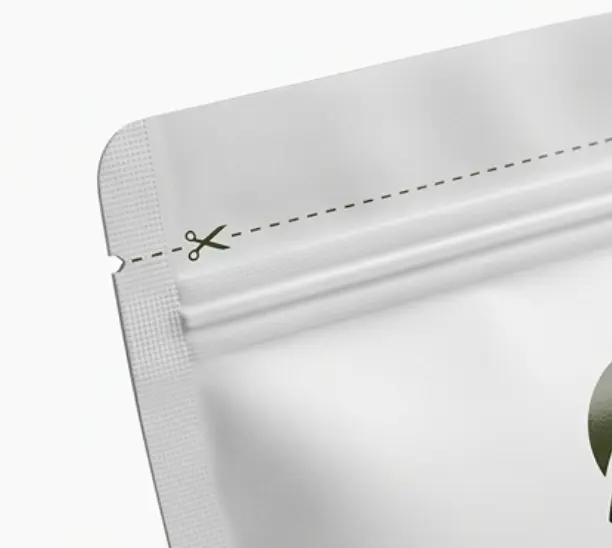
Retail buyers increasingly ask for it. A tear-notch above the zipper, a laser-scored top strip, or a full hermetic seal above the closure all work. It costs little and removes a common objection during retail listing reviews.
Getting Retail-Ready: What Buyers Look For
Figuring out how to package dried fruit for retail sale means thinking past the bag itself and into the shelf, the planogram, and the back room.
Size Your SKUs to the Channel
- Grocery mainstream: 150g–250g stand-up pouches at eye level
- Natural / specialty: 100g–200g, premium finish, often kraft or matte
- Club and warehouse: 800g–1.5kg flat-bottom bags with slider zippers
- Convenience and impulse: 30g–50g sachets on clip strips
- Online direct: Add a shipper-friendly outer; pouches alone tear in transit
Physical Details That Get Products Rejected
Euro slot or round hang hole placement must match fixture spacing. Bag height must clear shelf gaps. Bottom gusset width determines whether the pouch stands after handling — 30mm to 40mm is a safe range for a 200g fruit pouch.
We also recommend confirming that your printed barcode zone stays flat. A UPC printed across a gusset fold fails scanning, and that's a conversation with a retailer nobody enjoys.
Finish Choices That Signal Quality
Matte lamination with spot gloss on the fruit imagery is currently the most-requested combination in the premium snack category. Soft-touch finishes photograph beautifully but scuff during transit — if your product travels far, a matte BOPP with a scuff-resistant overprint varnish holds up better.
Labeling and Compliance: The Part That Delays Launches
More product launches slip on artwork compliance than on production. Understanding dried fruit packaging requirements and labeling regulations early saves weeks of reprints.
United States (FDA)
- Statement of identity and net quantity on the principal display panel
- Nutrition Facts in the current format, with added sugars declared — critical for sweetened cranberries and mango
- Ingredient list in descending order by weight
- Sulfite declaration required at 10 ppm or above ("Contains sulfites") — extremely common in apricots, golden raisins, and pineapple
- Allergen statement where shared lines handle tree nuts or peanuts
- Name and address of the manufacturer, packer, or distributor
- Country of origin marking for imported product
European Union (Regulation 1169/2011)
- Minimum 1.2mm x-height for mandatory text on packs with surface area above 80 cm²
- Allergens emphasized in the ingredient list through bold or contrasting type
- Energy and nutrient declaration per 100g
- Sulphur dioxide and sulphites declared above 10 mg/kg
- Quantitative ingredient declaration (QUID) where a fruit is named or pictured
Practical Artwork Advice
Leave a clean, unprinted area for date coding and lot numbers — ideally a light-colored panel on the back, at least 40mm x 15mm. Thermal transfer and inkjet coders struggle on dark, glossy, or heavily textured surfaces.
Recycling claims deserve special care. Don't print a "recyclable" symbol on a metallized laminate; that claim has drawn regulatory attention in both the US and EU. If sustainability messaging matters to you, build the structure to match the claim first.
Sustainable Options Without Wrecking Shelf Life
This is the most common tension we help brands navigate. Sustainable materials and long shelf life pull in opposite directions, and dried fruit sits right in the middle of that tug-of-war.
| Option | Shelf Life Impact | End-of-Life Reality | Honest Assessment |
|---|---|---|---|
| Mono-material PE with EVOH | Reduces by ~15–25% | Store drop-off in US, expanding EU streams | The most practical current path |
| Mono-material PP | Reduces by ~20–30% | Improving but limited collection | Good clarity, decent stiffness |
| PCR content (30% in outer layers) | Minimal | Same as base structure | Easy win; food-contact layer stays virgin |
| Compostable (PLA/cellulose) | Reduces by 50%+ | Industrial facility only in most regions | Works for short supply chains only |
| Paper-based with barrier coating | Reduces by 40–60% | Kerbside paper streams in some markets | Great tactile appeal, weak against humidity |
Our usual recommendation: start with recycled content in the outer print layer and a right-sized pouch. Downgauging film and trimming 10mm of headspace often cuts material use more than switching to an exotic substrate — without gambling on shelf life.
We hold GRS certification for recycled-content materials, which means the recycled percentage in your structure is traceable rather than assumed. That documentation matters when a retailer audits your sustainability claim.
Working With a Supplier: A Practical Checklist
Whether you produce 5,000 pouches or 500,000, the same questions separate a smooth launch from a costly reprint. Bring this list to every conversation.
Before You Request a Quote
- Product weight, density, and whether pieces are sticky or oil-coated
- Target shelf life and the climate your product will travel through
- Fill method — hand-fill, semi-auto, or an existing automated line (and its bag width limits)
- Selling channel and required SKU sizes
- Whether you need a window, and how much of one
- Sustainability commitments you've already published
Questions Worth Asking Any Manufacturer
- Can you share finished-pouch WVTR and OTR data, not just film specs?
- What food-safety certifications cover the production environment?
- Is printing done in-house, and what's the color tolerance (ΔE) you guarantee?
- What's the realistic lead time from artwork approval to shipment?
- Will you produce a physical pre-production sample before the full run?
That last one is non-negotiable. Screen proofs lie about color on metallized film — silver substrates shift warm tones noticeably, and a coral-colored mango illustration can print orange.
Where Production Environment Matters
Dried fruit is a ready-to-eat food, so the bag interior is a direct food-contact surface. In our 6,800㎡ cleanroom facility, laminating and slitting happen in a controlled-particulate environment, which is the practical reason FDA and ISO 22000 audits go smoothly rather than becoming a scramble.
As a manufacturer running our own presses for over 20 years, we'd also flag a subtle risk: solvent retention. Poorly cured laminates transfer off-odors into fruit, and dried fruit absorbs aromas readily. Ask about residual solvent testing — it's a question few buyers think to ask and a defect that's nearly impossible to fix after filling.
Common Mistakes We See (And How to Avoid Them)
| Mistake | What It Costs | Fix |
|---|---|---|
| Choosing clear film for a 12-month product | Hardening and browning by month five | Metallized base with a small window |
| Oversized pouch for the fill weight | "Slack fill" complaints, wasted material | Size to 80–85% volumetric fill |
| Standard zipper on sticky fruit | Reseal failure, negative reviews | Pocket or hooded zipper |
| No date-code panel in artwork | Illegible coding, rework at the co-packer | Reserve a light matte area on the back |
| Recyclable claim on foil laminate | Regulatory exposure, retailer pushback | Match structure to claim before printing |
| Skipping accelerated shelf-life testing | Recalls or shortened best-before dates | 12 weeks at 38°C / 90% RH before launch |
Putting It All Together
If you remember three things from all of this, make them these:
- Barrier first. Choose your film structure around target shelf life and destination climate — everything else is secondary.
- Reseal properly. Dried fruit is eaten over days or weeks; a closure that fails on the third opening quietly kills repeat purchase.
- Validate before you scale. One physical sample and one accelerated shelf-life test cost less than a rejected production run.
Get those right and the rest — finish, window shape, hang hole placement — becomes a design conversation rather than a risk.
If you'd like a structure recommendation based on your specific fruit, target markets, and fill equipment, YLTPACK's design and technical team is happy to work through it with you. Reach us on WhatsApp at +86 182 1944 5665 or by email at [email protected] — sharing your product details and shelf-life target is usually enough for us to propose two or three viable structures with real barrier data attached.
Frequently Asked Questions
How long can dried fruit stay fresh in a high-barrier pouch?
With a metallized laminate and a properly sealed zipper, most fruit holds quality for 10 to 14 months at ambient temperature. Foil structures extend that to 18–24 months. Clear PET/PE typically caps out around 3–6 months before texture and color noticeably decline.
Do I need nitrogen flushing for dried fruit?
Usually not for plain fruit, but it helps considerably for oil-coated, yogurt-covered, or chocolate-enrobed products where rancidity is the limiting factor. Flushing only pays off if your bag already has a low oxygen transmission rate — pushing nitrogen into a permeable pouch accomplishes very little.
Should I use a window on my pouch?
You can, with limits. Keep the transparent area under roughly 15% of the front panel, place it low where product settles, and skip it entirely for pigment-sensitive items like cherries, goji berries, and dyed pineapple. Narrow vertical strips give strong visual impact with minimal barrier loss.
What's the smallest order that makes custom printing worthwhile?
It depends on printing method rather than a fixed rule. Digital printing suits smaller launch quantities and multi-SKU tests, while rotogravure becomes efficient at higher volumes with better per-unit economics and richer color. Many brands start digital, validate demand, then transition — we'll advise which threshold fits your forecast when we quote.
Can compostable bags work for dried fruit?
They work best for short supply chains — farmers' markets, local retail, subscription boxes with fast turnover, and pack sizes under about 150g. Expect roughly 3–5 months of usable shelf life, and confirm that industrial composting is actually available where your customers live, since most home compost systems won't break these films down.