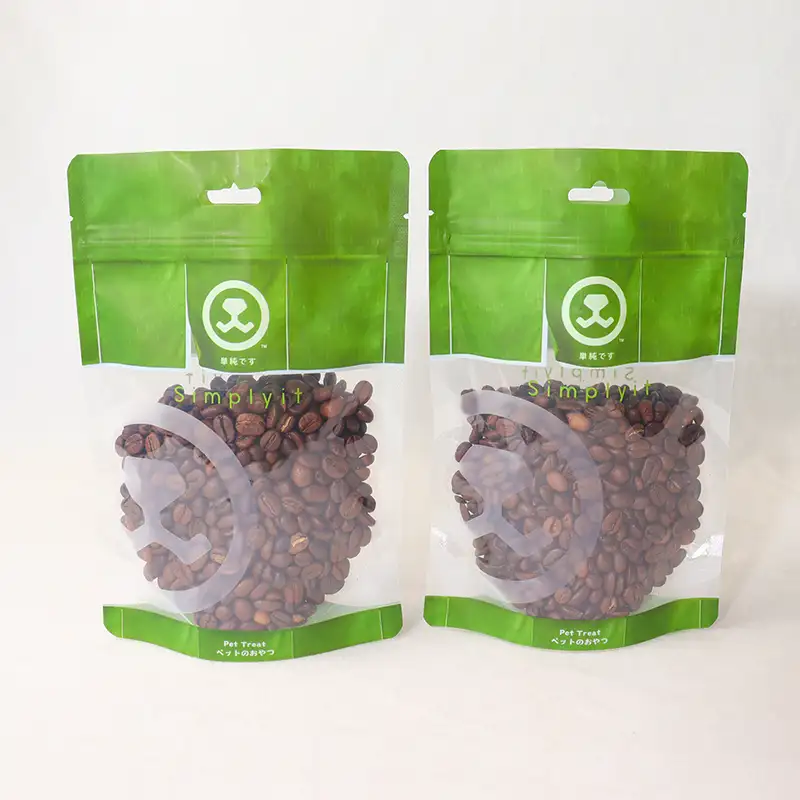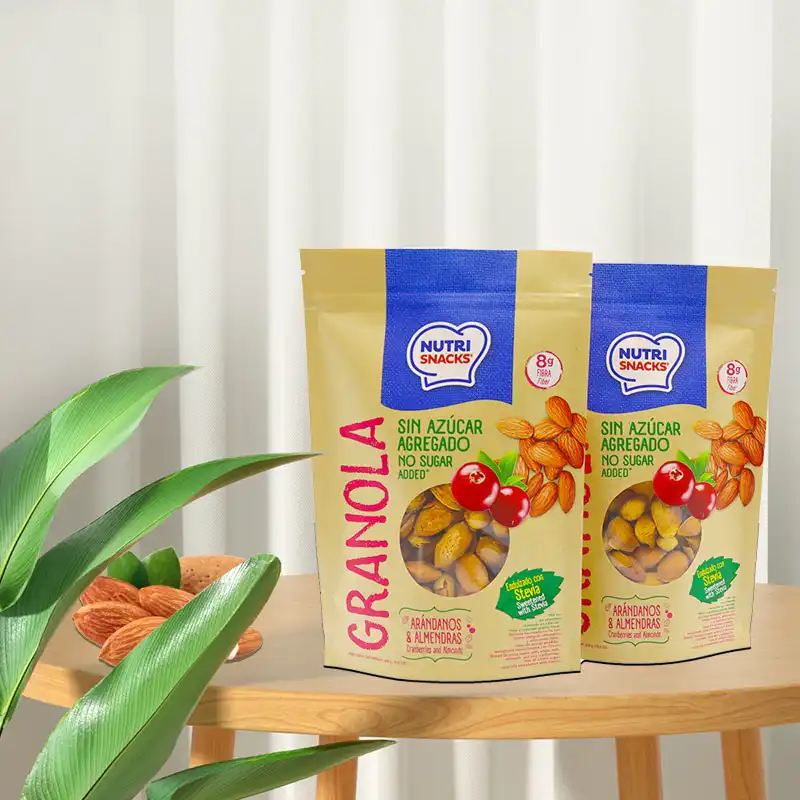
The short answer: if your granola looks as good as it tastes, a window earns its keep. If your product is fragile, oily, light-sensitive, or sold in bright retail lighting for six months at a stretch, go fully printed. In practice, the whole debate around window pouch vs non window pouch comes down to one trade-off: showing the product versus protecting it. Everything else — film structure, window size, closure type — is just how you manage that trade-off.
Let's unpack it properly, because we've watched brands lose margin on both sides of this decision. Some hid a gorgeous cluster granola behind opaque film and wondered why sampling didn't convert. Others cut a big oval window into a low-barrier laminate and had rancidity complaints by month four.
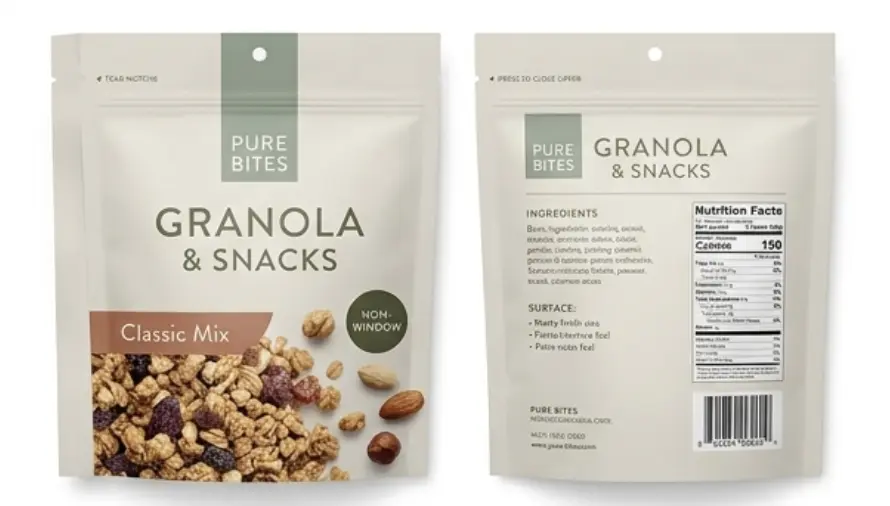
What Each Format Actually Does for Snacks
A transparent panel is a sales tool. A solid printed face is a shelf-life tool and a branding canvas. Neither is inherently better; they solve different problems at different points in your product's life.
Why Windows Sell Granola
Granola is one of the few snack categories where the product itself is the hero image. Chunky clusters, visible almonds, flecks of freeze-dried strawberry — that texture communicates "handmade" faster than any adjective on the front panel.
Shoppers also use visibility as a trust signal. In the better-for-you aisle, buyers who read ingredient panels are the same buyers who want to confirm the granola isn't dust at the bottom of the bag. A window answers a question they haven't asked out loud.
Why Fully Printed Pouches Still Win Plenty of Briefs
Remove the window and you gain three things: uninterrupted barrier, uninterrupted print area, and a slightly simpler production path. For oil-rich formats — nut butter granola, coconut-heavy clusters, seed brittle, chocolate-coated bites — that barrier matters more than the peek.
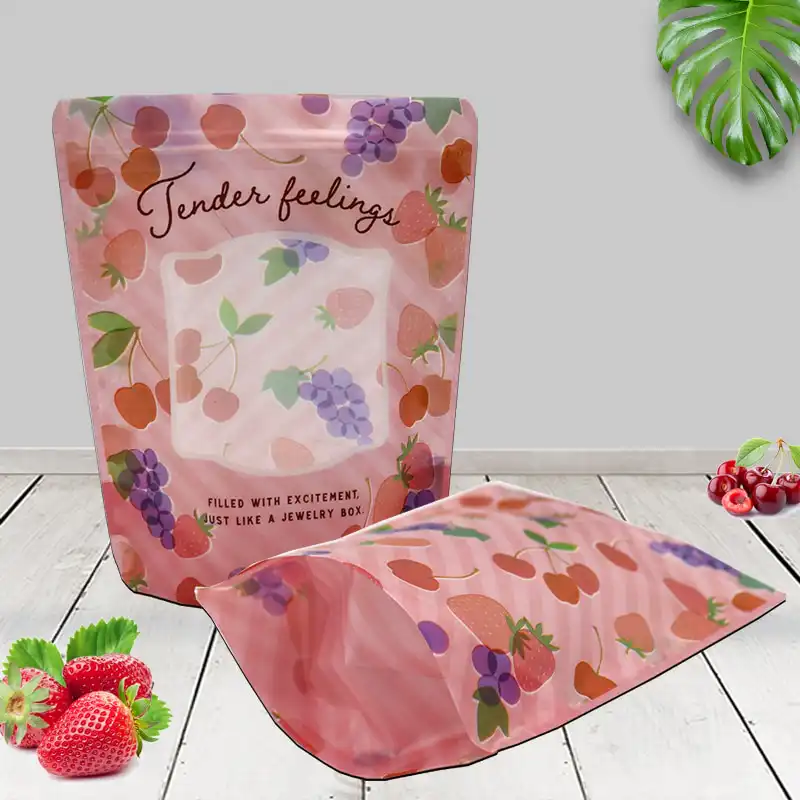
You also get design freedom. Full-bleed artwork, matte-and-spot-gloss contrast, metallic effects across the entire face. Brands with strong visual identity often prefer this because they'd rather own the shelf with color blocking than with a two-inch oval.
The Part Most Brands Underestimate: Light
Oxygen gets all the attention. Light does quieter damage. Photo-oxidation degrades unsaturated fats, fades natural colorants, and breaks down light-sensitive vitamins — riboflavin and vitamin A are the usual casualties, which is why dairy and cereal researchers have studied this for decades.
For granola, the practical symptoms are a stale-cardboard note in the aroma, dulled fruit color, and shortened peak-freshness window. It rarely fails a safety test. It fails the second purchase.
Retail lighting is harsher than most people assume. LED shelf lighting commonly runs 800–1,500 lux at product level, and refrigerated or endcap displays can push higher. Here's how typical structures compare:
| Front-panel construction | Approx. visible light transmission | Typical OTR (cc/m²/24h) | Best fit |
|---|---|---|---|
| Full aluminum foil laminate (no window) | <1% | <0.1 | Oily nut clusters, coffee-adjacent, long export cycles |
| Metallized PET laminate (no window) | 1–3% | 0.5–2.0 | Standard 12–18 month granola SKUs |
| White/kraft laminate with small clear window (≤15% of face) | ~10–15% of total face | 1.0–3.0 | Retail granola, trail mix, most snack lines |
| Large clear window (35–50% of face) | 35–50% of total face | 2.0–5.0 | Fast-turn subscription, farmers market, seasonal |
| Fully transparent PET/PE | >85% | 5.0–15.0 | Short shelf life, refrigerated, bulk food service |
Numbers above are indicative ranges for common laminate families as of 2026, not a spec sheet — actual performance depends on film gauges, sealant choice, and lamination quality. As a manufacturer that has run these structures for 20+ years, we test barrier per project rather than per catalog, because a 0.5 OTR difference changes your stated shelf life.
The Window-Size Math That Actually Matters
A window doesn't cost you barrier proportionally to how pretty it looks — it costs you barrier proportionally to its area. Cutting a window across 40% of the front panel means roughly 40% of that face now performs like clear film.
The workaround most brands miss: shrink and reposition instead of removing. A 25mm × 90mm vertical strip window, offset to one side, shows texture beautifully while keeping light exposure under about 10% of the face.
Cost and Production Reality for Bulk Orders
People assume the transparent version is always cheaper because there's less ink. That's not how it works at volume. Here's the honest breakdown of what shifts when you compare the two directions in a custom run:
| Factor | With window | Fully printed |
|---|---|---|
| Tooling / plate setup | Same plate count; window is a print knockout, not a die cut | Same |
| Ink coverage | Slightly lower | Slightly higher |
| Registration tolerance | Tighter — window edge misalignment is visible | More forgiving |
| Barrier compensation | May need upgraded structure to hold shelf life | Standard structure usually sufficient |
| Rejection risk | Higher — scratches and haze inside the window are visible defects | Lower |
| Net effect at volume | Usually neutral to slightly higher | Usually neutral to slightly lower |
The bigger cost lever isn't the window at all — it's order quantity, structure, and how many SKUs share a film. Brands running four flavors often save more by standardizing one film and changing only the print than by debating the transparent panel.
One production note worth knowing: window clarity depends on how clean your printing environment is. In our 6,800㎡ cleanroom facility, the window area is the first thing our QC team inspects under light, because airborne dust trapped during lamination shows up there and nowhere else.
Matching the Format to Your Specific Snack
Category matters more than aesthetics. Here's how we typically advise, based on formulation and turn rate:
| Product | Recommendation | Why |
|---|---|---|
| Cluster granola (baked, 12–20% fat) | Small-to-medium window | Texture sells; moderate fat tolerates limited light |
| Nut-butter or coconut-oil granola (>25% fat) | Fully printed or tiny window | High unsaturated fat is photo-oxidation prone |
| Trail mix with chocolate | Fully printed | Light plus heat causes bloom and color fade |
| Freeze-dried fruit snacks | Fully printed, high barrier | Color and crispness collapse fast with light and moisture |
| Protein bites / energy balls | Small window | Shows portion count; usually short shelf life anyway |
| Granola for food service / bulk | Window or clear | Fast turn, visual inventory checks matter |
| Savory crackers, veggie chips | Medium window | Low fat, seasoning visuals drive trial |
| Jerky and meat snacks | Fully printed | Light accelerates color change; barrier is non-negotiable |
The Channel Question People Forget
Where you sell changes the answer. Online, the window does almost nothing at the point of purchase — your product photography does the selling. It only matters at unboxing.
In physical retail, the transparent panel competes for a two-second glance. On a subscription model with monthly turn, light exposure barely accumulates, so you can be generous with visibility. Export shipments sitting in a warehouse for eight months are the opposite case entirely.
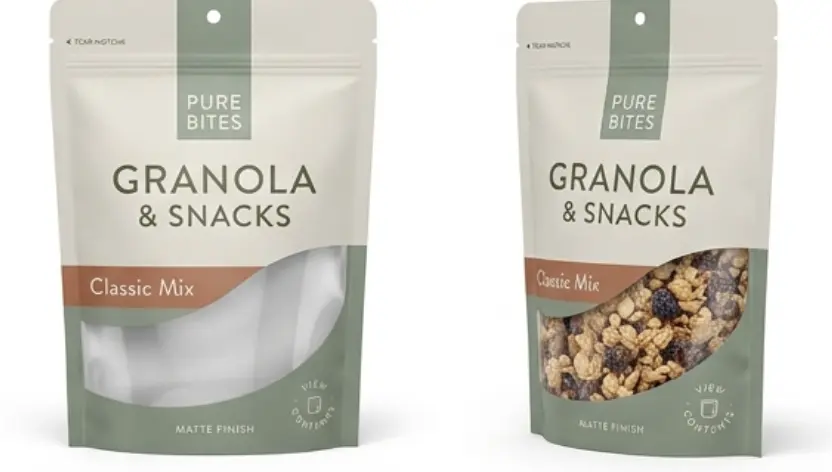
How Closure Type Changes the Calculation
Granola is rarely a single-serve product. Once a 340g bag is opened, the closure controls freshness more than the original barrier does. This is where the debate over a resealable window pouch vs non window pouch tilts toward practicality rather than looks.
- Zipper (press-to-close): the default for granola over 200g. Pair with a tear notch above the zip so customers don't destroy the seal.
- Slider zipper: easier for older hands and premium-feeling, but adds bulk and requires taller headspace.
- Pocket zipper: keeps a clean front face — useful when you want a window uninterrupted by hardware.
- Tin tie on kraft: charming for artisan positioning, weak on moisture retention. Fine for two-week turn, risky for national retail.
- Degassing valve: unnecessary for granola, essential if you're co-packing coffee on the same line.
Stand-up pouches with a bottom gusset shelve better for granola because clusters settle into the base and the bag stays upright as it empties. Flat-bottom (box) pouches give you five printable panels and stack tighter on pallets — worth it if shelf facing is contested.
Sustainability: Where the Window Complicates Recycling
This is the underdiscussed part. Mixed-material laminates are hard to recycle, and adding a clear PET window to a PE-based structure can push a pack from "store drop-off recyclable" to "not recyclable" in some regional programs.
If recyclability is on your roadmap, the cleaner path is a mono-material PE structure with a mono-PE clear window — the whole pack stays in one polymer family. Metallized layers and PET windows are the usual disqualifiers.
Recycled-content claims need paperwork, not vibes. Because we hold GRS certification alongside ISO 9001 and ISO 22000, we can document recycled-content chains for brands making on-pack claims — which matters when a retailer's compliance team asks for evidence.
Compostable Options and Their Honest Limits
Kraft paper with a compostable inner liner and a cellulose-based window exists and looks lovely. Its barrier is modest, its moisture resistance is limited, and realistic shelf life for granola sits closer to 4–6 months than 12. Great for regional brands with fast turn. Difficult for national distribution.
Design Details That Separate Good Windows From Bad Ones
A window is a design element, not a hole. Working with snack brands across North America and Europe, we've found the most common mistake is placing the window where the product isn't.
- Fill line first: a 340g granola fill in a 180×280mm pouch typically settles around 65–70% of pouch height. Windows above that line show empty air and read as underfilled.
- Round the corners: sharp window corners concentrate stress and are the most common source of pinholes in transit.
- Keep 10mm clearance from all seals. Windows that run into the seal area cause leakers.
- Match window shape to product shape: vertical strips for clusters, wide horizontals for flat crackers, circles for round bites.
- Back-panel windows are an underused move: full brand impact on the front, product proof on the back.
Our in-house design team often helps brands who arrive with only a rough sketch and a fill weight — we'll mock up the window against the actual settled fill line before plates are made, because that's the change nobody wants to discover after the run.
A Note on Print Effects Around the Window
Matte varnish across the panel with a gloss window border makes the product look framed and intentional. Spot UV outlines work too. Avoid heavy metallic ink right against the window edge — any registration drift becomes obvious.
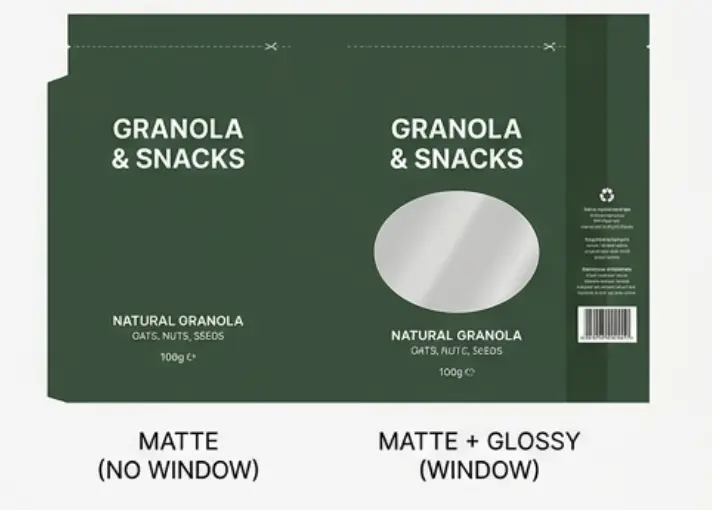
Beyond Food: The Same Technology in Other Applications
The transparent-panel principle isn't unique to snacks, and understanding the parallels helps clarify why places are misunderstood in the granola aisle. A clear window pouch vs opaque pouch decision in dry goods shares logic with what a packaging engineer weighs when designing a window pouch for mailing envelopes, where visibility of the contents matters but so does the tamper-evidence of the sleeve. The physics are the same; the stakes just differ.
For documents, a window is about instant verification — you can confirm the address is right without breaking the seal. For granola, the window does the same thing: it verifies the product is intact, textured, and actually what the label claims. Both applications trade barrier integrity for visual confirmation. Neither is wrong; the right answer depends on how much authenticated visibility your customer needs.
One parallel is worth stealing directly from office supplies: the kraft window pouch for documents that keeps a stiff, protective back while exposing only a narrow strip of the front. That asymmetric design is exactly what granola brands should copy — rigid, protective back; selective, narrow reveal. It gives you the selling power of transparency without letting light flood the whole bag.
Window, No Window, and the Middle Path
Here's the practical upshot after all that analysis. The cleanest solution is not always binary. There's a spectrum you can choose from, and most brands land somewhere in the middle:
- Full front window: maximum visibility, minimum protection, suited to fast-turn premium products.
- Medium shaped window: a solid balance of show-and-protect, the workhorse of mid-priced granola.
- Small strip window: visible proof with barrier intact, ideal for oily or long-shelf versions.
- Back-panel window: full-front brand impact with product proof out of the main light path.
- Fully printed: complete protection, complete design real estate, best for high-fat and export.
Your decision flow should be this simple:
- What is your fat content and anticipated real shelf life in shelf conditions?
- What is your retail channel — physical storefront, online only, or subscription?
- How fast does your stock actually turn, not how fast does your forecast say it will?
- Is a window going to show the product at its best, or at its bottom-of-bag worst?
- Does your brand identity live in a color story or in the texture of the product itself?
Answer those five and the format calls itself. When in doubt, use a small window on a high-barrier laminate and shrink the transparent area rather than removing it entirely.
A Quick Confidence Checklist Before You Order
Before you finalize a custom run with any supplier, run through this list. It's the same one we use when a brand sends us a brief with "surprise me" as the only spec:
| Check | What to confirm | Why it matters |
|---|---|---|
| Barrier spec | OTR and WVTR for your specific film, not a catalog average | Averages hide a 3× real-world spread |
| Window placement | Measured against the settled fill line, not empty-bag geometry | Misplaced windows read as underfilled |
| Film structure | Mono-material if recyclability is a claim; metallized only if shelf life is the priority | These two goals conflict more often than not |
| Closure quality | Zipper seal integrity after the bag is opened and closed repeatedly | Granola lives or dies on the reseal |
| Certification | Food-contact compliance and documentable recycled content if claimed | Retail compliance teams ask for evidence, not promises |
| Window clarity | Haze and scratch tolerance on the transparent area | Defects there are the reason product gets rejected at shelf |
One thing to remember as you evaluate a potential partner: because we hold FDA/ISO 22000 certifications, we recommend you ask any supplier for a validated migration test on the exact film they plan to convert for the food-contact layer. A certification exists, but the specific film spec is what determines whether your oily granola stays compliant on a long storage cycle.
The Bottom Line on Your Decision
So after all the trade-offs, here's where we land. Choose a window when your product's texture is the strongest selling point, your fat content is moderate, and your stock turns in a few months. Choose a fully printed face when your formulation is rich, your distribution is long, or your brand identity rests on a bold printed look.
And if you're genuinely torn, start with a small window and keep the barrier high. That's the configuration that gives a brand the least downside in nearly every scenario, and it's the one we most often recommend to clients who aren't sure yet.
A final thought from the supplier side: every formula and every budget is different, so there's no universal default. But a good packaging partner should walk you through the barrier numbers for your exact filling, not hand you a price list and wish you luck. That's why we always bring material samples and a fill-line mockup to the first conversation, rather than a catalog.
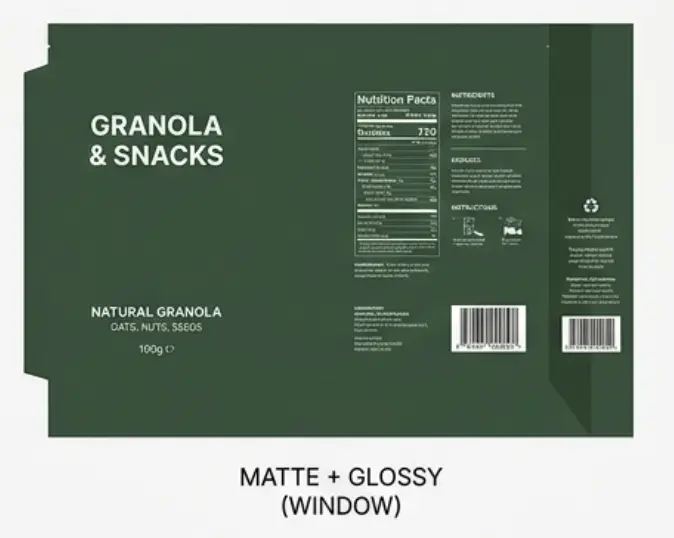
Frequently Asked Questions
Does a window shorten how long my granola stays fresh?
Only the windowed area does, and only in proportion to its size. A small strip window on a high-barrier laminate has a negligible effect on shelf life, while a 40% front window can meaningfully accelerate oxidation in oily formulations. If your shelf life is already tight, shrink the window, don't remove the whole concept.
Which option looks more premium to shoppers?
That depends on your brand. A crystal-clear window with a matte frame and a visible product reads as artisanal and fresh. A full-color printed matte face with spot gloss reads as established and premium. Neither is inherently more upscale; consistency with your other packaging and your shelf siblings matters more.
Can I get a window that won't tear at the corners during shipping?
Yes, if the corners are rounded and the window stays at least 10mm away from all seals. Rounded corners distribute stress much better than sharp ones, and keeping clearance from the seal area prevents pinholes and leakers during transit and stacking.
Are transparent-panel pouches more expensive to produce at volume?
Not necessarily. The window itself is a print knockout rather than an extra die cut, so ink savings can offset some cost. But rejection risk runs a little higher because window clarity defects are visible to your customers. At scale, the difference usually flattens out; structure and order quantity move the price more than the window does.
My granola is high in nuts and oil. Should I even consider a window?
Keep it small and ask for a barrier verified for your fat content. High-fat recipes are the most photo-oxidation prone, so a narrow strip is the safer version. If you're shipping internationally or storing long term, skip the window and invest the real estate in a strong printed design instead.
However you decide, remember that a reliable supplier will give you options, not ultimatums, and will help you test before you commit. That's been the core of how we work at YLTPACK — from our cleanroom production to our in-house design support — because the right package is the one that survives both the distribution chain and the customer's kitchen. Questions about your specific granola line? Email us at [email protected] or reach us on WhatsApp at +86 182 1944 5665, and bring your fill weight and your target shelf life — we'll run the numbers with you.