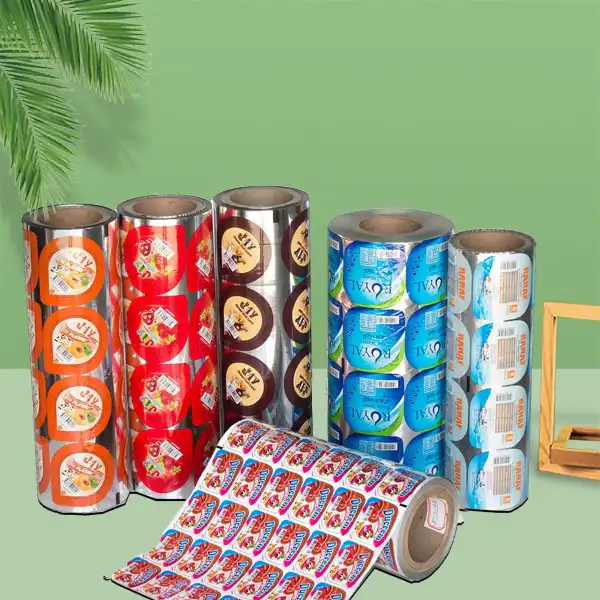

The seal allowance gets left out. Buyers measure the pack, add nothing for the fin or lap, and order film that is a few millimetres short. This VFFS film width selection method takes you from product and bag size to a film width, roll specs and an order brief your supplier can quote without guessing.
Start with the answer: film width equals the bag circumference plus seal allowance
On a vertical form-fill-seal (VFFS) machine, film width equals the filled bag's circumference plus the seal overlap, then confirmed against the forming tube. Two variables change the result: whether the back seal is a fin seal or a lap seal, and the actual circumference of the filled pack, not the flat bag width.
A VFFS machine pulls flat film from a roll, wraps it around a hollow forming tube (the former), seals the back, seals the bottom, drops the product in and seals the top. The film wraps the tube once. So the width is a loop of material, and the loop has to close with enough film left over to make a seal. A fin seal joins the two inner faces and leaves a ridge standing out from the back. A lap seal overlaps one edge on top of the other, so it lies flat but needs the inner and outer layers to bond.
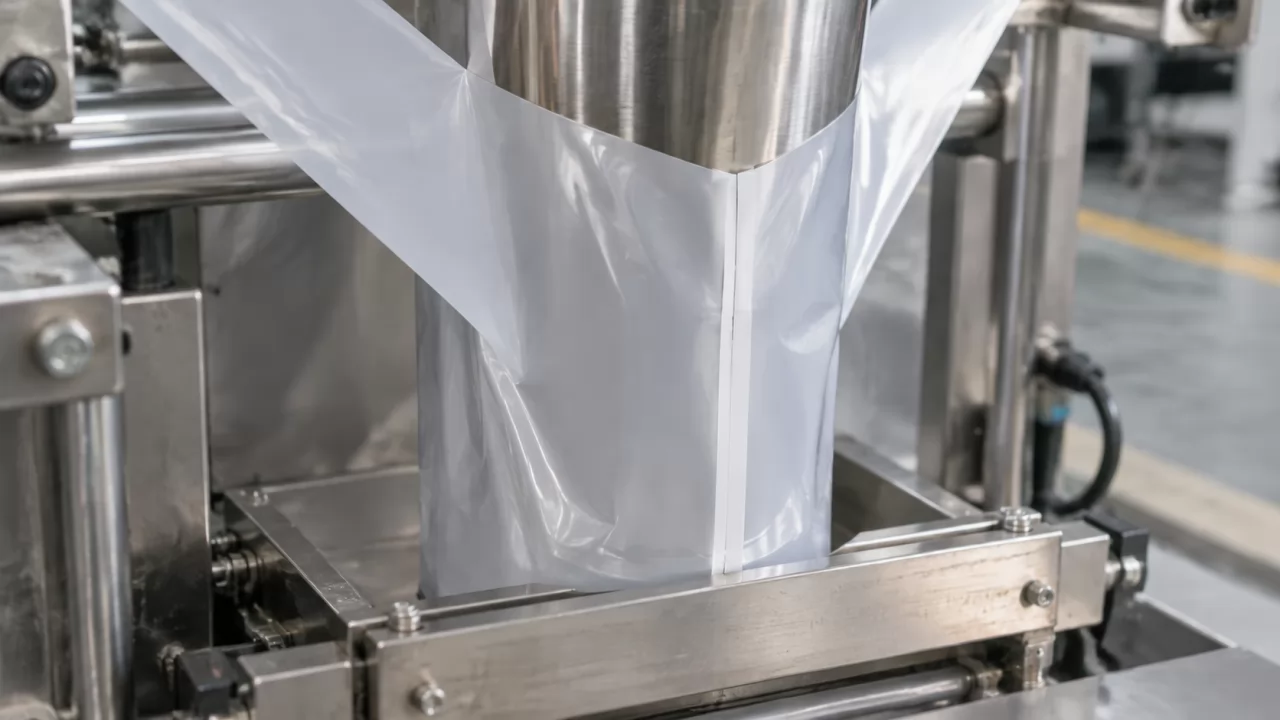
The allowance differs between the two. Fin seals typically need film for two seal widths, while lap seals need film for one overlap. Exact figures depend on the machine's seal jaw and the film structure, so take them from the machine manual and a trial run, not from a rule of thumb.
Gather these inputs before you calculate
Some inputs come from paper and some only from a real fill. Collect both first, because a width worked out from the label weight alone is the most common reason a first run fails.
From the machine manual or the line operator, you need the former diameter or size range, the maximum and minimum film width the machine accepts, the unwind's core size and maximum roll diameter, and the jaw type (a horizontal crimp, or a flat or serrated jaw). From the product, you need the fill weight and the bulk density as filled, not as poured loose. Powders and granules settle after a few drops, and a snack with air in it behaves differently from the same snack crushed.
- Record the fill weight per bag and the settled bulk density from a real trial fill.
- Note the bag style: pillow, gusseted or block bottom.
- Copy the former size and the machine's film-width limits from the manual.
- Confirm fin seal or lap seal, and the seal width the jaws produce.
- Write down the core size and the maximum roll diameter of the unwind.
- Keep one reference bag from the current line, or a sample bag you like.
The manual gives you the limits. Only a trial fill gives you density, and density drives everything downstream.
Work out the width in six ordered steps
Each step ends with something you can measure on a sample bag, so an error shows up early rather than on the line.
- Convert fill weight and settled density to volume, so you know how much space the product needs.
- Pick a target bag width and length that holds that volume with headspace for the top seal.
- Calculate the circumference: for a pillow bag, roughly twice the flat bag width, taken between the seal edges.
- Choose fin seal or lap seal and add its allowance to the circumference.
- Compare the result with the former's circumference and the machine's width limits.
- Make a hand-formed sample bag from a film offcut and check the seals, fit and look before you order.
Set the target bag width and fill volume
Divide fill weight by settled density to get volume. Then choose a flat bag width and length that hold it with space left above the product, since the top jaws must seal clean film and not trapped powder. If you only know the fill volume and not the bag size, a pouch capacity calculator helps you get a first dimension to test.
Choose fin seal or lap seal and add the allowance
A fin seal is more forgiving and seals well on most films, but it costs extra film width and leaves a ridge that has to fold flat on the shelf. A lap seal saves width and gives a flatter back panel, yet it needs a film whose outer face will bond to its inner face, which not every laminate allows. Pick the style that suits the structure first, then add the allowance.
Check the width against the forming tube
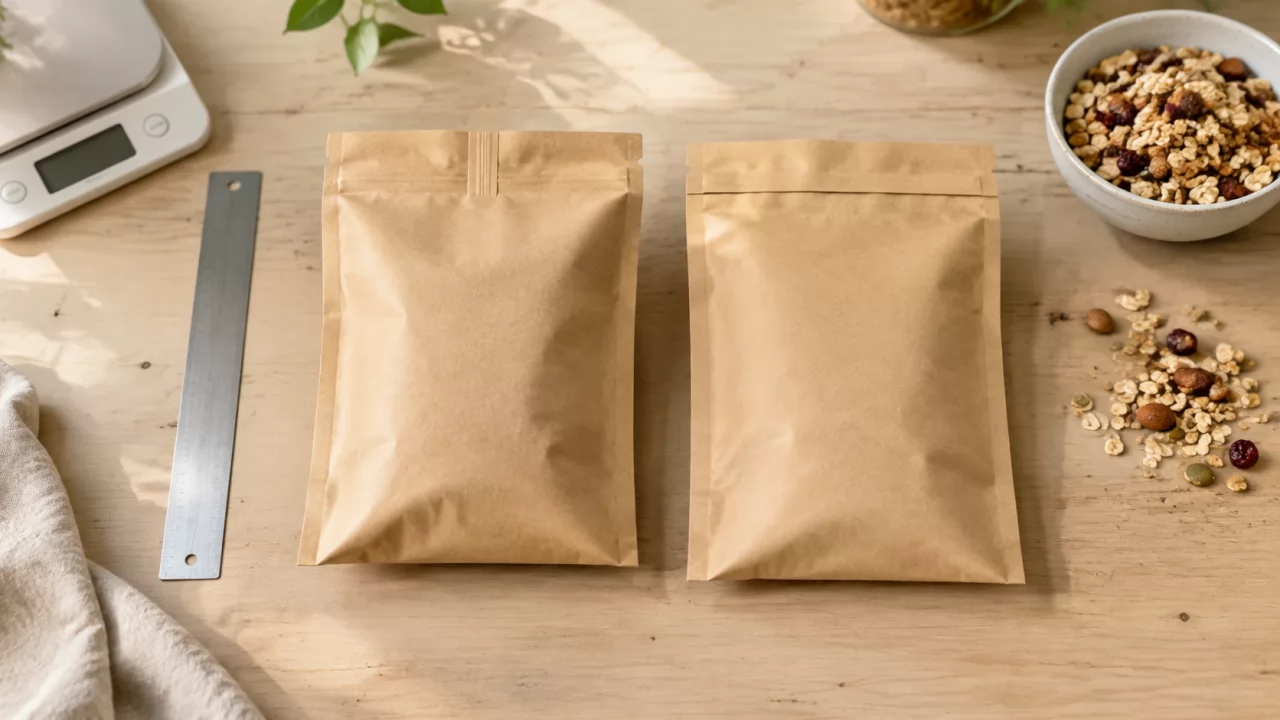
The film has to wrap the former with the right tension. Too wide and it bunches and wanders. Too narrow and it cannot close, or it pulls the seal thin. If your calculated width falls between two standard widths the machine can run, tell the supplier both and let the trial decide.
Repeat length and roll size are set by the bag, not by the film supplier
Rollstock repeat length is the distance from one printed bag design to the next along the film, and it must equal the bag length the machine cuts. It is fixed by the bag, not by the film maker. The photo-eye mark (a small printed block the sensor reads) sits at the same point in every repeat, so registration holds from bag to bag.
If the repeat is wrong by even a small amount, the print creeps against the seal over a long roll. The machine's registration control can absorb some drift but not a systematic error. Give the supplier the bag length you actually run, plus the eye-mark colour, size and position, and agree these in writing with the artwork proof.
Core size and roll diameter come from the unwind, not from your preference. Common core sizes are 3 inch (76 mm) and, less often, 6 inch, but check your own machine. A larger roll saves changeovers yet may exceed the unwind's limit or the weight an operator can lift. A free roll film calculator gives length, diameter and weight from the film thickness and width, which helps you set a diameter that fits.
Compare your options in one table before you ask for quotes
Seal style, bag format and film structure each move width and cost in a different direction. The table keeps the trade-offs side by side, using qualitative values only.
| Criterion | Fin seal | Lap seal | Gusseted pillow |
|---|---|---|---|
| Film width needed | Wider | Narrower | Wider, plus gusset film |
| Back panel look | Ridge at the back | Flat back | Flat sides, folded |
| Film constraint | Few | Inner and outer faces must bond | Needs gusset-capable former |
| Film use per bag | Higher | Lower | Highest |
| Best for | Most laminates, general use | Flat-back packs, saving film | Stable, boxier packs |
Fin seal is the safer starting point for most structures, and lap seal is worth testing once you know the film bonds to itself.

How does film structure change the width you can run?
Film structure changes the width you can run because stiffness, stretch and thickness all affect how the film wraps the former and holds tolerance. Stiffer laminates need a more exact width, while softer films forgive small errors but may stretch under tension and pull seals out of line.
A foil or other high-barrier laminate is usually stiffer and resists stretch, so it tracks well but shows creases at the fin. A polyethylene (PE) based film is typically softer and seals at lower temperatures, yet it can stretch if tension is set too high. Thickness is commonly quoted in microns, and a film thickness calculator converts between micron, mil and gauge when specs arrive in different units. Choose the structure against the product's barrier needs for oxygen, moisture and light first, then confirm the width for that structure. Where printing and lamination are done under one roof, as at our plant, the width and structure can be adjusted together, which cuts out a round of handoffs.
Tips from the buying side that prevent a wasted first run
Slitting tolerance is the first place a good calculation goes wrong. Film is slit to width within a tolerance, and the machine only accepts so much variation. Ask the supplier for the tolerance on slit width and the allowed variation on repeat length, and compare them with what your line can absorb.

Do not approve artwork until the eye-mark position, the repeat length and the seal area are shown on the proof. A mark that lands inside the seal zone cannot be fixed after printing.
Order a trial roll before a full run. A short roll lets you test tracking, seal strength and registration on your own machine at your own speed. Keep one reference bag from the trial, labelled with the date and settings, so later rolls can be compared with something real.
Minimums depend on the print method and the film structure, and they are confirmed in the quote. Digital printing generally suits shorter runs and several designs, while gravure suits repeat volume. Special structures may carry higher minimums than standard ones.
Troubleshooting: what a wrong width looks like on the line
Most width problems show up as seal faults or tracking drift. The table links the symptom to its likely cause and the first fix to try.
| Symptom | Likely cause | First fix |
|---|---|---|
| Wrinkled back seal | Film too wide or tension uneven | Check width against the former |
| Film drifts sideways | Roll off-centre or width mismatch | Re-centre the roll, check core fit |
| Bag too tight at fill | Circumference too small | Increase width or reduce fill |
| Bag loose, floppy | Circumference too large | Reduce width or raise fill |
| Leaking fin | Seal allowance too small | Widen the seal or raise jaw temperature |
| Print creeping off mark | Repeat length does not match bag length | Re-check repeat against cut length |
Change one thing at a time, and write down each change. Otherwise you cannot tell which adjustment fixed the fault.
FAQ
Can one film width run two bag sizes?
Sometimes, yes. If both bags share the same circumference and only the length differs, one width works with different cut lengths, but the repeat length must change with the artwork.
Does a wider film always give a stronger seal?
No. A wider seal area helps only up to the point the jaws can heat evenly; seal strength depends mostly on film structure, jaw temperature, pressure and dwell time.
What should an RFQ for rollstock include?
Product and fill weight, machine model, former size, film width and tolerance, repeat length, core size, maximum roll diameter, eye-mark position, structure, print method and quantity per design.
How many samples should you test before a full order?
At least one trial roll run on your own machine. Increase the number if you change the structure, the seal type or the product density.
Send your brief and get a width recommendation
Which figure on your line is least certain right now: the settled density, the former size or the seal allowance? Send that, plus the product and fill weight, machine model, a bag drawing or photo and the quantity per design, and our team will reply with a recommended structure and width. The roll length and film weight calculators on the website can give you a first estimate before you write.