Why So Many Brands Are Switching to Flexible Pouches with Spouts
Having worked with brands across food, beverage, personal care, and household categories for over two decades, we've seen which products thrive in this format — and which ones need a different solution entirely. Let's walk through the categories that genuinely benefit, so you can make an informed decision.
Understanding What Makes This Format Work
Before diving into product categories, it helps to understand the structural advantages that make spouted pouches perform well. The format combines a flexible laminated body (typically multiple barrier layers) with a rigid spout and cap. That combination creates some distinct benefits:
- Controlled dispensing — The spout allows precise pouring without mess, unlike tear-open sachets
- Resealability — Consumers can open, use, and close multiple times without product degradation
- Lightweight structure — Up to 70% lighter than equivalent rigid containers, reducing freight costs
- Barrier customization — Film layers can be engineered for oxygen, moisture, UV, or aroma retention
- Compact storage — Unfilled pouches ship flat, saving warehouse space before production
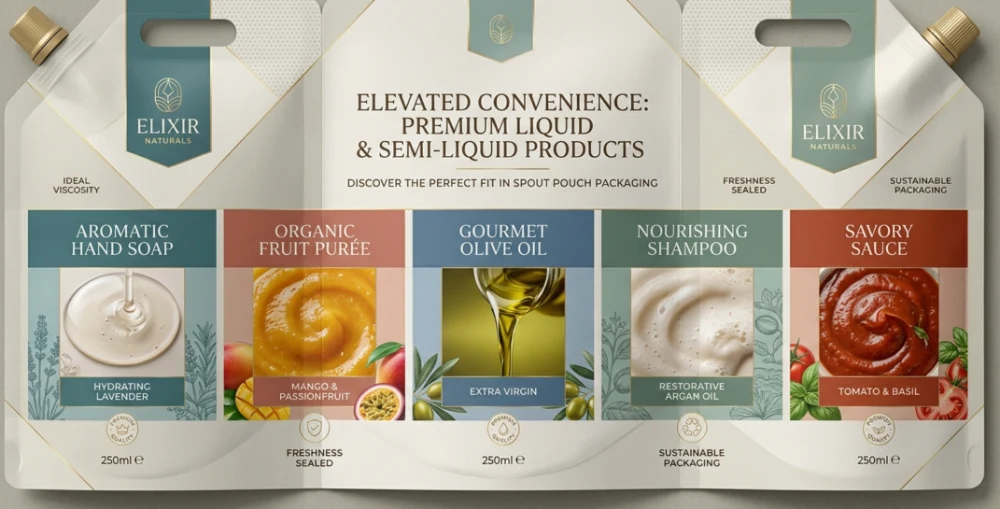
These characteristics make the format ideal for products with specific viscosity ranges, shelf-life requirements, and dispensing needs. Let's look at what fits.
Liquid Beverages: From Juices to Smoothies
This is perhaps the most natural fit. Fruit juices, smoothie blends, coconut water, cold-pressed drinks, and even wine and cocktail mixes perform exceptionally well in this format. The key reasons:
Oxygen barrier films preserve freshness and vitamin content without preservatives. For cold-pressed juice brands, this is critical — a 2025 market study from Smithers showed that flexible packaging with high-barrier films extended juice shelf life by 30-40% compared to standard HDPE bottles. The resealable cap means consumers can sip over time rather than finishing the entire portion at once.
We've produced beverage pouches for brands in North America and Southeast Asia, and the most common question is about seal integrity under pressure. In our 6,800㎡ cleanroom facility, every batch goes through burst-pressure testing and drop-impact simulation before shipping. For beverages, seal failure isn't just a waste issue — it's a brand reputation issue.
What to consider for beverages:
- Carbonated drinks are not suitable — internal pressure requires rigid containers
- Hot-fill beverages need specialized film structures rated above 85°C
- Dairy-based drinks require excellent light-blocking layers to prevent off-flavors
Baby Food and Infant Nutrition
Walk through any baby care aisle and you'll see dozens of squeezable puree pouches with spouts. There's a reason this category adopted the format so aggressively: parents need mess-free, portable, single-serve feeding options. The spout allows direct feeding or squeezing onto a spoon.
Safety is non-negotiable in this category. Because we hold FDA and ISO 22000 certifications, we guide brands toward food-contact-safe materials that comply with both U.S. and EU migration limits. The inner film layer matters enormously here — it's what contacts the food directly, and infant nutrition regulators scrutinize it carefully.
Typical products in this segment include:
- Fruit and vegetable purees
- Yogurt-based snacks
- Organic grain porridges
- Electrolyte drinks for toddlers
Brands entering this space should plan for retort-capable structures if the product needs ambient shelf stability without refrigeration. Retort pouches can withstand sterilization temperatures, giving your product a 12-18 month shelf life without chemical preservatives.
Sauces, Condiments, and Liquid Seasonings
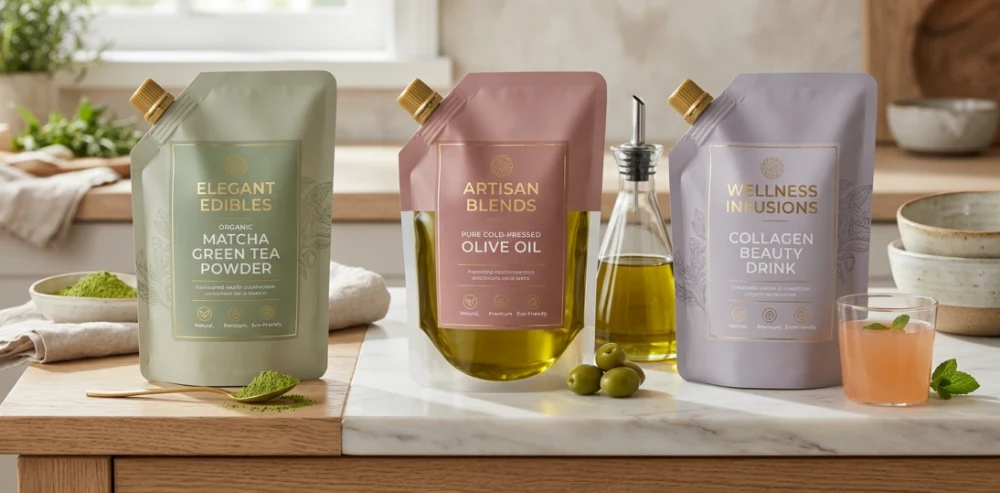
Ketchup, soy sauce, salad dressings, hot sauces, cooking oils, and marinades — this category has exploded in flexible packaging adoption. Why? Because restaurants, meal-kit companies, and food service operators want portion-controlled, lightweight options that reduce breakage during shipping.
For thicker sauces (think sriracha or barbecue sauce), the spout diameter matters. Too narrow, and consumers struggle to squeeze the product out. Too wide, and you lose the controlled-pour advantage. Our in-house design team often helps brands who only have a rough concept choose the right spout caliber — typically 8mm for thin liquids, 10-12mm for medium viscosity, and 15mm+ for chunky or thick products.
| Product Type | Viscosity Level | Recommended Spout Size | Barrier Priority |
|---|---|---|---|
| Soy sauce / vinegar | Low (water-like) | 8-9mm | Oxygen + UV |
| Salad dressing | Medium | 10-12mm | Oxygen + moisture |
| Ketchup / BBQ sauce | High | 12-15mm | Oxygen |
| Chunky salsa | Very high (particulates) | 16mm+ | Oxygen + aroma |
One thing we've noticed working with sauce brands: aroma retention is underrated. Garlic-infused oils, truffle sauces, and fermented condiments need barrier films that prevent aromatic compounds from escaping through the film (a phenomenon called scalping). If your product sells on its smell, mention that during the specification stage.
Personal Care and Beauty Products
Shampoo, conditioner, body lotion, face masks, hair treatments, and serums — personal care brands are rapidly moving toward flexible pouch formats for both refill packs and primary packaging. The drivers are sustainability messaging and the Instagram-ready unboxing experience that pouch formats enable.
For beauty brands specifically, print quality makes or breaks the decision. Consumers associate packaging quality with product quality. Matte finishes, spot UV, metallic inks, and transparent windows are all achievable on flexible film — and they create a premium look that rigid bottles struggle to match at comparable cost points.
Refill economy: a growing use case
Eco-conscious brands are selling a durable dispenser bottle once, then offering pouch refills at a lower price point. This model reduces plastic waste by 60-80% compared to buying a new rigid bottle each time. The pouch with a spout makes the refilling process clean and intuitive — pour, cap, recycle the pouch.
Working with brands across North America and Europe, we've found that the most common mistake in personal care pouches is underestimating chemical compatibility. Essential oils, alcohol-based toners, and certain surfactants can degrade standard film structures over time. Always request a compatibility test with your actual formula before committing to a full production run.
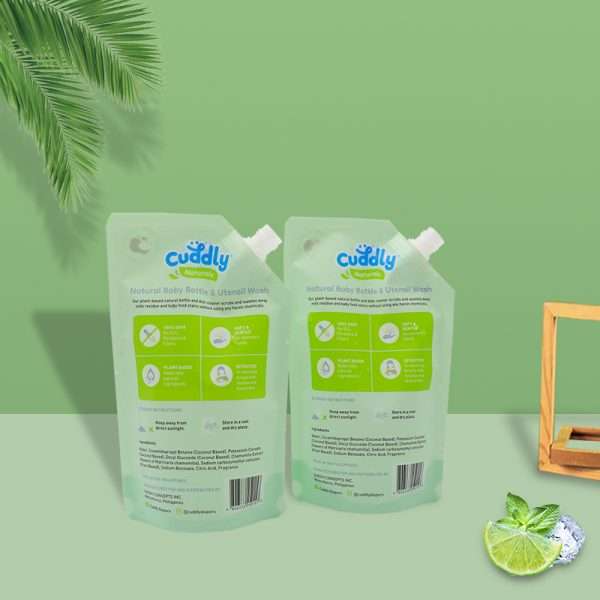
Household Cleaners and Detergents
Laundry detergent, dish soap, surface cleaners, and fabric softeners are increasingly sold in spouted flexible pouches — especially as refill packs. The sustainability angle is strong: a 2024 Nielsen report found that 67% of consumers said they'd switch brands for more environmentally responsible packaging.
The practical advantages are clear for household products:
- Reduced plastic use per unit compared to HDPE jugs
- Lower shipping weight saves on logistics costs
- Stand-up format with bottom gusset provides shelf stability
- Child-resistant spout caps are available for products with safety concerns
One caveat: highly alkaline or acidic cleaners (pH below 3 or above 11) require specialized inner films. Standard polyethylene liners can degrade over time with aggressive chemistry. This is one reason we always ask for a product data sheet before recommending a structure — getting the material spec wrong costs far more than the testing phase.
Health Supplements and Functional Liquids
Collagen drinks, protein shakes, liquid vitamins, herbal tonics, pre-workout mixes, and energy gels — the supplement industry has embraced flexible packaging with spouts for both single-serve and multi-serve formats. Athletes appreciate the portability. Health-conscious consumers appreciate the portion control.
For supplement brands, regulatory compliance drives packaging decisions. In the U.S., liquid supplements must be packaged in FDA-compliant, food-contact-safe materials. In our facility, we maintain traceability from raw film rolls to finished pouches, which simplifies the documentation process when brands face regulatory audits.
Key considerations for supplements:
- Light-sensitive ingredients (like Vitamin C and probiotics) need aluminum or metalized film layers
- Single-serve formats (30-100ml) need smaller spout profiles to minimize product waste
- Multi-serve formats (500ml-1L) benefit from measuring caps for dosage accuracy
- Gel-consistency products (energy gels, collagen jellies) require wider spouts and flexible body panels for squeezability
Pet Food and Animal Nutrition
Wet pet food, gravy toppers, liquid treats, and pet supplements are a fast-growing segment for this packaging format. Pet owners today read ingredient labels as carefully for their animals as they do for themselves. They want to see what's inside, understand the nutrition, and dispense it without mess.
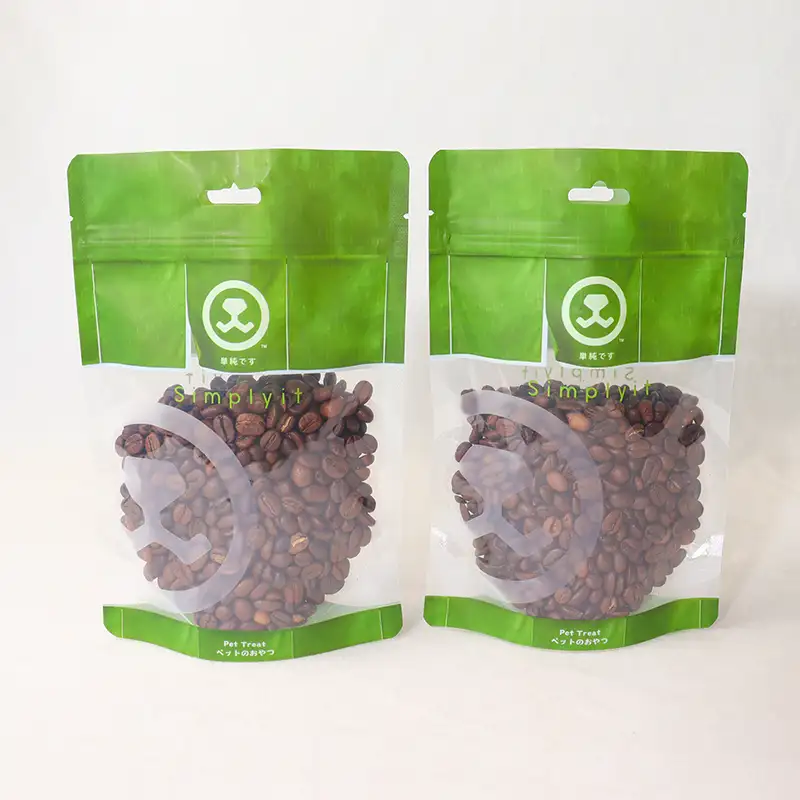
Transparent windows in the pouch body let consumers see product color and consistency — which builds trust for premium pet food brands. Pet owners associate visual cues with freshness and quality. If your product looks good, show it off through a clear panel.
Portion control matters here too. Overfeeding is a common concern among pet owners, and single-serve or measured-pour pouches help manage serving sizes. For larger multi-serve formats, the resealable spout keeps remaining portions fresh in the refrigerator after opening.
Industrial and Agricultural Liquids
Not all applications are consumer-facing. Fertilizer concentrates, pesticide solutions, automotive fluids, and industrial lubricants also use this format — typically in larger sizes (1-5 liters) with heavy-duty spouts and anti-tamper features.
For industrial applications, puncture resistance and chemical stability are the primary concerns. Film structures tend to be thicker (150-200 microns total) with nylon or PET outer layers for mechanical strength. The format saves significant storage space compared to rigid drums or jerry cans — important for distributors managing warehouse capacity.
Products That Don't Belong in This Format
Knowing what works is only half the equation. Here's what doesn't fit well:
| Product Type | Why It Doesn't Work | Better Alternative |
|---|---|---|
| Carbonated beverages | Internal CO₂ pressure exceeds flexible film tolerance | Aluminum cans, PET bottles |
| Dry powders (flour, protein) | Spout clogs easily, no dispensing advantage | Stand-up zipper pouches |
| Solid chunks in liquid (large fruit pieces) | Pieces block spout, frustrate consumers | Wide-mouth jars or cups |
| Very hot-fill products (above 95°C) | Standard spout materials warp at extreme temps | Retort-rated rigid containers |
| Products requiring microwave reheating | Spout materials may not be microwave-safe | Microwave-safe trays or bowls |
If your product falls into a gray area — say, a thick smoothie with small seed particles — it's worth running a dispensing trial before committing. As a manufacturer that has produced packaging for 20+ years, we always recommend prototyping first with your actual product formula rather than assuming compatibility based on similar products.
How to Choose the Right Structure for Your Product
Once you've confirmed your product is a good candidate, the next step is specifying the right laminate structure, spout type, and capacity. Here's a simplified decision framework:
Step 1: Define your product characteristics
- What's the pH level? (Acidic products need different inner films than neutral ones)
- What's the viscosity? (This determines spout diameter and pouch flexibility)
- Does it contain oils or volatile compounds? (Affects barrier layer selection)
- What's the target shelf life? (6 months vs. 18 months requires different barrier levels)
Step 2: Determine usage pattern
- Single-serve or multi-serve?
- Will consumers squeeze directly into their mouth (like baby food or energy gels)?
- Will they pour into another container (like a refill)?
- Does it need refrigeration after opening?
Step 3: Consider regulatory requirements
- Which markets will you sell in? (FDA, EU, Japan, etc. have different standards)
- Do you need organic certification compatibility?
- Are there specific recycling or sustainability claims you want to make?
Getting these answers documented before approaching a packaging partner saves weeks of back-and-forth. If you're unsure about any of these parameters, a reliable manufacturer should be willing to consult with you before quoting — that's how we approach every new project at YLTPACK.
Sustainability Angle: Why This Format Supports Eco-Goals
Brands today face increasing pressure — from consumers, retailers, and regulations — to reduce packaging waste. Flexible pouches with spouts use significantly less material than their rigid counterparts. A typical 500ml standup pouch uses 75-80% less plastic by weight than an equivalent PET bottle.
The latest development in this space is mono-material recyclable structures. By using all-polyethylene (PE) or all-polypropylene (PP) laminates, the entire pouch becomes compatible with existing recycling streams. We've invested in equipment capable of producing these mono-material structures without sacrificing barrier performance — it's a balance that requires precise extrusion control and material science expertise.
For brands that hold or are pursuing GRS (Global Recycled Standard) certifications, your packaging partner needs to be certified too. Our GRS certification means we can incorporate post-consumer recycled content into your pouch structure with full chain-of-custody documentation.
Making Your Decision: A Quick Checklist
Before you move forward, run through this mental checklist:
- ✅ Is your product a liquid, gel, paste, or pourable semi-liquid?
- ✅ Do consumers benefit from resealability and controlled dispensing?
- ✅ Are you shipping in volume where weight reduction creates real savings?
- ✅ Does your product avoid the "not suitable" list (carbonation, extreme heat, large solids)?
- ✅ Can your formula maintain stability in a flexible film environment for your target shelf life?
If you checked all five, you're likely looking at a strong fit. The next step is specifying materials, testing prototypes, and validating with your actual product before scaling.
The more detail you share upfront, the faster a qualified manufacturer can narrow down your ideal structure. At YLTPACK, we typically provide material recommendations within 48 hours of receiving a complete brief — and we send physical samples for your own testing before any bulk commitment.
Got questions about which structure works for your specific formula? Reach out via WhatsApp at +86 182 1944 5665 or email [email protected].
Frequently Asked Questions
What volume range works for spouted flexible pouches?
Most manufacturers (including YLTPACK) produce these in sizes from 50ml to 5 liters. The sweet spot for consumer products is 100ml to 1 liter. Single-serve portions (50-200ml) work well for baby food, energy gels, and supplements. Larger sizes (1-5L) are common for refill packs, industrial liquids, and bag-in-box applications. Your minimum order quantity will depend on the pouch size and complexity of your design.
Can I use a spout pouch for hot-fill applications?
Yes, but with limitations. Standard polypropylene spouts tolerate hot-fill temperatures up to approximately 85°C. For products filled between 85-95°C, you'll need high-temperature-rated spout materials and a film structure engineered for thermal stress. Beyond 95°C, the format becomes unreliable and retort-rated rigid options are safer. Always confirm your fill temperature during the specification stage.
How do I ensure my pouch is safe for food contact?
Request documentation confirming the inner film layer meets FDA 21 CFR compliance (for the U.S.) or EU Regulation 10/2011 (for Europe). Your packaging supplier should provide migration testing results and material safety data sheets. Certifications like ISO 22000 and HACCP indicate the manufacturer maintains food-safety management systems throughout production. Don't hesitate to ask for test reports — any credible supplier will provide them.