Why the Inner Layer of Your Pet Food Bag Matters More Than You Think
As a manufacturer that has produced packaging for 20+ years, we've watched hundreds of brands wrestle with this exact decision. It's not always obvious which film is right, because both PE and PP work well — just in different situations. Let's break it down so you can choose with confidence.
PE Inner Layer: The Flexible Workhorse
What PE Brings to the Table
Polyethylene is the most widely used inner-layer film in the pet food industry for good reason. It seals at lower temperatures, offers excellent puncture resistance, and provides a reliable moisture barrier that keeps dry kibble crunchy. If your product includes irregularly shaped pieces or bone-shaped treats, PE's flexibility handles those pressure points without cracking.
PE also excels in cold-seal applications. Brands shipping to colder climates or storing products in unheated warehouses appreciate that PE maintains its pliability even at low temperatures. It won't become brittle the way some films do.
Where PE Shines
- Bags with heavy fill weights (10 kg and above) that need drop-test durability
- Products with higher fat content where moisture barrier matters most
- Brands requiring a softer hand-feel for premium shelf appeal
- Resealable zipper bags — PE bonds well with most closure systems
PP Inner Layer: The Clarity and Stiffness Advantage
What PP Offers Differently
Polypropylene runs stiffer and clearer than PE. That stiffness translates to better machinability on high-speed filling lines — fewer jams, fewer wrinkles, faster throughput. If you're running large volumes through automated equipment, PP's dimensional stability keeps your production humming.
PP also has a higher melting point, which matters if your product goes through any heat-based processing or if bags sit in hot shipping containers during summer transit. The film holds its integrity where PE might soften.
Where PP Makes Sense
- Smaller treat bags and pouches where crispness and clarity matter
- Products that go through metal detection (PP creates less interference)
- Brands prioritizing a glossy, high-end visual through transparent windows
- Warm-climate distribution where heat resistance is non-negotiable
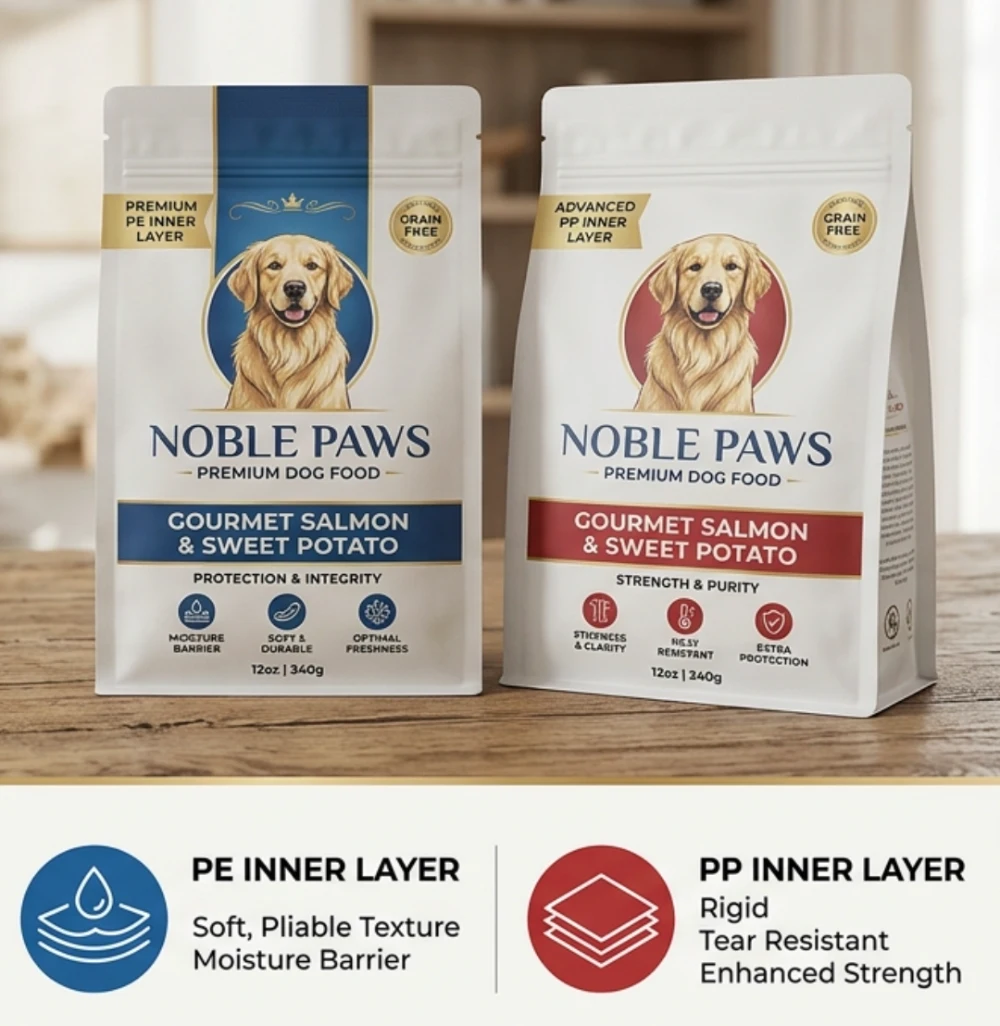
Head-to-Head: PE vs PP for Your Inner Film
Rather than guessing, let's compare the properties that actually matter when you're choosing animal feed packaging materials for your next production run.
| Property | PE (Polyethylene) | PP (Polypropylene) |
|---|---|---|
| Seal Temperature | Lower (approx. 120–150°C) | Higher (approx. 140–170°C) |
| Moisture Barrier | Excellent | Good |
| Puncture Resistance | Superior | Moderate |
| Clarity/Transparency | Moderate (slightly hazy) | High (crystal clear) |
| Stiffness | Low — soft and flexible | High — crisp and rigid |
| Heat Resistance | Lower melting point | Higher melting point |
| Machinability (high-speed lines) | Good | Excellent |
| Cost | Slightly lower | Slightly higher |
| Recyclability | Widely recyclable (#2 or #4) | Recyclable (#5), less collected |
The short version: PE wins on flexibility, seal reliability, and moisture protection. PP wins on clarity, stiffness, and heat tolerance. Neither is universally superior — it depends on your product, your filling line, and your brand goals.
Matching the Material to Your Product Type
Large Bags of Dry Kibble (5–25 kg)
Go with PE. These heavy bags need to survive drops, stacking, and months of shelf time. PE's puncture resistance and strong heat-seal performance protect against burst seams. We see this consistently in our 6,800㎡ cleanroom facility — when we run durability tests on heavy-fill premium dog food bags, PE inner layers outperform PP on drop-test metrics every time.
Small Treat Pouches and Snack Bags
PP often works better here. Treat pouches benefit from that crisp, retail-ready feel. The clarity lets consumers see the product through windows — and pet owners absolutely want to inspect what they're giving their dogs. A 2025 Nielsen IQ study found that 68% of pet treat buyers said visible product windows influenced their purchase decision.
Freeze-Dried or Raw-Coated Products
These premium products demand the strongest barrier you can get. PE inner layers paired with aluminum or EVOH middle barriers create the oxygen-blocking structure that keeps raw coatings stable. Because we hold FDA and ISO 22000 certifications, we recommend this multi-layer approach for any product where freshness directly affects safety.
The Sustainability Factor: What Eco-Conscious Brands Need to Know
Sustainability isn't optional anymore — it's table stakes. Both PE and PP are thermoplastics and technically recyclable, but real-world collection rates differ significantly. PE (especially LDPE) is accepted in more store drop-off programs, while PP recycling infrastructure remains patchy in many regions.
If you're exploring eco-friendly dog food packaging materials, consider mono-material structures. A bag made entirely from PE (including the inner layer) is far easier to recycle than a mixed-material laminate. The trade-off is reduced barrier performance, so this works best for products with shorter shelf-life targets or faster turnover.
Working with brands across North America and Europe, we've found that the most common mistake is claiming "recyclable" on a multi-material bag that no facility actually accepts. Honest labeling builds trust with the ingredient-conscious pet parents your brand is trying to reach.
How Your Inner Layer Choice Affects Shelf Design and Branding
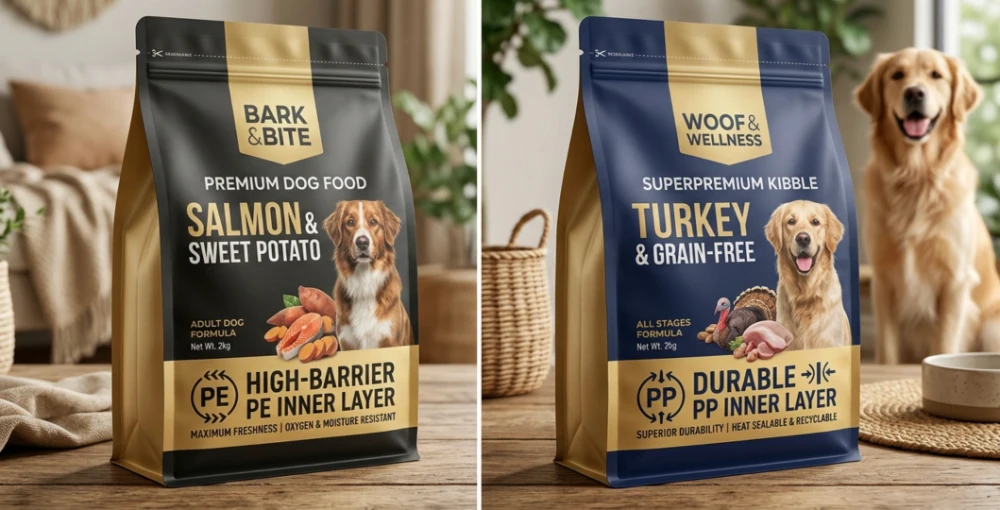
This is where things get interesting. Your inner layer isn't just a functional choice — it affects what your pet food label design can accomplish on the outside. A stiffer PP structure holds its shape better on shelf, making flat-bottom pouches stand upright with confidence. A softer PE structure allows more creative bag shapes and a tactile "premium" feel.
Our in-house design team often helps brands who only have a rough idea of what they want. One thing we consistently advise: decide your inner layer first, then design outward. The film structure dictates print registration accuracy, finish options, and how matte or gloss laminates behave over time.
For brands exploring custom dog food packaging for small businesses, this integrated approach prevents costly mid-production changes. Nail the structure, then build the visual identity on top of it.
Regulations You Can't Afford to Ignore
Both PE and PP are FDA-approved for direct food contact, but that doesn't mean every formulation is compliant. Additives, slip agents, and anti-block compounds vary between suppliers. If your product ships to the EU, you'll also need to meet EC 1935/2004 requirements for food contact materials.
Understanding dog food packaging regulations and requirements upfront saves you from costly recalls or label violations. Key checkpoints include:
- Migration testing — ensuring no harmful substances transfer from film to food
- Correct recycling symbols (Resin Identification Codes) for your market
- State-specific rules (e.g., California Proposition 65 warnings if applicable)
- AAFCO labeling guidelines for nutritional claims on the bag exterior
At YLTPACK, every material we source comes with full compliance documentation. We've found that brands often underestimate the paperwork side — but getting this right from the start prevents delays at customs and retail buyer rejection.
Real-World Decision Framework: A Quick Checklist
Still not sure which inner layer fits your situation? Run through this checklist:
- Fill weight over 5 kg? → Lean toward PE for durability
- Product contains visible fats or oils? → PE for superior moisture barrier
- Need transparent product windows? → PP for clarity
- Running high-speed automated filling? → PP for machinability
- Shipping through hot climates? → PP for heat resistance
- Mono-material recyclability goal? → All-PE structure
- Resealable zipper required? → PE bonds more reliably with zippers
- Small treat pouch under 500g? → PP for shelf presence
If you checked items in both columns, a hybrid approach might be the answer. Some structures use a PE sealant layer with a PP-based outer — combining the advantages of both. This is where an experienced manufacturer can help you engineer the right solution rather than forcing a compromise.
What About Sustainable Dog Food Packaging Trends Moving Forward?
The industry is shifting fast. According to a Smithers report published in early 2026, the global flexible packaging market for pet food is projected to grow 4.8% annually through 2030, with mono-material and recyclable-ready structures driving much of that growth.
Brands aligning with sustainable dog food packaging trends are increasingly asking for PE-based mono-structures with water-based inks and solvent-free adhesives. This combination makes the entire bag recyclable through existing soft-plastic collection streams — a genuine environmental win rather than a greenwashing claim.
PP-based recyclable structures are catching up, but collection infrastructure lags behind. If your timeline is 12–18 months out, PE mono-material gives you the clearest path to credible sustainability claims today.
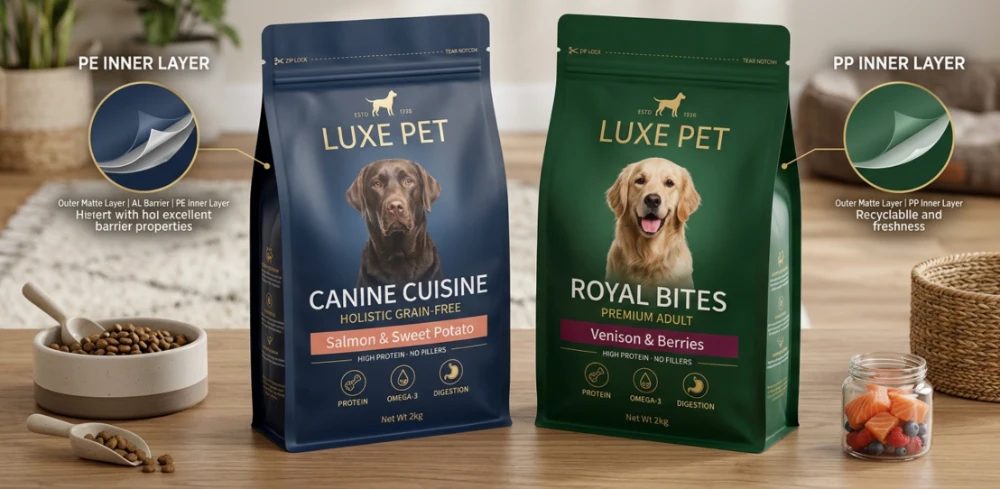
Making Your Final Decision
There's no universal "correct" answer here. The right inner layer depends on your specific product characteristics, distribution environment, filling line capabilities, and brand positioning. What we can tell you after two decades of producing dry dog food pouches and large-format bags is this: most regrets come from choosing based on cost alone.
A slightly more expensive inner layer that protects your product properly, runs smoothly on your filling line, and supports your sustainability story will save money in the long run through fewer returns, less waste, and stronger retailer relationships.
If you're weighing options and want a material recommendation based on your specific product, reach out to our team. We're happy to run sample tests and provide data — no obligation, just clarity.
WhatsApp: +86 182 1944 5665
Email: [email protected]
Frequently Asked Questions
Can I use a PE inner layer for small treat bags, or is PP always better for pouches?
You absolutely can. PE works for small pouches — it just produces a softer, less structured feel. If your brand identity leans toward a matte, artisanal look, PE might actually support that aesthetic better. PP is preferred when you need the bag to stand rigidly on a retail hook or shelf display with crisp edges.
Does the inner layer material affect how long kibble stays fresh?
Yes, but not in isolation. Freshness depends on your complete barrier structure — outer layer, middle barrier (aluminum or EVOH), and inner sealant all working together. PE provides a slightly better moisture barrier than PP, which matters for kibble storage containers and bags holding high-fat formulas prone to oxidation.
Which inner layer is safer for direct contact with pet food?
Both PE and PP are FDA-approved for direct food contact and considered inert. The safety question isn't really about base resin — it's about the additives in a specific film formulation. Always request migration test certificates from your supplier, regardless of which polymer you choose.
What are the best dog food packaging design ideas for 2026 if I want my brand to stand out?
The biggest trend we're seeing is matte-finish bags with tactile coatings combined with one small clear window. This creates a premium unboxing feel while still letting pet owners inspect the product. Pair that with bold, minimal typography and clear ingredient callouts — today's pet parents value transparency over flashy graphics.
How do I choose between PE and PP if I'm launching a new brand with limited volume?
Start with PE. It's more forgiving during production setup, seals at lower temperatures (reducing energy costs on smaller machines), and bonds well with most zipper and valve systems you might add later. As your volume grows and you invest in faster filling lines, you can reassess whether PP's machinability benefits justify a material switch.