You've narrowed your packaging format down to a flexible pouch. Smart move — pouches reduce shipping weight, maximize shelf presence, and cost less per unit than rigid containers at scale. But now comes the question that stalls thousands of procurement decisions every year: should you go with kraft or plastic?
The answer is rarely as simple as "kraft looks natural" or "plastic is cheaper." The right choice depends on your product's barrier needs, your brand positioning, your sustainability commitments, and your total landed cost — not just unit price.
This guide breaks down both options layer by layer, so you can walk into supplier conversations with clarity instead of assumptions. No vague claims. No greenwashing. Just the material science, cost logic, and practical workflow knowledge you need to make a confident decision.
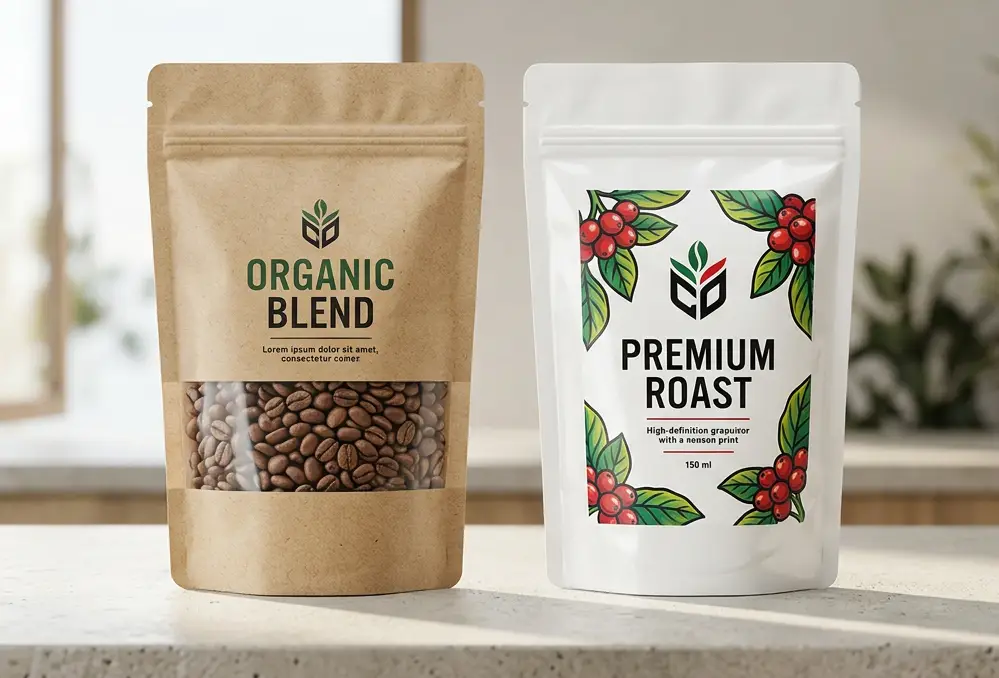
What Exactly Is a Kraft Pouch? (Material Breakdown)
Here's the first misconception worth clearing up: most kraft pouches are not made of pure paper. If they were, they'd offer almost no moisture or oxygen protection. The "kraft" label refers to the outer layer — what your customer sees and touches. What's inside is an entirely different story.
Kraft Paper Pouch Construction — Layers Explained
A kraft pouch is a multi-layer laminate. The outer layer is kraft paper — either virgin or recycled — chosen for its distinctive natural texture and matte, earthy appearance. This is the layer that communicates "organic," "artisan," or "small-batch" to consumers at a glance.
Beneath that outer layer, one or more functional barrier films do the real protective work. Common inner layers include PE (polyethylene) for heat-sealing and basic moisture resistance, PET (polyester) for added strength and printability, aluminum foil for high-barrier oxygen and light protection, or bio-based films like PLA for brands pursuing compostable positioning.
This means kraft paper pouch packaging is fundamentally a laminate product. The structure you choose determines everything — shelf life, recyclability, cost, and food safety compliance. Here are the most common configurations:
| Structure | Barrier Level | Best For | Recyclability |
|---|---|---|---|
| Kraft / PE | Basic | Dry snacks, tea, bakery items | Limited (multi-material) |
| Kraft / PET / PE | Medium | Coffee, nuts, granola | Limited |
| Kraft / AL foil / PE | High | Ground coffee, supplements, pet treats | Not recyclable |
| Kraft / PLA | Basic–Medium | Organic or eco-positioned brands | Commercially compostable |
Understanding this table is critical. A buyer who selects kraft for its "green" appearance but pairs it with an aluminum foil liner has created a package that cannot be recycled in most municipal systems. The outer layer sets the visual tone; the inner layers set the functional reality.
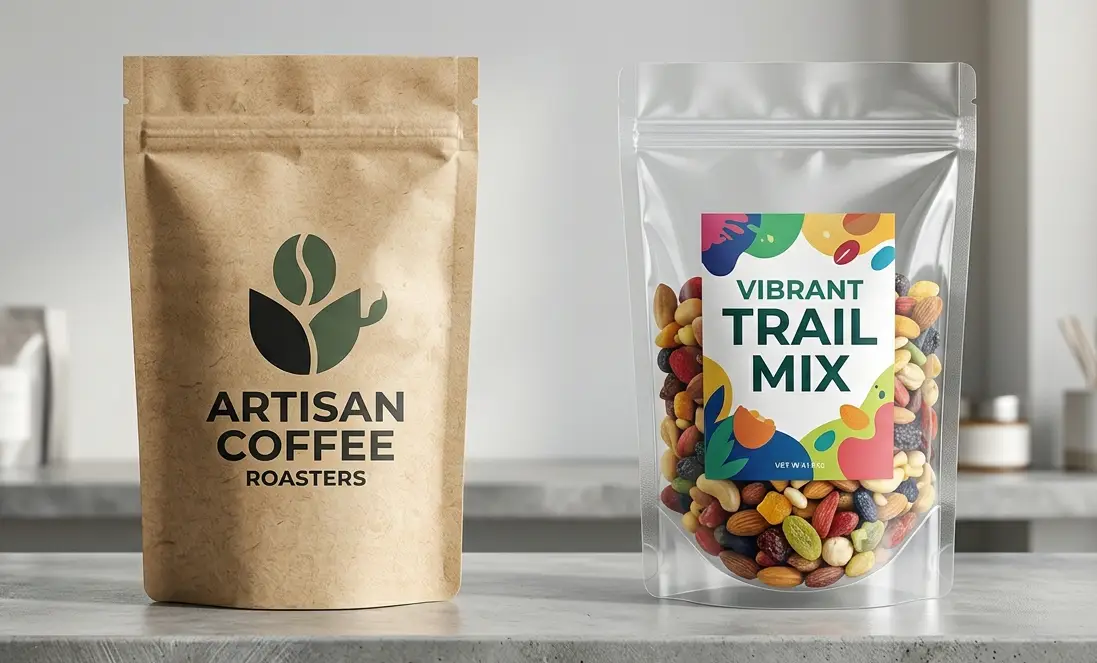
Common Kraft Pouch Formats
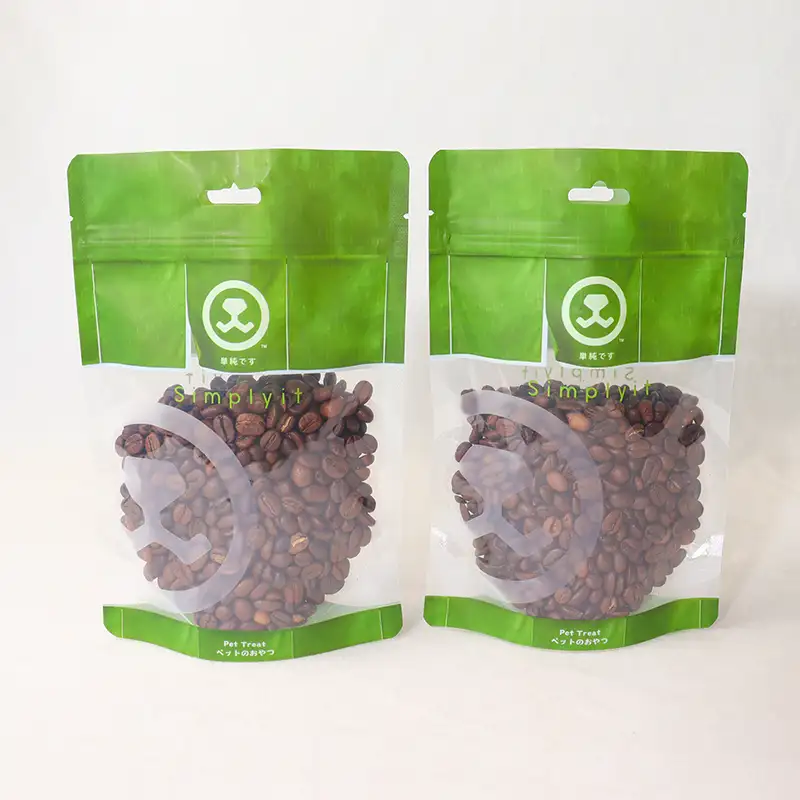
Kraft pouches come in nearly every flexible packaging format available. The most popular is the stand up kraft pouch, available with or without a clear window — the window lets consumers see the product inside while the kraft exterior maintains brand storytelling.
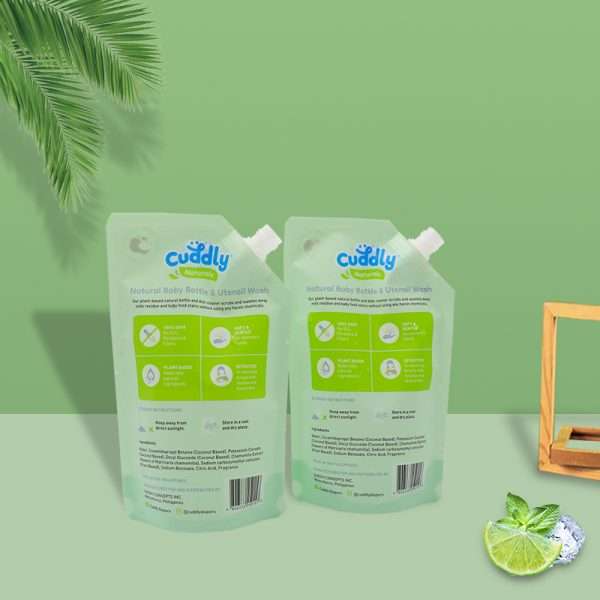
Other common formats include flat bottom kraft bags (ideal for retail shelf stability and a premium unboxing feel), three-side seal kraft pouches (a cost-effective option for sample packs or single-serve portions), and kraft pouches with functional additions like resealable zippers, one-way degassing valves for coffee, or spouts for liquid products.
What Exactly Is a Plastic Pouch? (Material Breakdown)
The term "plastic pouch" covers an enormous range — from a simple single-layer poly bag to a sophisticated multi-layer laminate engineered for retort processing. Understanding this spectrum prevents the common mistake of treating all plastic pouches as interchangeable.
Plastic Pouch Construction — Common Film Types
Plastic pouches are built from various polymer films, each contributing specific properties. PET (polyester) provides excellent clarity, stiffness, and printability. PE (polyethylene) serves as the most common sealant layer, offering strong heat-seal performance and moisture resistance. BOPP (biaxially oriented polypropylene) delivers high clarity and a crisp, glossy finish at low cost.
Nylon adds puncture resistance and flex-crack durability — critical for products with sharp edges or for vacuum-sealed applications. VMPET (metallized polyester) provides a cost-effective oxygen and light barrier without the weight of full aluminum foil. And aluminum foil laminates remain the gold standard for maximum barrier protection against oxygen, moisture, and UV light.
Finish options are virtually unlimited: clear, matte, glossy, soft-touch, holographic, and metallic effects are all achievable on plastic substrates. This design flexibility is one of the primary reasons brands choose plastic pouches for shelf-competitive categories.
One important development worth noting: mono-material plastic pouches — structures made entirely from a single polymer family like all-PE or all-PP — have gained significant traction as a recyclable alternative to traditional multi-layer laminates. These structures are now accepted in an increasing number of recycling streams, making them a genuinely more circular option than many multi-layer kraft alternatives.
Common Plastic Pouch Formats
The stand up pouch dominates the plastic pouch category and represents the most searched format for buyers comparing options. Its bottom gusset allows it to stand upright on shelves, maximizing brand visibility and consumer convenience.
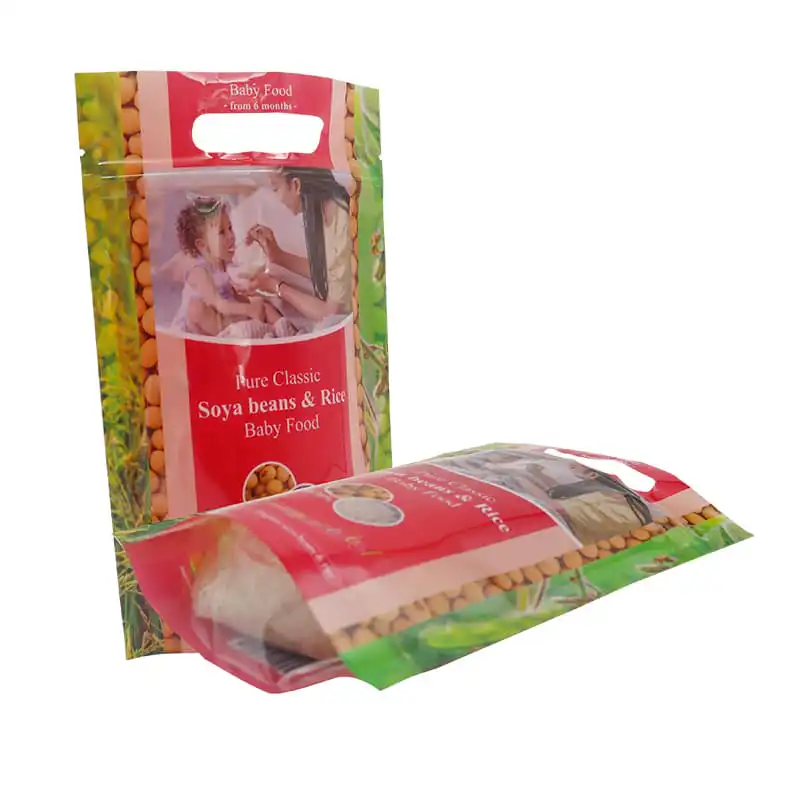
Beyond stand up pouches, plastic formats include flat pouches (sachets, sample packs), side-gusseted bags (common for coffee and pet food), spouted pouches (for liquids, sauces, and baby food), and retort pouches (engineered to withstand high-temperature sterilization for shelf-stable meals and wet pet food).
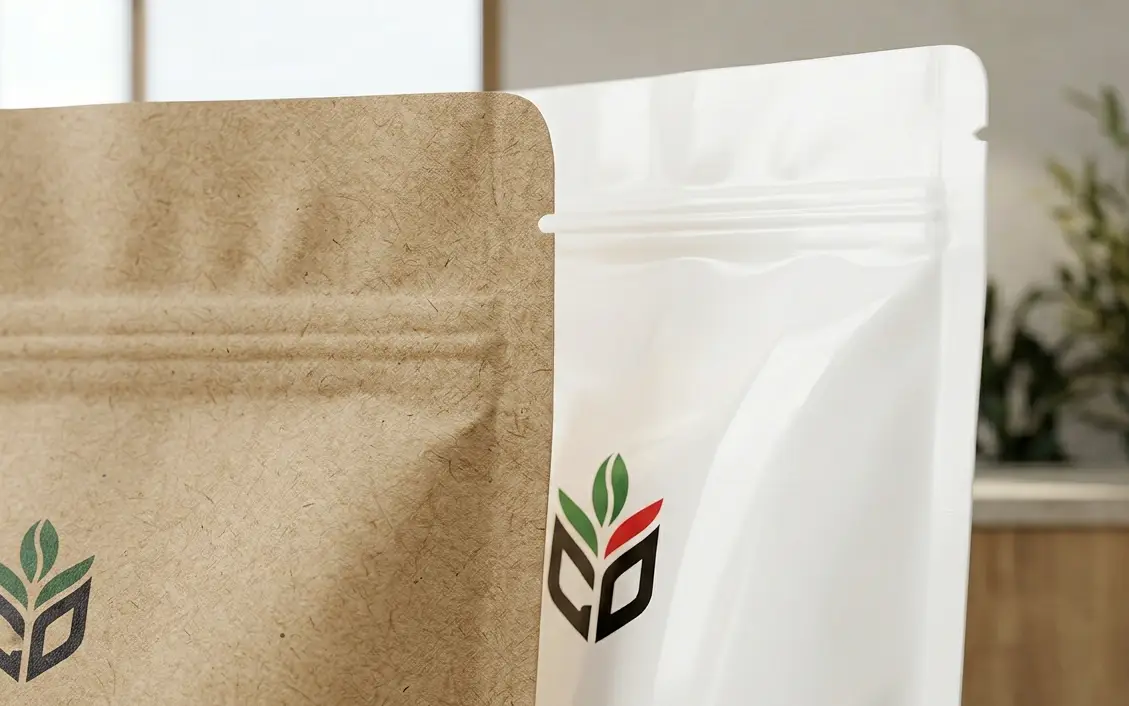
Kraft Pouch vs. Plastic Pouch — Head-to-Head Comparison
This is the section to bookmark. Below is a comprehensive comparison across every factor that typically influences a packaging procurement decision. After the table, we'll unpack the nuances that the table alone can't capture.
| Factor | Kraft Pouch | Plastic Pouch |
|---|---|---|
| Shelf Appearance | Natural, artisan, premium-organic feel | Versatile — glossy, matte, transparent, metallic |
| Printability | Good (matte/natural look); limited vibrancy on kraft surface | Excellent (full CMYK, spot color, high-resolution photo printing) |
| Product Visibility | Only via clear window | Full transparency possible |
| Moisture Barrier | Moderate to high (depends on inner lining) | High to very high |
| Oxygen Barrier | Moderate to high (depends on inner lining) | High to very high |
| Puncture Resistance | Lower (paper outer layer tears more easily) | Higher |
| Weight per Unit | Slightly heavier | Lighter |
| Perceived Sustainability | High (consumers associate kraft with "eco-friendly") | Lower (even if technically recyclable) |
| Actual Recyclability | Complex (multi-layer laminates are hard to recycle) | Improving (mono-material options now available) |
| Shelf Life Extension | Good with AL foil liner | Excellent |
| Cost per Unit (Bulk) | Slightly higher (paper + lamination process) | Generally lower at scale |
| MOQ Flexibility | Comparable | Comparable |
| Ideal Product Categories | Coffee, tea, organic snacks, supplements, artisan foods, pet treats | Snacks, candy, frozen food, liquids, sauces, supplements |
Barrier Performance — When Protection Is Non-Negotiable
For products where shelf life is a primary concern — ground coffee, nutritional supplements, pet food, dried mushrooms — barrier performance should drive your material decision, not aesthetics.
Kraft pouches can match plastic barrier performance when built with an aluminum foil or VMPET inner layer. A kraft/AL foil/PE structure delivers oxygen transmission rates comparable to the highest-performing all-plastic laminates. So if you want the kraft look for a high-barrier product, it's absolutely achievable — you just need to specify the right internal structure.
However, there are applications where plastic is the safer — sometimes the only — option. Retort pouches for shelf-stable meals must withstand temperatures above 121°C during sterilization; kraft paper cannot survive this process. Frozen food pouches need to resist condensation and temperature cycling without delaminating; paper outer layers are vulnerable here. And liquid products (sauces, beverages, baby food) require full moisture impermeability that only all-plastic or foil-laminate structures reliably provide.
Branding & Shelf Appeal — Which Pouch Tells Your Story Better?
Material choice is a branding decision as much as a functional one. A kraft pouch sends an instant signal: natural ingredients, careful sourcing, small-batch quality. This visual shorthand is powerful for organic food brands, specialty coffee roasters, artisan snack makers, and supplement companies targeting health-conscious consumers.
A plastic pouch, by contrast, offers maximum design freedom. Photographic-quality printing, vivid color reproduction, full transparency to showcase the product, metallic finishes, soft-touch coatings — the creative palette is essentially unlimited. For brands competing in visually crowded retail categories like candy, chips, or frozen meals, this flexibility can be the difference between getting picked up and getting passed over.
Many brands find the sweet spot in a hybrid approach: a kraft exterior with a clear window. This combines the natural, trustworthy feel of kraft with the product visibility that drives purchase confidence. Getting this balance right — window size, placement, shape — requires artwork expertise specific to flexible packaging substrates. Working with a manufacturer that has an in-house design team, like YLTPACKING, can streamline this process significantly, especially for brands developing their first custom pouch.
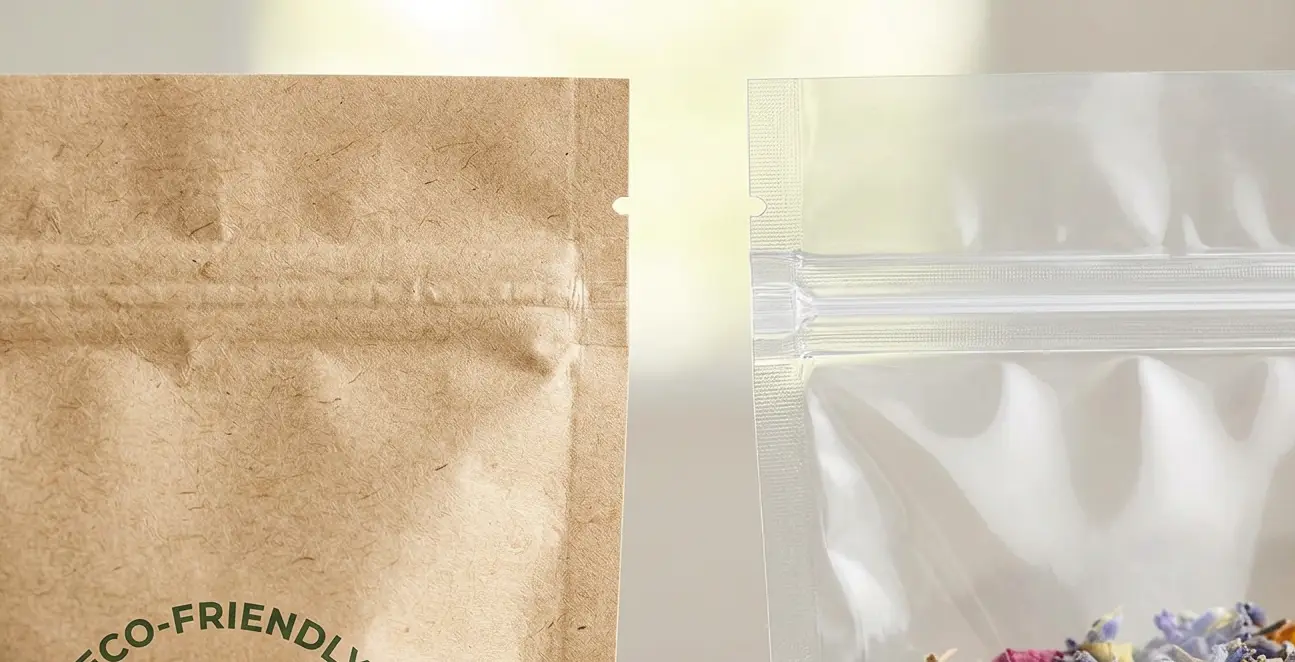
Sustainability — Cutting Through the Greenwashing
This is where honest conversation matters most. Consumer perception and material reality often diverge sharply in the eco-friendly food pouches category.
The perception: Kraft pouches are "green" because they look and feel like paper. Plastic pouches are "bad" because they're plastic.
The reality: A kraft pouch with an aluminum foil inner layer is a multi-material laminate that cannot be separated for recycling in virtually any municipal system worldwide. Meanwhile, a mono-material all-PE stand up pouch — which looks and feels entirely like plastic — may actually be accepted in store drop-off recycling programs and is compatible with mechanical recycling infrastructure that continues to expand.
Compostable options exist. A kraft/PLA structure can be commercially composted — but "commercially compostable" means it requires industrial composting facilities operating at sustained high temperatures. It will not break down in a home compost bin or a landfill. Brands making compostability claims need to understand and communicate these limitations honestly.
The flexible packaging industry has made measurable progress toward recyclable structures. As of 2026, several major resin producers and packaging converters have commercialized high-barrier mono-material films that approach the performance of traditional multi-layer laminates. This trend is reshaping the sustainability calculus: the most recyclable pouch on the market today may well be plastic, not kraft.
The practical takeaway: Choose your structure based on honest lifecycle analysis, not surface-level optics. Then communicate your sustainability story accurately. Consumers increasingly reward transparency over performative green claims.
Cost Considerations for Bulk Custom Orders
Because custom pouches are quoted based on specific dimensions, materials, print complexity, and order volume, no responsible manufacturer will publish a universal price list. But understanding what drives cost helps you budget accurately and negotiate effectively.
Kraft pouches tend to carry a slightly higher per-unit cost than comparable plastic pouches. The kraft paper layer adds material cost, and the lamination process to bond paper to plastic films requires additional production steps. Print vibrancy on kraft is naturally limited by the brown paper surface, which sometimes leads brands to add a white ink base layer — another cost factor.
Plastic pouches benefit from material efficiency (thinner films achieve equivalent or superior barrier performance), lighter weight (reducing shipping costs per unit), and broader material availability. At higher order volumes, these advantages compound.
For both pouch types, cost per unit drops meaningfully as order quantities increase. Printing plate or cylinder fees, machine setup time, and material waste are amortized across more units. This is why MOQ matters — and why working with a manufacturer that owns its own production equipment (rather than outsourcing) often provides better cost efficiency and MOQ flexibility.
Don't overlook hidden costs that can inflate your total spend: artwork revision rounds, color matching iterations, sample shipping, and — most importantly — damage rates. A pouch that costs less per unit but arrives with a 3% puncture rate during transit is not actually cheaper. Experienced manufacturers with rigorous quality control processes, like YLTPACKING's facility with over 20 years of production history, tend to deliver lower defect rates that protect your bottom line over time.
Ordering Custom Kraft or Plastic Pouches — What to Expect from the Process
If you've decided on a pouch type — or narrowed it to two options for sample comparison — here's what the ordering process typically looks like with a capable manufacturer, and how to avoid the most common pitfalls.
Typical Custom Pouch Order Workflow
- Share your product details and packaging goals. What's being packaged? What shelf life do you need? What retail environment will it sit in? What's your target order volume? The more specific you are here, the faster and more accurate the recommendation you'll receive.
- Receive a material and structure recommendation. A knowledgeable manufacturer will suggest specific layer structures, pouch formats, and closure types based on your product's requirements — not just hand you a catalog.
- Artwork design and file preparation. You provide your brand assets, and the manufacturer creates a print-ready file mapped to the exact pouch dimensions and bleed requirements. Manufacturers with in-house design teams can handle this end-to-end; others may require you to supply finished artwork.
- Sample production and approval. Physical samples let you evaluate print quality, material feel, seal strength, and overall appearance before committing to a full production run. Never skip this step.
- Bulk production. Once samples are approved, full production begins. Timelines vary by complexity and volume, but a well-equipped factory typically delivers within 15–25 business days for standard orders.
- Quality inspection and shipping. A thorough QC process — including seal integrity testing, print color verification, and dimensional checks — should happen before any order leaves the facility. Ask your manufacturer what specific inspections they perform and whether you can receive a QC report with photos.
Key Questions to Ask Any Pouch Manufacturer
Not all suppliers operate at the same standard. Before you commit to a production partner, these questions will help you separate capable manufacturers from middlemen and under-equipped facilities:
- What certifications do you hold? FDA registration, ISO 9001, BRC, or equivalent food safety certifications are non-negotiable for food-contact packaging. Ask for documentation, not just claims.
- Can you provide material test reports? Reputable manufacturers can supply migration testing results, solvent residue reports, and barrier performance data for the specific structures they recommend.
- Do you offer design support, or do you only accept print-ready files? If you're a growing brand without a dedicated packaging designer, in-house design capability at the factory level saves time and reduces costly revision cycles.
- What's your production capacity and typical lead time? A manufacturer running its own equipment can give you reliable timelines. A trading company relying on third-party factories often cannot.
- Can I get physical samples before committing to a full order? Any manufacturer confident in their output will say yes without hesitation.
These questions establish a baseline for what "good" looks like in a packaging partner. For reference, YLTPACKING operates a 6,800㎡ dust-free production facility with in-house printing, laminating, bag-making, and quality control — meaning every step from file preparation to final inspection happens under one roof. This integrated setup is the benchmark you should measure other suppliers against, because it directly impacts consistency, lead time reliability, and your ability to resolve issues quickly.
Common Mistakes to Avoid
Choosing kraft purely for aesthetics without verifying barrier requirements. A beautiful kraft pouch that allows your coffee to go stale in three weeks is a branding failure, not a branding win. Always start with your product's protection needs, then work backward to appearance.
Assuming "plastic = bad" without evaluating mono-material recyclable options. As discussed in the sustainability section, the most recyclable flexible packaging option available today may be an all-PE plastic pouch — not a multi-layer kraft laminate. Let data guide your environmental claims.
Skipping sample testing before bulk production. Samples cost a small fraction of a failed production run. Test your product inside the pouch under real storage conditions — not just on a conference table. Check for seal integrity, aroma retention, and visual appearance after one, two, and four weeks.
Overlooking total landed cost. Unit price is only one component. Factor in shipping weight (kraft is heavier), damage rates during transit (paper outer layers are more vulnerable to scuffing and tearing), and potential waste from barrier failures. A pouch that costs a fraction more per unit but arrives intact and performs reliably is the more economical choice over a full production cycle.
Frequently Asked Questions
Are kraft pouches actually better for the environment than plastic pouches?
Not automatically. Most kraft pouches contain plastic or aluminum inner layers that make them difficult to separate and recycle through standard municipal systems. The honest answer is that sustainability depends on the complete layer structure, not just the visible outer material. In many cases, mono-material plastic pouches — made entirely from PE or PP — are now easier to recycle than multi-layer kraft alternatives. Evaluate the full construction before making environmental claims.
Can kraft pouches keep coffee fresh as long as plastic pouches?
Yes — when the kraft pouch includes an aluminum foil or VMPET inner barrier layer combined with a one-way degassing valve, it can deliver shelf-life performance comparable to all-plastic coffee pouches. The freshness protection comes from the internal barrier, not the external material. Specify the right inner structure, and kraft performs excellently for coffee applications.
What's the minimum order quantity (MOQ) for custom kraft or plastic pouches?
MOQs vary based on pouch dimensions, material structure, and print specifications. Manufacturers that own their production equipment — rather than outsourcing to third parties — can typically offer more flexible minimums, especially for standard pouch sizes and common structures. YLTPACKING, with over 20 years of manufacturing experience and fully owned production lines, works with brands at various scales, from emerging startups testing their first SKU to established companies running high-volume repeat orders.
Are kraft stand up pouches FDA-approved for food packaging?
Kraft pouches can absolutely be FDA-compliant for direct food contact — but compliance is determined by the specific materials used across all layers, not just the outer kraft paper. The inner sealant layer, any adhesives used in lamination, and any inks that could migrate through the structure all factor into food safety certification. Always request food-grade material certificates and compliance documentation from your supplier. Look for manufacturers with FDA registration and ISO certification as baseline qualifications.
How do I decide between a kraft pouch with a window and a fully transparent plastic pouch?
Consider what drives the purchase decision for your specific product. If product visibility is the primary conversion factor — think colorful candy, visually appealing granola clusters, or uniquely shaped pasta — a fully transparent plastic pouch lets the product sell itself. If your brand narrative centers on natural ingredients, artisan craftsmanship, or organic sourcing, a kraft pouch with a strategically sized window offers the strongest balance: it reinforces your brand identity while still giving consumers a reassuring glimpse of what's inside. Many successful brands test both formats with small initial runs before committing to a single direction at scale.
Can one manufacturer produce both kraft and plastic pouches?
Yes — and working with a single supplier for both formats offers meaningful advantages. You consolidate communication, maintain consistent quality standards, and simplify logistics. A manufacturer with comprehensive capabilities can also produce comparison samples in both materials, helping you make a side-by-side evaluation with your actual product inside. This is far more reliable than choosing based on stock photos or material descriptions alone.
Ready to evaluate your options with real samples? Share your product details, target shelf life, and branding goals with the YLTPACKING team. With FDA and ISO certifications, a dedicated design team, and two decades of flexible packaging production experience, we'll recommend the right structure — kraft, plastic, or both — and send you physical samples so you can make your decision with confidence, not guesswork.