One word on a pouch can get it pulled from the shelf. If you print "biodegradable" on the back panel without proof, a retailer's compliance team or a regulator may ask for test data you do not have. So how long does it take a plastic bag to biodegrade? The answer depends mostly on the material and on where the bag ends up. That makes it a packaging spec decision as well as an environmental question.
A conventional polyethylene (PE) bag does not biodegrade on any timescale a brand can put on a label. It breaks into smaller pieces over decades or longer. If you want a breakdown claim, you need a certified compostable structure, a named standard and a disposal route that matches the claim. Mono-PE and recycled-content films support narrower claims about recycling or recycled content.
How Long Does It Take a Plastic Bag to Biodegrade?
A standard PE bag has no reliable biodegradation time. Microbes break down polyethylene very poorly, so the film slowly fragments instead of turning into natural compounds. The decomposition times quoted online are usually decades or centuries. They are projections from short lab ageing and field observation. No test has actually run that long.
Why Every Plastic Bag Decomposition Time Figure Is an Estimate
Nobody has watched a PE bag for 500 years. Published figures extrapolate from short tests, and real conditions vary widely. A bag on a sunny beach ages at a very different rate from one buried in compacted landfill or one drifting in cold seawater.
Treat any single number as a talking point, not a spec. It should never appear on a pouch.
What "Biodegrade" Actually Means
Biodegradation is the process in which microorganisms turn a material into carbon dioxide (or methane, where there is no oxygen), water and biomass. Fragmentation is different. The plastic gets smaller but stays plastic. A claim only means something when it describes biodegradation under stated conditions within a stated time.
Do Plastic Bags Biodegrade in Landfill?
Plastic bags mostly do not biodegrade in landfill. Modern landfills are compacted, capped and short of oxygen, light and moisture. Even materials designed to break down usually do so very slowly there. Compostable film sent to landfill can stay largely intact for years, and what does break down without oxygen can give off methane.
Photodegradation vs Biodegradation
Photodegradation is the breakdown of polymer chains by ultraviolet light. Sunlight makes PE film brittle. The film cracks and flakes until the bag seems to disappear, but the polymer is still there in smaller pieces. Buried bags get almost no UV, so landfill slows down even this partial process.
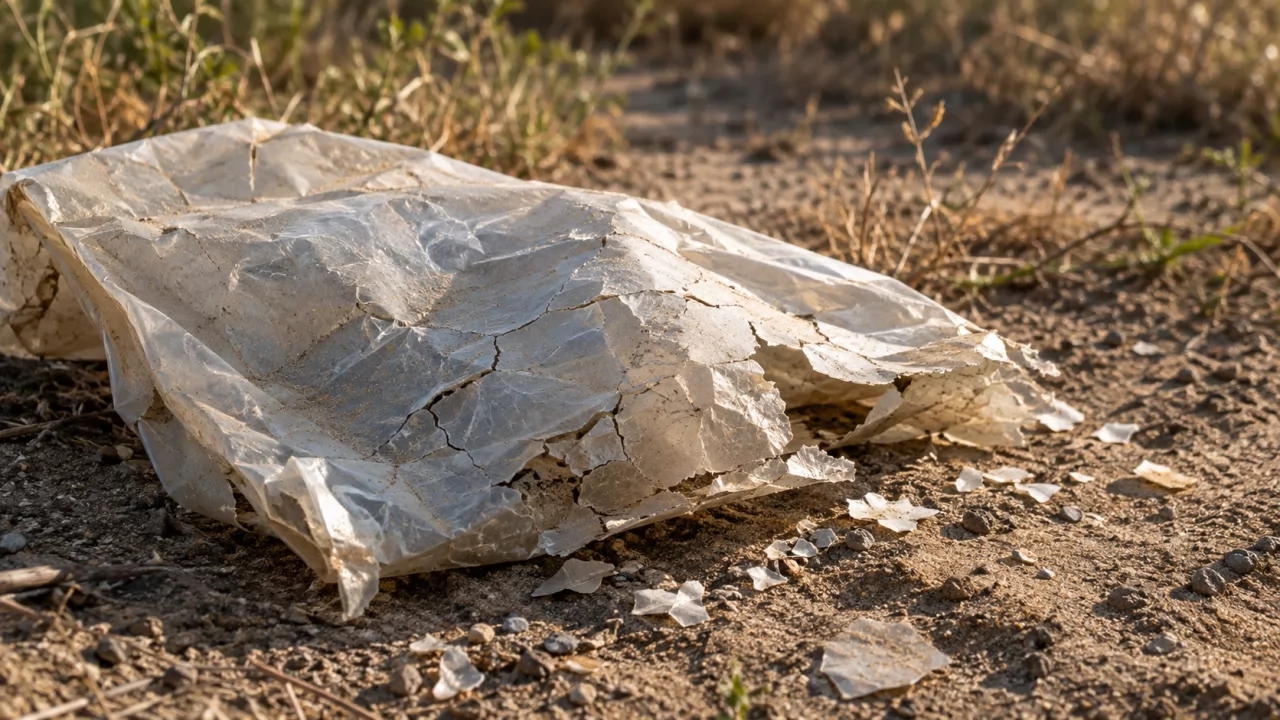
Microplastics From Plastic Bag Degradation
Microplastics are plastic fragments smaller than 5 mm, the size limit most commonly used. Pieces that break off a bag and never fully biodegrade can stay in soil and water as microplastics.
That risk is the main reason regulators distrust "degradable" claims. A film that fragments faster can spread more particles, not fewer.
Compostable vs Biodegradable Plastic Bags: What Each Label Really Means
"Compostable" and "biodegradable" are not interchangeable labels. "Biodegradable" with no stated conditions or timeframe tells a buyer almost nothing, because almost everything breaks down eventually. "Compostable" is tied to a defined test standard such as EN 13432 and to a defined disposal route, industrial or home composting, with limits on time and residue.
Compostable packaging is packaging certified to break up and biodegrade in a composting process within a fixed period, without leaving harmful residue. "Biodegradable" is a looser word, and several markets restrict its use on plastic products.
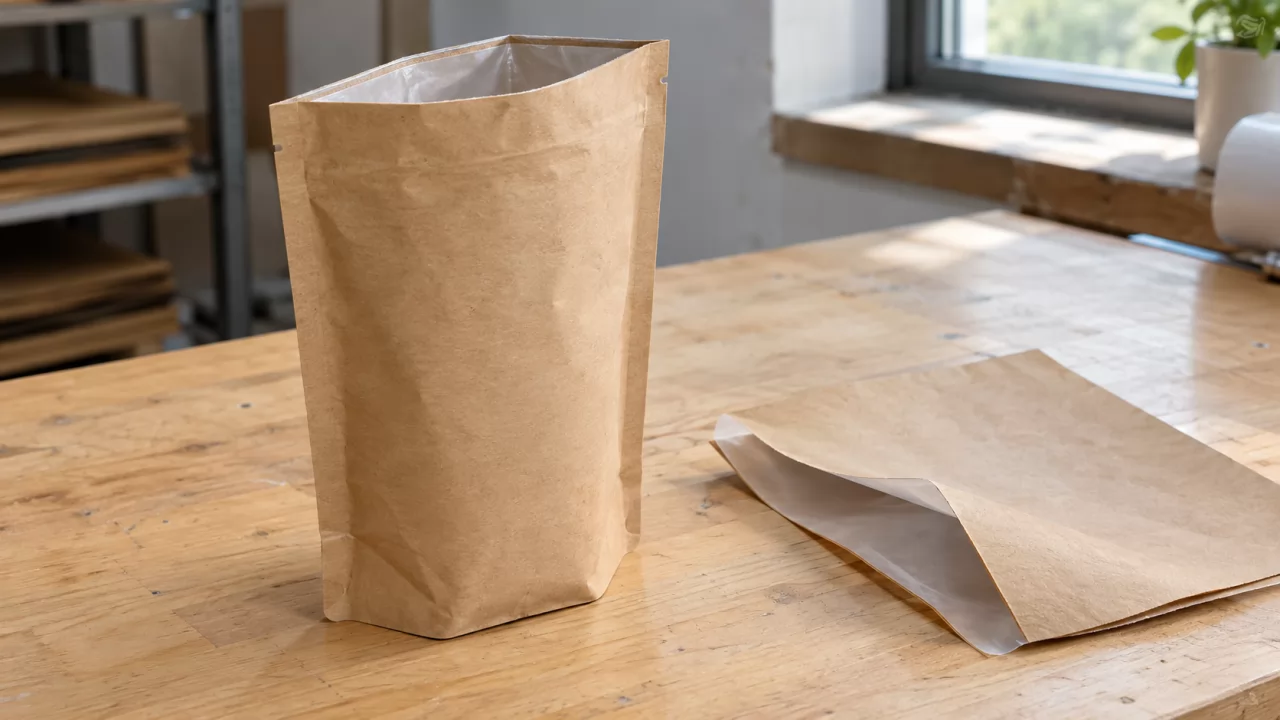
Comparison: How Common Pouch Materials Behave at End of Life
| Material | Designed disposal route | How it typically breaks down | Claim risk |
|---|---|---|---|
| Conventional PE laminate (e.g. PET/PE) | None specific; usually landfill or energy recovery | Fragments slowly; no meaningful biodegradation | High if any breakdown claim is printed |
| Oxo-degradable PE | None; an additive makes the film fragment | Faster fragmentation into microplastics | Very high; banned in the EU |
| Compostable kraft/PLA | Industrial composting; home only if certified for it | Biodegrades under composting conditions; slow in landfill | Lower with a certificate for the exact structure; high without |
| Mono-PE | PE film recycling where it is collected | Does not biodegrade; built to be recycled | Medium; a recyclable claim depends on local collection |
| PCR / recycled-content film | Same as the base film | Same as the base film; no biodegradation benefit | Lower with GRS chain of custody; high without |
| Foil or mylar laminate | Landfill or energy recovery | Does not biodegrade; layers are hard to separate | Do not claim recyclable or degradable |
Only certified compostable structures can support a breakdown claim. The other materials support a recycling or recycled-content claim at most, or no environmental claim at all.
Why Compostable Does Not Mean "Breaks Down Anywhere"
Industrial composting is hotter, wetter and more tightly controlled than a garden heap. EN 13432 requires packaging to break up within 12 weeks and reach 90% biodegradation within six months under those test conditions. Home composting is cooler and less predictable.
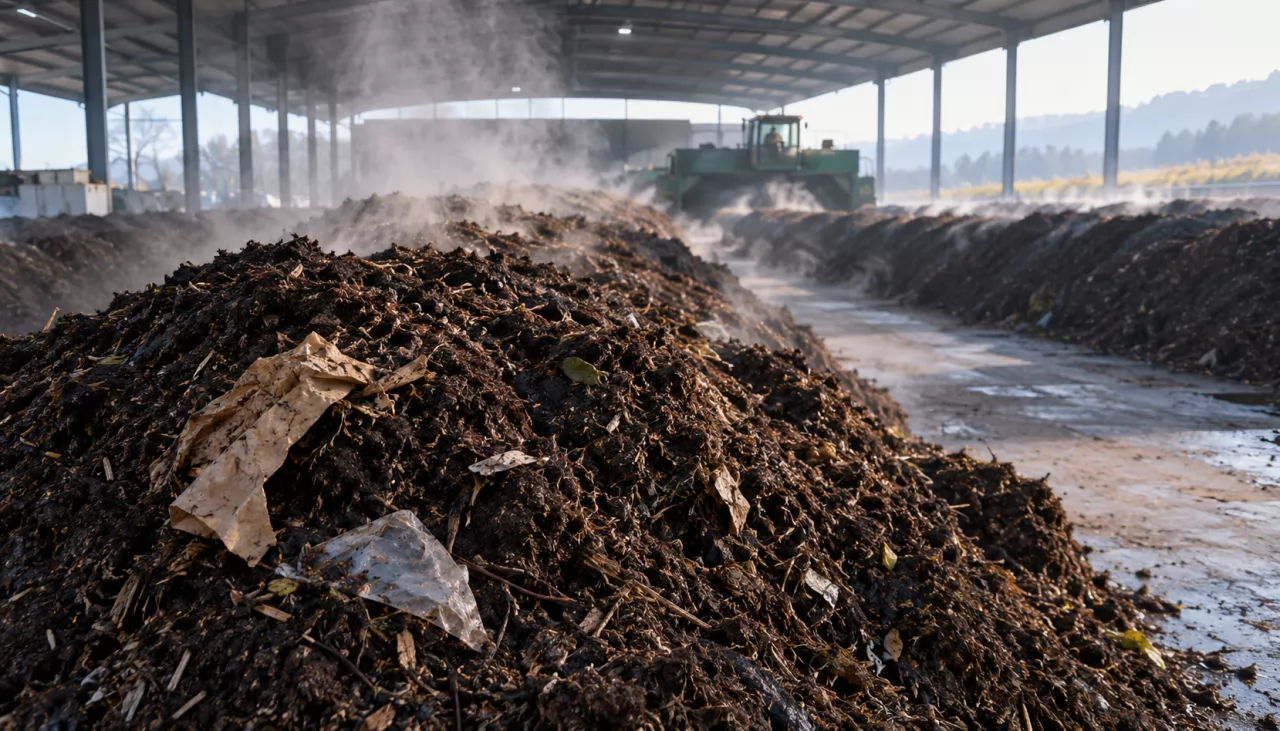
In landfill or seawater, certified compostable film can behave much like ordinary plastic for a long time. If few people in your market can reach an industrial composter, an industrial-compost claim may be true on paper and useless in practice.
Which Standards and Certificates Back a Breakdown Claim?
A breakdown claim on a pouch only holds up if it names a recognized standard and is backed by a certificate for the exact film structure in your bag. A certificate for one layer, or for a different gauge, does not cover the finished laminate. Retailers and regulators typically ask for both the standard and the certificate.
Composting and Biodegradation Standards
- EN 13432: European standard for packaging recoverable through industrial composting and biodegradation.
- ASTM D6400: US specification for plastics designed to compost aerobically in municipal or industrial facilities.
- ISO 17088: International specification for compostable plastics.
- TÜV Austria OK compost HOME: Certification scheme for home-compostable products.
- AS 5810: Australian standard for biodegradable plastics suitable for home composting.
Claim Rules in Your Target Market
- United States: The FTC Green Guides (16 CFR Part 260) require environmental claims to be qualified and backed by evidence. California law prohibits labeling plastic products as "biodegradable", "degradable" or "decomposable".
- European Union: The Single-Use Plastics Directive (Directive (EU) 2019/904) bans oxo-degradable plastic products. Directive (EU) 2024/825 restricts generic environmental claims made without proof.
- Recycled content: The Global Recycled Standard (GRS) verifies chain of custody for recycled material. YLTPACK holds GRS certification, and film certificates are sent with the quote.
- Food contact: Environmental claims come on top of food-contact rules, such as FDA 21 CFR in the US and Regulation (EC) No 1935/2004 in the EU. At YLTPACK, the PE film is tested to FDA 21 CFR food-contact requirements.
Common Mistakes That Catch Brands Out
Most pouch claim problems come from a few repeated assumptions about materials and wording. Checking each one against the film structure and the target market before artwork goes to print is far cheaper than a reprint, a relabel or a delisting after the bags have shipped.
- Treating "biodegradable" as a selling point. In California the word is prohibited on plastic products, and in the EU an unqualified claim invites challenge. Use a qualified, certified claim such as "industrially compostable, certified to EN 13432", or leave the claim off.
- Adding oxo-degradable additives to PE. The additive speeds up fragmentation, not biodegradation, and the EU bans it. Choose a certified compostable structure or a mono-PE film instead.
- Assuming a kraft outer layer makes the pouch compostable. The inner layers decide what happens at end of life. Kraft laminated to PET, foil or standard PE is not compostable, so check every layer and the adhesive.
- Calling foil or mylar pouches recyclable. These laminates do not support a recyclable claim. If your product needs foil-level barrier, take environmental claims off the artwork.
- Switching structure without retesting barrier and MOQ. Compostable and mono-PE films generally give lower barrier than foil, so shelf life can change. Test a sample with your actual product. The MOQ changes too: at YLTPACK, compostable, recyclable mono-PE and recycled-content structures start at 30,000 pcs per design. Standard structures start at 1,000 pcs for digital print and 10,000 pcs for gravure.
FAQ
How long does compostable packaging take to break down?
Typically weeks to a few months in an industrial composting facility, within the limits set by the certifying standard. Home composting is usually slower. In landfill the timescale is unpredictable.
Can a compostable pouch hold coffee or oily snacks?
Sometimes. Barrier is generally lower than foil, so oxygen, moisture and grease resistance need to be checked against your product and the shelf life you need. For fresh coffee, also confirm that the degassing valve fits the claim.
Are foil or mylar pouches recyclable?
No. Do not put a recyclable claim on a foil or mylar laminate. If you need that claim, ask for a mono-PE structure and test its barrier first.
What is the MOQ for compostable or mono-PE pouches?
30,000 pcs per design at YLTPACK. Pricing depends on material, size, print colors and extras, and is itemized in the quote.
Get a Structure Recommendation for Your Pouch
Send your product, fill weight, quantity per design and target market to [email protected] or WhatsApp +86 182 1944 5665. Within one business day you get an itemized quote with a recommended structure and the film certificates. The sample is free and you pay the courier. Production takes 7-15 days after artwork approval.