The Quick Verdict: Safe, But Only When Built Right
A spouted pouch is just as safe as a glass jar or a can, provided the film, the cap, and the filling process all meet food-contact standards. The packaging itself does not spoil food. What protects the contents is the barrier structure and a clean, properly sealed fill.
Where things go wrong is almost never the shape. It is the cheap film, the wrong cap material, or a filling line that introduced contamination. Get those three right and you have a format that pediatric brands and jam makers trust every single day.
Working with brands across North America, we have found that the most common mistake is choosing a film based on price alone, then discovering it cannot survive the heat of pasteurization. Safety starts at material selection, not at the seal.
What Actually Makes a Squeeze Pouch Food-Safe?
Safety in flexible packaging comes down to a few measurable things. None of them are visible to the naked eye, which is exactly why sourcing matters so much. Here is what determines whether a pack is genuinely safe for sensitive products.
1. Food-grade, migration-tested film
The inner layer that touches the food must be food-contact compliant, meaning it will not leach chemicals into the product. Look for compliance with FDA 21 CFR and EU Regulation 10/2011. These standards cap how much, if anything, can migrate from packaging into food.
2. BPA-free and phthalate-free construction
Parents read labels obsessively, and rightly so. A reputable supplier will document that every layer, including the cap, is free of BPA and phthalates. This is non-negotiable for anything aimed at infants.
3. A strong oxygen and moisture barrier
Baby purees and fruit jellies are wet, acidic, and prone to spoilage. The right multi-layer structure keeps oxygen out, which protects color, nutrients, and shelf life. A weak barrier is where mold and off-flavors creep in.
4. Heat tolerance for sterilization
Most shelf-stable baby food is retort-processed, meaning the filled pack is cooked under pressure. That demands a film engineered to survive 121°C without delaminating. Standard snack film will fail here, and a failed seam is a safety hazard.
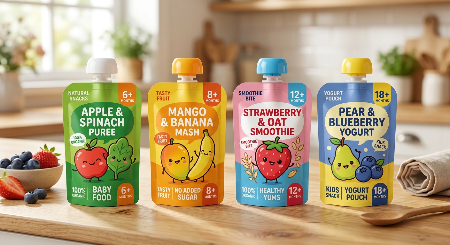
Baby Food vs. Jelly: Same Format, Different Demands
People lump these two together because the packaging looks identical. Under the surface, they ask very different things from the material. The table below breaks down what each product really needs.
| Requirement | Baby Food / Puree | Jelly / Fruit Spread |
|---|---|---|
| Processing method | Usually retort sterilization (high heat) | Hot-fill or pasteurization |
| Acidity level | Low to moderate, often near neutral | High acid, sugar-heavy |
| Barrier priority | Oxygen + nutrient protection | Moisture + aroma retention |
| Cap concern | Choke-safe spout, tamper-evident | Clean dispensing, no drip |
| Regulatory focus | Infant-grade migration limits | Standard food-contact compliance |
Notice the spout itself matters more for baby products. Regulators in several markets require infant spouts to meet choking-hazard dimensions, and many brands now add a removable cover the child cannot detach alone. For jelly, the focus shifts to clean dispensing and keeping that bright, fresh flavor locked in.
Reusable or Single-Use? The Decision That Shapes Everything
This question changes your whole material spec, so it is worth settling early. Each route has a clear use case, and neither is automatically better.
- Single-use, retort-grade: The standard for commercial baby food and store-shelf jelly. Sealed once at the factory, sterilized, and never reopened for refilling. This is the safest path for mass retail.
- Reusable, fill-at-home: Popular with parents who make fresh purees. These reusable pouches with spouts for baby food are designed for repeated washing and home filling, so the film and zipper must handle dishwasher cycles without breaking down.
If you are selling a finished, shelf-stable product, go single-use and retort-capable. If your brand sells empty packs for parents to fill themselves, durability and easy cleaning become the safety story you tell.
How to Vet a Packaging Partner Before You Commit
Honestly, this is where most safety problems are won or lost. A beautiful design printed on weak film is still unsafe. Use this checklist when you compare suppliers, and treat any missing item as a red flag.
- Can they show current FDA and ISO 22000 certificates, not expired ones?
- Do they provide migration test reports for the exact film you are buying?
- Is the production environment a controlled cleanroom, not an open warehouse?
- Will they run a retort or hot-fill compatibility test on your specific recipe?
- Do they document BPA-free and phthalate-free status for film and caps?
- Can they trace each material batch if a problem ever surfaces?
As a manufacturer that has produced flexible packaging for more than twenty years, I can tell you that the suppliers who hesitate on these questions are the ones to avoid. Certifications should arrive within minutes of asking, not after a week of stalling.
Because we hold FDA and ISO 22000 certifications, we recommend that any brand entering the baby category request the full migration test report up front. It is the single document that separates a compliant pack from a risky one.
The Cleanroom Factor Nobody Talks About
Food safety is not only about the film. It is also about where the pack is made. Dust, airborne bacteria, and stray particles can contaminate a pouch long before your product ever goes in.
In our 6,800㎡ cleanroom facility, air filtration and controlled access keep particulate counts low, which matters enormously for infant products. When you are comparing quotes, ask whether the packs are produced in a clean, monitored space. A lower number on the invoice means nothing if the environment introduces risk.
For high-volume programs, this also affects consistency. Brands ordering stand up pouches with spouts bulk need every unit identical, because one weak seam in a pallet of thousands can trigger a recall. Controlled production is what keeps that quality steady at scale.
Customization Without Compromising Safety
Here is the good news: you do not have to choose between safety and a pack that looks fantastic on the shelf. Modern printing and structural options let you do both, as long as the inks and adhesives stay on the outer layers, far from the food.
Printing and branding
Food-safe inks, matte or gloss finishes, and clear windows are all fair game. For brands ordering custom printed pouches with spouts for liquids, the key is keeping every printed element on the exterior film so nothing migrates inward. Our in-house design team often helps brands who only have a rough sketch turn it into a print-ready file that respects those safety boundaries.
Spout and cap choices
Spout diameter, cap color, and tamper-evident bands can all be tailored. A wider spout suits thicker purees, while a narrow one gives jelly cleaner control. Tamper-evident features are quickly becoming an expectation, not a luxury, especially for products aimed at children.
Format flexibility
The same safe structure can be adapted across categories. Beverage and wellness brands launching refillable pouches with spouts for smoothies use nearly the same barrier film as baby purees, just tuned for cold-chain or ambient distribution. One reliable structure, many product lines.
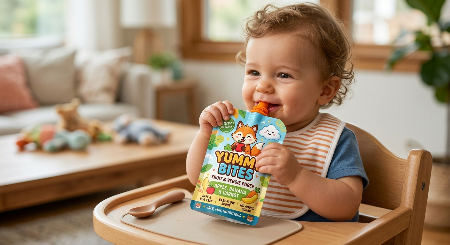
Industry Reality: What Buyers Get Wrong
After two decades watching brands enter this space, the same patterns repeat. Knowing them ahead of time saves you money and protects your launch.
- Ordering before testing the recipe. A pack that handles water may not handle a high-acid jelly. Always run a compatibility test with your actual formula first.
- Underestimating barrier needs. Brands chase a thinner film to cut cost, then watch shelf life collapse. Nutrient loss in baby food is a safety and reputation issue, not just a quality one.
- Ignoring spout regulations. Infant spout dimensions are regulated in several regions. Skipping this step can block your product from retail entirely.
- Forgetting traceability. If you cannot trace a batch, you cannot manage a recall cleanly. That documentation is worth its weight in gold the one day you need it.
For companies sourcing plastic pouches with spouts wholesale, these mistakes scale up fast. A small spec error multiplied across a large order becomes an expensive problem, which is exactly why the testing phase deserves your patience.
A Simple Pre-Launch Safety Checklist
Before your first big run, walk through this quick list. If you can tick every box, you are in genuinely solid shape.
| Checkpoint | Why it matters |
|---|---|
| Migration report on file | Proves nothing leaches into food |
| Recipe compatibility test passed | Confirms film survives your process |
| BPA & phthalate-free confirmed | Meets parent and regulator expectations |
| Spout meets infant-safety dimensions | Avoids choking-hazard and retail blocks |
| Cleanroom production verified | Reduces contamination risk |
| Batch traceability in place | Enables fast, clean recall if needed |
The Bottom Line
So, are these squeeze packs safe for baby food or jelly? Absolutely, when the material, the spout, the sterilization, and the production environment all line up. The format has earned its place on store shelves because, done properly, it protects delicate food as well as glass and far more conveniently.
The real safety decision is not about the pouch shape at all. It is about choosing a partner who can prove their film, document their certifications, and test against your specific recipe. Get that right, and you give your product the protection it deserves and your customers the confidence they expect.
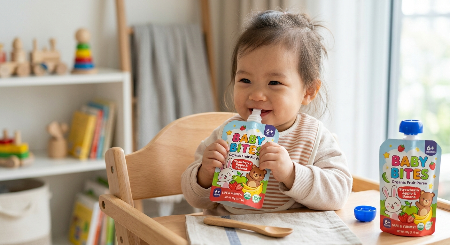
Talk to Our Packaging Team
Ready to test a sample against your own recipe or request migration reports for a specific film? We are happy to walk through your project and share certificates up front. Reach us directly and we will respond quickly.
- WhatsApp: +86 182 1944 5665
- Email: [email protected]
Frequently Asked Questions
Are spouted pouches safe for newborn formula?
For powdered formula, the barrier and moisture protection matter most, and a properly sterilized, food-grade pack handles it well. For ready-to-feed liquid formula, you will need a retort-capable structure and an infant-safe spout. Always confirm migration testing for products this sensitive.
Can high-acid jelly damage the inner film over time?
Only if the film is not rated for acidic contents. A correctly specified barrier layer resists acid and sugar for the product's full shelf life. This is why a recipe compatibility test before bulk ordering is so important.
How long do these packs keep baby food fresh?
Shelf-stable, retort-processed purees commonly hold 12 to 18 months when the oxygen barrier is strong. Refrigerated or home-filled versions last only a few days. The barrier structure, not the shape, drives that number.
What certifications should I ask my supplier for?
At minimum, request current FDA food-contact compliance and ISO 22000 food-safety certification. For sustainability-focused brands, GRS certification on recycled content is a strong bonus. Ask to see the actual documents, not just claims on a website.
Is it cheaper to order in large volumes?
Per-unit cost generally improves with volume, though exact figures depend on your size, film spec, and finish. The smarter saving comes from getting the specification right the first time, which avoids reprints, failed batches, and recalls. Quality consistency at scale is where a controlled production setup truly pays off.