"It's starch, so it's compostable." That sentence skips what decides the claim: how the chips are made, what binder or coating they carry, and where they end up. A typical order looks like this. A distributor moving boxed housewares wants loose fill that fits a sustainability policy without more breakage. This article works backwards from a good result to the specs and checks that produce it, starting with the brief you give a custom biodegradable packing chips manufacturer.
Custom biodegradable packing chips are loose-fill cushioning pieces, usually extruded from starch, made to a specified shape, size and density. They suit you if you ship fragile goods and need an environmental claim you can defend. Specify the material structure, the test standard behind the claim and the density range, then verify all three on a sample lot.
What a Good Result Looks Like
A good result has four parts: breakage no higher than with the loose fill you replace, a carton that opens without a mess, an environmental claim backed by a named test report, and chips that behave the same in every lot. If one is missing, the switch costs more than it saves.
Protection that holds
Void fill does its job only if it keeps the product away from the carton walls for the whole trip. Chips settle under vibration, and a carton packed full at the pack bench can have a gap at the top by the time it reaches the customer. Judge any chip against your own drop and vibration tests, using your real cartons and your real products. Supplier cushioning claims are generic. Your product's fragility and weight are not.
A claim you can defend
"Eco-friendly" on a carton invites a challenge from a retailer, a customer or a regulator. A defensible claim names a structure (what the chip is made of), a test basis (which standard it was tested to) and a scope (industrial composting, home composting, or neither). If your market has green-claims rules, such as the US Federal Trade Commission's Green Guides or EU consumer-protection rules on environmental claims, vague wording is the first thing that gets challenged.
Consistency between lots
Chip size, bulk density and moisture content should stay stable from one shipment to the next. A lot that is lighter or drier than the approved sample packs differently, compresses differently and may break differently. Put the acceptable range in the order terms, not just in the sample you liked.
Are Biodegradable Packing Peanuts Really Compostable?
Not automatically. Starch-based packing peanuts are biodegradable in principle, but "compostable" is a narrower claim that needs a test report to a recognised standard, and "water-soluble" is a separate property again. Each term needs its own evidence, and one does not imply the others.
Terms that get mixed up
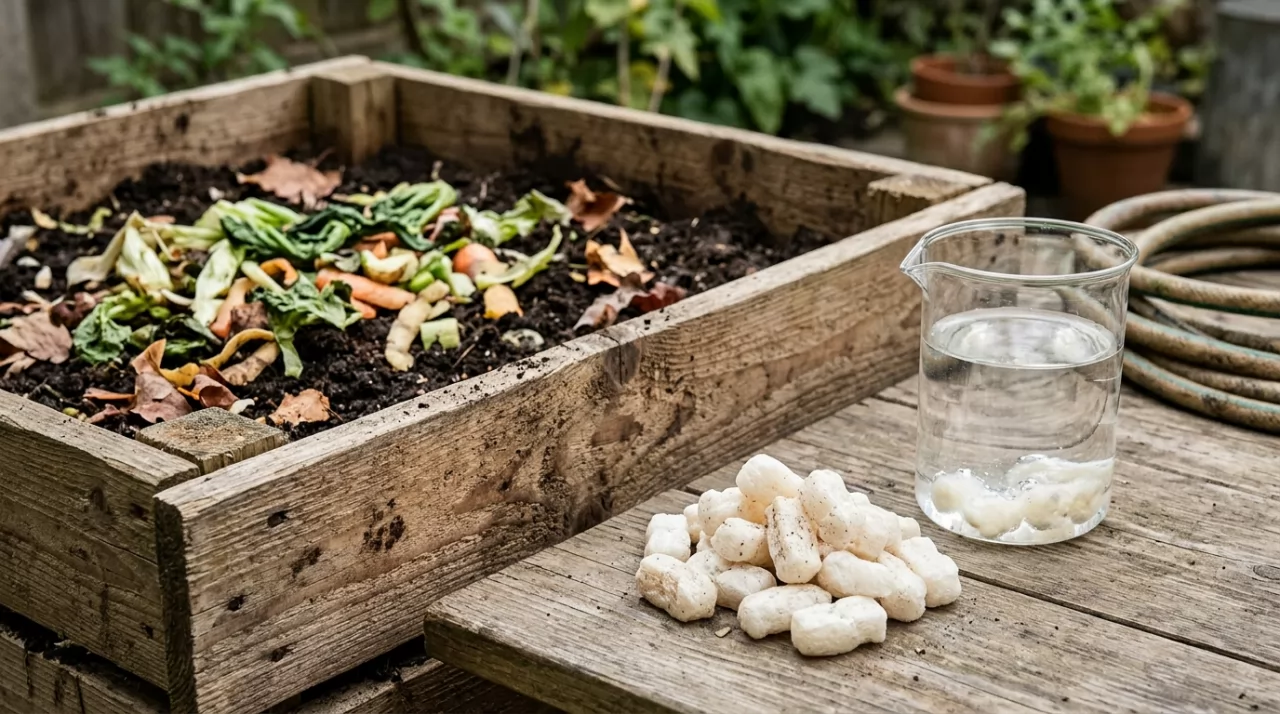
Biodegradable describes a material that microorganisms can break down into water, carbon dioxide and biomass. It says nothing about speed or conditions, so on its own it is a weak claim. Compostable means the material breaks down in a composting environment within a defined time and leaves no harmful residue, as shown by standardised tests. Water-soluble, or dissolvable, means the chip dissolves in water. That is a physical behaviour, not proof that anything biodegrades afterwards. A chip can dissolve and still carry additives that matter once it goes down the drain.
Standards behind the claim
Two public standards come up most often. EN 13432 is the European standard for packaging recoverable through composting and biodegradation. ASTM D6400 is the US specification for plastics designed to be composted in municipal or industrial facilities. A useful test report names the standard, the exact material tested, the laboratory and the date. It should also cover the full set of criteria, not just one headline result. Some suppliers show a certificate for a raw starch resin. That tells you about the resin, not about your finished chip with its blowing agent, colour or surface treatment.
Disposal reality
Industrial composting and home composting are different environments. Industrial facilities run at higher, controlled temperatures. A garden heap does not. Certification schemes exist for home composting too, but a chip tested for industrial conditions should not be described as home-compostable. Then there is access: many of your end customers have no municipal organics collection that takes packaging. For them, a compostable chip may end up in general waste. Your claim should say what the chip is, and say plainly where it can go.
Moisture matters here as well. Starch chips take up water, soften and lose cushioning. Damp chips also start to degrade before they ever reach the customer.
Material and Shape Options
Starch chips are not the only biodegradable void fill. Paper-based fill and molded pieces each win in some situations, and the right choice depends on item weight, humidity exposure and how the carton gets packed.
Starch-based chips
Starch-based packing peanuts are light, flow easily around odd shapes and fill voids quickly, which suits a manual or semi-automatic pack line. They compress and recover reasonably well under light to moderate loads. The catches are real. Humidity softens them. Some types carry static, so chips cling to the packer, the tape gun and the product. Others shed fine dust that settles on glossy housewares and shows at unboxing. Ask for samples from the same lot you would receive, and run them through your own pack line before you judge them.
There is also a handling point. A chip that dissolves in water is convenient for the customer, but a wet pallet or a leaking neighbouring carton can wreck it. Check the packaging format and the storage conditions before you order, not after.
Paper and other fills
Crumpled kraft paper and paper-based void fill suit heavier or irregular items, where chips would shift. Paper does not attract static and handles humidity better than starch. It is also easier to recycle through curbside paper streams in many regions, though that depends on the local scheme and on any coating or adhesive. The trade-off is volume. Paper takes more space in storage and more time to pack, and it generally cushions less per unit of volume than chips.
Molded pulp and corrugated inserts are a different approach. They are shaped to the product, so they hold it in place rather than filling space around it. That gives strong, repeatable protection for a single SKU, but you pay for tooling and lose the flexibility of loose fill across many product sizes. Mixed catalogues usually stay with loose fill. A few high-volume, fragile SKUs may justify an insert.
Custom Specs You Can Set
Most of what you can customise sits in the chip's geometry, density and colour. Cartons and bags for the chips themselves can carry your print as well.
Shape and density
Cushioning performance links directly to geometry and bulk density. Chips with open or curved profiles interlock, resist settling and hold their position under vibration. Smooth, round shapes flow better but can migrate and leave voids. Size matters in the other direction: small chips fill tight gaps but give less cushioning in large voids, and large chips can bridge and leave pockets. Density is the trade-off between protection and weight. A denser chip cushions heavier items but costs more to ship and may add weight per carton.
Set the density as a range with a tolerance and agree how it is measured. Ask the supplier for a test method, such as weighing a known volume under a defined fill procedure, so both sides read the same number. Your own drop and vibration tests then tell you whether that range is the right one.
Color and labelling
Colour is usually a simple way to separate lots or product lines. Two colours can tell your warehouse that one chip is the starch type and another is a different grade. Check that any colourant is covered by the same test report as the base chip. Added colour is a change in structure, and a report on natural chips does not automatically cover dyed ones.
Printed cartons and bags for the chips can carry your brand, handling instructions and the claim wording. Print the claim only once the wording is agreed against the test report. Printed claims on a pack are harder to correct than a line on a data sheet.
Vetting a Custom Biodegradable Packing Chips Manufacturer
If you are working out how to choose a biodegradable loose fill packaging supplier, check the evidence before the price. These five points separate a supplier with a controlled product from one with a catalogue photo.
- Test reports that match your exact product. The material, colour and any coating on the report should be the ones you will receive.
- Sample lots from production, not hand-picked pieces. They show what a normal lot looks like, including dust and size spread.
- Process control. Ask how density, chip size and moisture are checked during production and what is recorded per lot.
- Moisture control in storage and packing. Finished chips need dry storage and sealed packaging, or the supplier is selling you a variable.
- Clear minimums and lead times, confirmed in the written quote rather than assumed from a web page.
A supplier who answers these in writing and without delay is usually running a controlled process. One who answers with a brochure is not.
Ask that every test report names the exact structure you will receive, not a similar grade. A report for "starch loose fill" tells you very little about your coloured, coated or differently sized chip.
Rule of thumb: if the report and the sample do not describe the same product, treat the claim as unproven.
Ordering Starch-Based Packing Chips in Bulk
Chips are mostly air, so freight cost follows volume rather than weight. Ask for carton dimensions and calculate carton CBM (cubic metres) for the full order before comparing quotes. A cheaper chip in a larger bag can cost more to ship than a denser one in a smaller bag. For biodegradable packing peanuts wholesale orders, pallet loading matters in the same way: ask how many cartons or bags fit per pallet and whether the stack height crushes the bottom layer.
Humidity is the other cost driver that does not appear on a price list. Sea freight exposes cartons to damp air and temperature swings in the container, which can soften starch chips. Sealed inner bags, desiccant and a moisture-resistant outer carton reduce the risk, and the quote should say what is included. Whether those extras are worth it depends on your route and season.
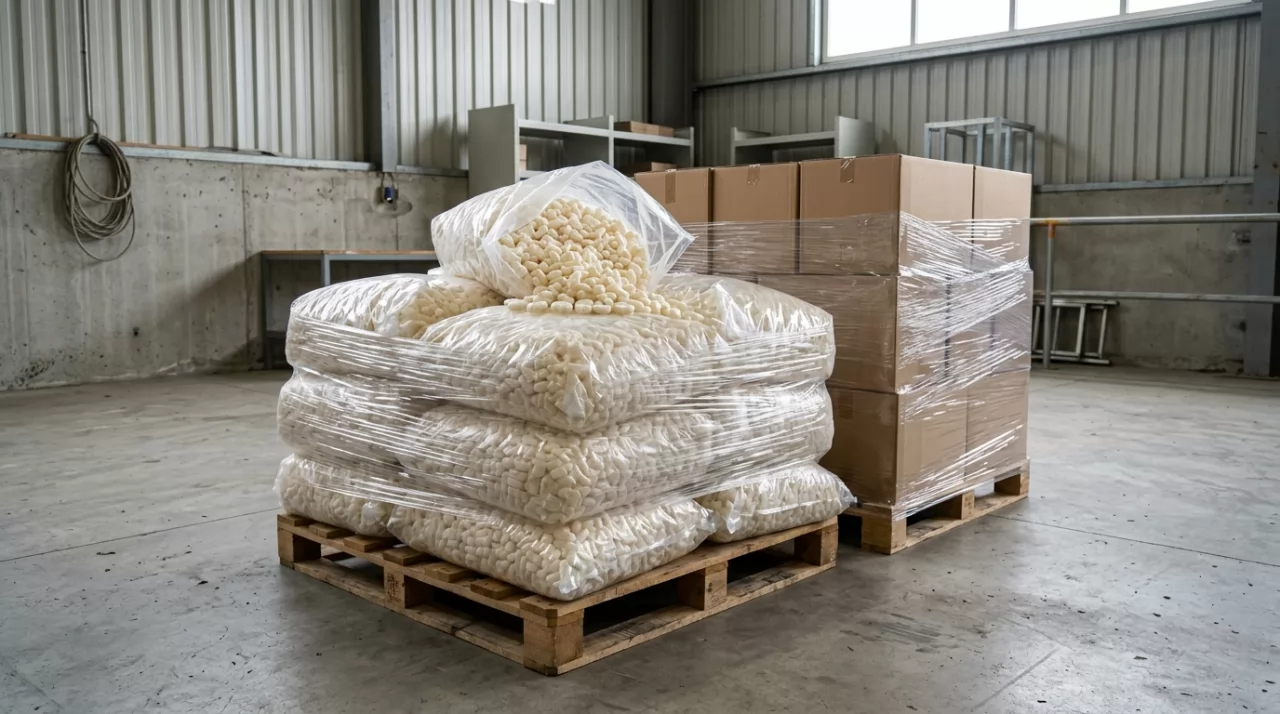
On arrival, move the goods to a dry area, keep them off the floor and open the bags only when you need them. Starch chips left open in a humid warehouse drift away from the approved sample. For starch based packing chips bulk orders, price, minimums, production time and shipping options are all confirmed in the quote. Do not plan around figures from a web page or a brochure.
Common Mistakes and Myths
The first myth is that biodegradable means any bin will take it. It does not. A chip tested for industrial composting belongs in an industrial composting stream, and where no such collection exists it goes to general waste. If your carton says "compostable" with no further detail, the customer is left to guess.
The second is that all starch chips are water-safe, or all are water-soluble. Formulations differ. Some dissolve readily, some resist moisture longer, and some carry binders or coatings that change both behaviour and disposal. Test the chip you are buying, in the humidity you will meet.
The third is that one sample proves every lot. A sample shows what the supplier can make on a good day. It says nothing about moisture, density or size spread across production. Agree on acceptance ranges, and compare the first delivered lot with the sample before you scale up.
The fourth is skipping a transit test. Chips that look right on the bench can settle, compress or break down in a real carton on a real route. A drop and vibration test with your own product is cheap compared with a returned pallet.
Pre-Order Checklist
Before you send an RFQ or sign off a sample, put these questions to yourself and your supplier:
- Do you know the product, its weight per carton and how fragile it is?
- Which test method and standard sit behind the claim you want to make?
- Is the exact claim wording agreed against the test report?
- Can your end customer actually dispose of the chips by the route you state?
- How much humidity will the goods meet in transit and storage?
- Have you signed off a production sample and received copies of the reports?
If any answer is "not yet," that is the item to settle before the order goes out.
FAQ
Can biodegradable packing chips be dissolved in water?
Many starch-based chips can, but not all. Dissolving is a physical property, and it does not prove the chip is compostable or safe to pour down a drain.
Do starch chips attract moisture or pests in storage?
They absorb moisture, so dry storage in sealed bags matters. Starch is a food-type material, so damp, open storage can also attract insects or mould. Keep stock off the floor and sealed.
What do I need to send for a quote?
Send the product type and carton size, weight per carton, the volume you expect to order, the claim you want to make and your destination market. Add any humidity or route concerns. Minimums, price and lead time come back in the written quote.
Can the chips be made to a custom size or color?
Often yes, within what the extrusion tooling allows. Colour and size changes can alter the structure, so ask whether the existing test report still covers the changed chip. Do not assume it does.
First Thing to Check
Ask for the test report for the exact product you will receive, then set your claim wording against what it actually says. Do that before you compare prices, request samples or print a single carton. If the report does not support the sentence, change the sentence.