A bad spec is expensive. Black panels can arrive scuffed from the carton. A "matte" finish can print out a washed grey. If the zipper fails, a gravure run of 10,000 pouches is scrap. A custom matte black stand up pouch is easy to brief and easy to get wrong. This guide covers structure, finish, extras, ordering and the usual failure points.
A matte black stand up pouch for food is a printed laminate with three parts: dense black ink, a matte outer surface and a food-contact inner layer. It suits snack, coffee, powder and pet-treat brands that sell on shelf look. Choose the barrier structure for the product first. Then pick the finish and extras.
What Does a Custom Matte Black Stand Up Pouch Actually Involve?
A matte black pouch combines heavy black ink coverage, a matte outer film or matte varnish, and an inner sealant layer suited to the food. Each part has its own job. A weak choice in any of the three shows up on a dark panel first, usually as scuffs, uneven tone or weak seals.
Where the Matte Effect Comes From
There are two common routes. A matte outer film is a film with a built-in low-gloss surface, usually matte BOPP or matte PET. It gives an even, soft finish across the whole bag. Matte varnish is a coating printed over a gloss film. Its look depends on how thick the coating is and how well it cures.
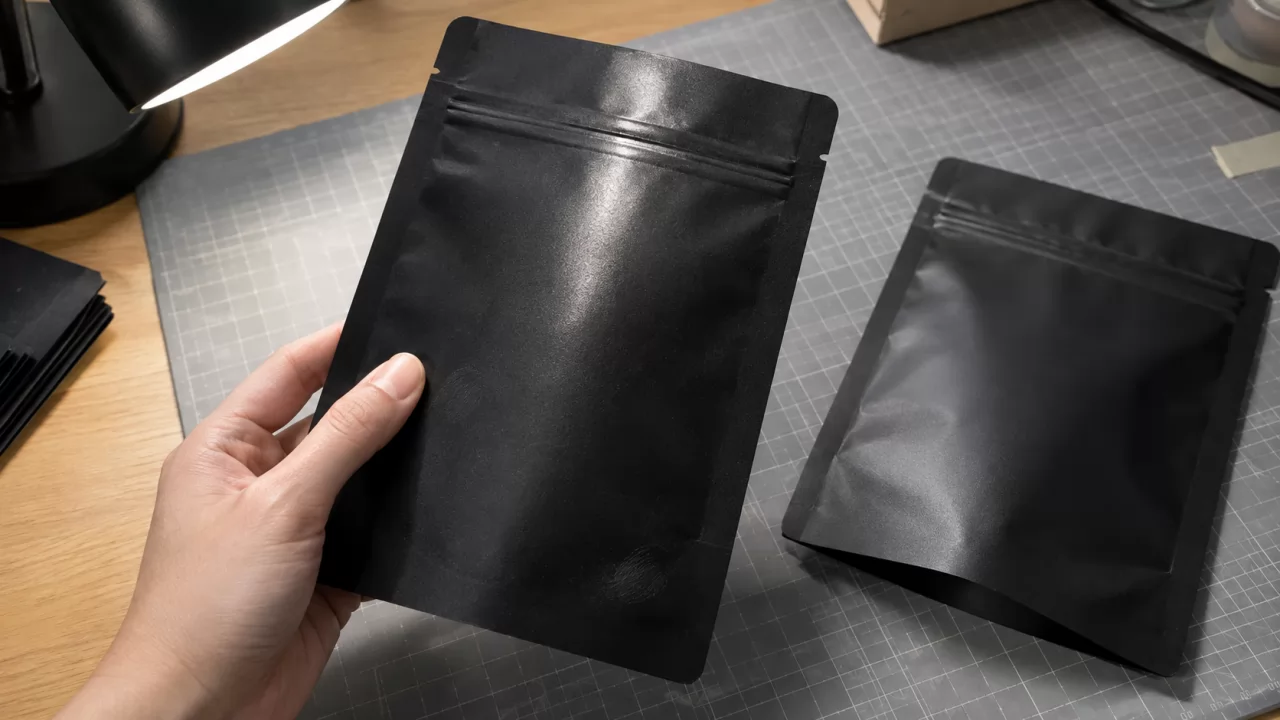
Both routes accept spot-gloss accents. Spot gloss is a gloss varnish printed only on chosen areas, such as a logo, so those areas catch the light against the matte background. Matte film usually feels softer in the hand. Varnish gives you more control over which areas stay matte.
Why Black Is Harder to Print Than It Looks
Flat black needs dense ink coverage. Thin coverage reads as grey or blotchy, especially under shop lighting. Dark panels also show rub marks, fingerprints and any ink or powder that gets into the seal area.
Ask for a rub check on your sample. Rub the panel against a carton, then check the corners and gusset folds. Those spots wear first.
What Material Is Best for Matte Black Food Pouches?
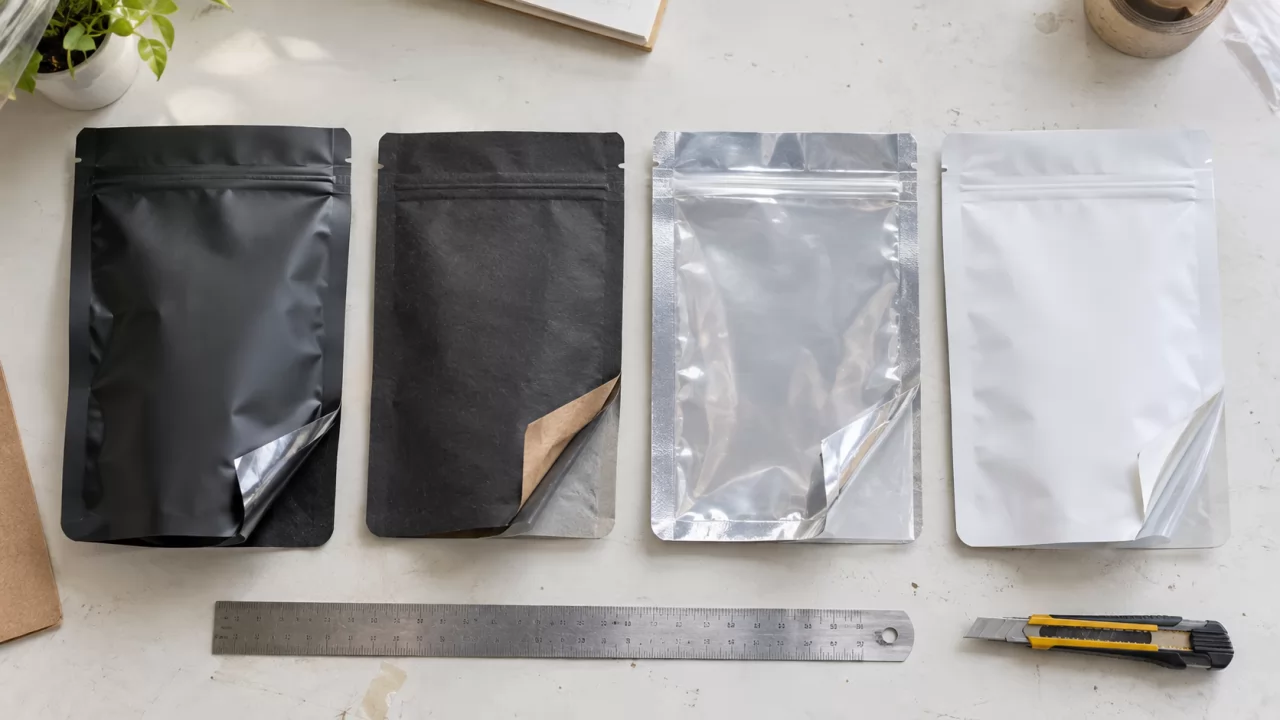
The right material for a matte black food pouch depends on how much barrier the product needs. Foil laminates give the highest barrier against oxygen, moisture and light. Metallized films sit in the middle. Kraft and clear-film structures give a different look with lower barrier. Match the film to the product, not only to the look.
| Structure | Look and feel | Relative barrier | Typical food uses | Watch-outs |
|---|---|---|---|---|
| Matte PET / foil / PE | Deep, even matte black | Highest; foil blocks light and oxygen | Coffee, powders, supplements | Stiffer feel; foil can crack at sharp folds; not recyclable |
| Matte PET / metallized PET / PE | Matte black, lighter in the hand | Medium to high, usually below foil | Snacks, granola, pet treats | The metallized layer can crack on repeated flexing |
| Kraft / metallized / PE | Paper texture under black print | Medium | Tea, dry snacks, nuts | Black looks less uniform on kraft fibers |
| Matte BOPP / PE | Clean matte surface, softer black | Lower; moisture barrier is fair, oxygen barrier is limited | Short shelf-life dry goods, candy | Not suited to oxygen-sensitive products |
| Black-printed kraft with window | Kraft texture, product visible | Lower at the window | Granola, cookies, dried fruit | The window lets light reach the product |
The takeaway: as barrier goes up, so do stiffness and cost, so the product's shelf-life needs should set the structure.
If You Need an Eco Structure
Mono-PE, compostable kraft/PLA and recycled-content structures can be quoted when you ask for that exact structure. Film certificates come with the quote. The MOQ for these structures is 30,000 pcs per design. Barrier and the matte effect can differ from foil laminates, so judge both on a sample.
Custom Printed Matte Black Pouches with Zipper, Window and Valve
Every extra on custom printed matte black pouches changes cost, barrier or seal behavior. Put each extra in the RFQ, with size and position where you know them. Then confirm each one on the physical sample before you approve artwork. Extras added after approval often mean a new proof.
Matte Black Kraft Stand Up Pouch with Window
A window is a clear area in the laminate that shows the product. Size and position decide how much light reaches the fill. Coffee, nuts and oily snacks are sensitive to light. Keep the window small, or place it where the product sits when the bag stands.
On dark designs, the border between black ink and clear film shows every registration error. Leave a clean margin around the window in the artwork. Check the edges on the proof under strong light.
Zipper, Degassing Valve, Tear Notch and Hang Hole
- Zipper: a press-to-close track that lets the buyer reseal the bag. Seal strength and the opening force are worth testing on the sample.
- Degassing valve: a one-way valve that lets fresh coffee release CO₂ without letting air in. Without one, fresh roasted coffee can swell the bag.
- Tear notch: a small cut that starts a clean opening tear above the zipper.
- Hang hole: a round or euro-slot punch for peg display.
Each extra adds material and a converting step, so each one appears as a separate line on an itemized quote. That lets you see what a zipper or valve adds per unit.
Where Matte Black Stand Up Pouches for Food Packaging Work Best
Matte black stand up pouches for food packaging fit products that sell on shelf appeal and get opened often. The dark matte surface gives strong contrast for logos. The stand-up gusset keeps the front panel facing the buyer. Fit still depends on fill weight, barrier and how the product is filled.
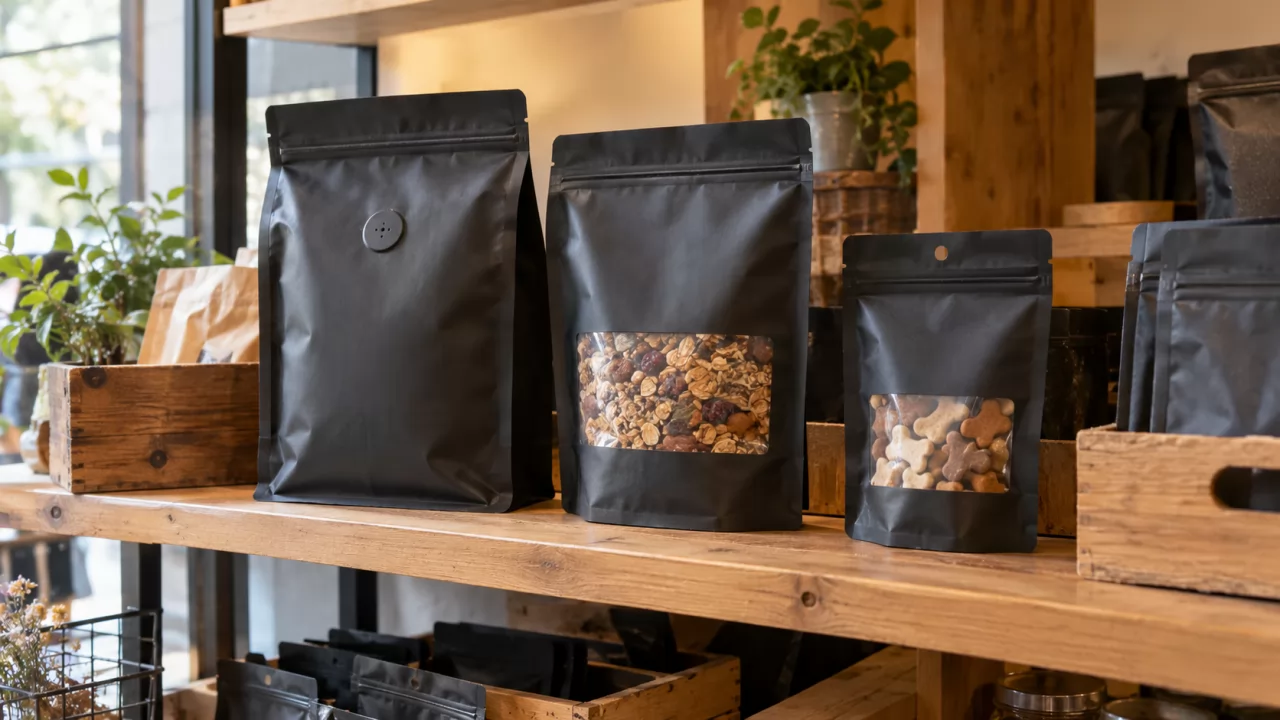
- Specialty coffee: roasters need a degassing valve, a zipper and a foil or high-barrier laminate. Check where the valve sits against the artwork.
- Snacks and granola: these brands need reseal and a clean front panel. A metallized structure with a zipper is common. Check scuff resistance at the gusset.
- Powders and supplements: these products need a high moisture barrier. Look for a foil laminate and a zipper that is not clogged by fine powder.
- Pet treats: owners open these bags many times a day. Check zipper durability and puncture resistance against hard or sharp treats.
Large fills that need a flat base and five printed panels often suit a flat bottom pouch better. Sauces, pastes and liquids belong in a spout pouch, leak-tested before production.
How Do You Spec, Sample and Order Without Reprinting?
Ordering without a reprint starts with fixed criteria set before you compare quotes. When every supplier quotes the same structure, size, finish and extras, the prices can be compared line by line. You also have a reference to check the sample against, so problems show up before a production run.
- Product and fill weight: these set bag size and seal strength.
- Barrier need: shelf life and sensitivity to oxygen, moisture and light decide between foil, metallized and lower-barrier films.
- Size: check the volume with a pouch capacity calculator, then confirm by filling a sample with real product.
- Finish: matte film or matte varnish, plus any spot gloss.
- Extras: zipper, valve, window, tear notch, hang hole.
- Print method and food-contact rules: quantity per design decides digital or gravure. The target market decides which food-contact test reports you need.
Rule of thumb: if a spec is not written in the RFQ, assume it will differ between quotes.
Digital or Gravure for Black Designs
Digital printing prints straight from files without cylinders. The digital MOQ is 1,000 pcs per design, which suits launches and ranges with many designs. Gravure printing uses an engraved cylinder for each color. The gravure MOQ is 10,000 pcs per design, and it gives the lowest unit price on repeat orders. If you plan to move from digital to gravure, have the same black checked on both methods.
Working With YLTPACK
YLTPACK, the Shenzhen Yongliantai New Material Technology Co., Ltd. brand, makes stand-up pouches for food, coffee and pet brands. It sends an itemized quote with a recommended structure within one business day, with free design support. Similar samples are free, and you pay the courier. Printing is done in house in up to 9 colors, with cleanroom production on a 6,520 m² site. Production takes 7-15 days after artwork approval, with 11 quality checks before packing. The PE film is tested to FDA 21 CFR food-contact requirements, and the company holds ISO 22000. Shipping is quoted with the order.
FAQ
Does a matte black pouch scuff or show fingerprints?
Yes, it can, more than lighter colors do. A matte outer film usually resists rubbing better than a thin varnish. A rub check on the sample shows how your structure holds up in transit.
Can digital and gravure runs match the same black?
Closely, but not always exactly. The two methods lay down ink differently. Approve against a physical proof, not a screen.
Is a matte black pouch food safe?
That depends mainly on the inner food-contact layer, not the black print. Ask for test reports that cover the rules in your target market.
How much does a custom matte black pouch cost?
There is no fixed price list. Price depends on material, size, print colors, quantity per design and extras, and each one is itemized on the quote.
Send Your Brief and Get an Itemized Quote
Send your product and fill per bag, a bag photo, size, quantity per design, number of designs, artwork or idea, extras and target market to [email protected] or WhatsApp +86 182 1944 5665. Before you send files, you can check them with the free Artwork DPI Checker on the website.